The ladder incident happened in March. I was two stories up on a wobbly aluminum thing I bought at a garage sale in 2019, one hand on the gutter, one hand holding a squeegee that had seen better decades, when the neighbor’s dog barked and I nearly became a cautionary tale my mom would tell at dinner parties. I came down, went inside, and did what any reasonable person does: I bought a cheap robot mop instead. Wrong robot. It sat under the couch for four months. This is relevant, I promise — it’s why, when the ERICAT Window Cleaner Robot showed up at my door, I was holding a grudge against the entire category before I’d even cut the tape on the box.
The tape, by the way, was that fibrous reinforced kind that shreds into strings and gets everywhere. Five full minutes with a kitchen knife. There’s a strip of it still stuck to my sock drawer. Anyway.
What This Thing Actually Is
The ERICAT Window Cleaner Robot — ASIN B0CNWTHKD1, sold by a storefront called LongChiKeJi, which I will not attempt to pronounce — is a corded, remote-controlled window cleaning robot with automatic water spray, a 2800Pa suction motor, and a built-in UPS that keeps it clinging to your glass for about 25 minutes if the power cuts. It costs $224.25. At the time I pulled the listing, it had zero customer reviews. Zero. I want you to sit with that, because I had to sit with it too.
I’ve been down this road before. I reviewed the GNOVEL window cleaning robot last year — the one claiming 8000Pa suction, which is the robot equivalent of a guy at the gym grunting too loud — and the HOBOT S7 Pro, which costs more and mostly earns it. The ERICAT slots in below both on price and on paper. My expectations were set to “mildly useful, probably annoying.”
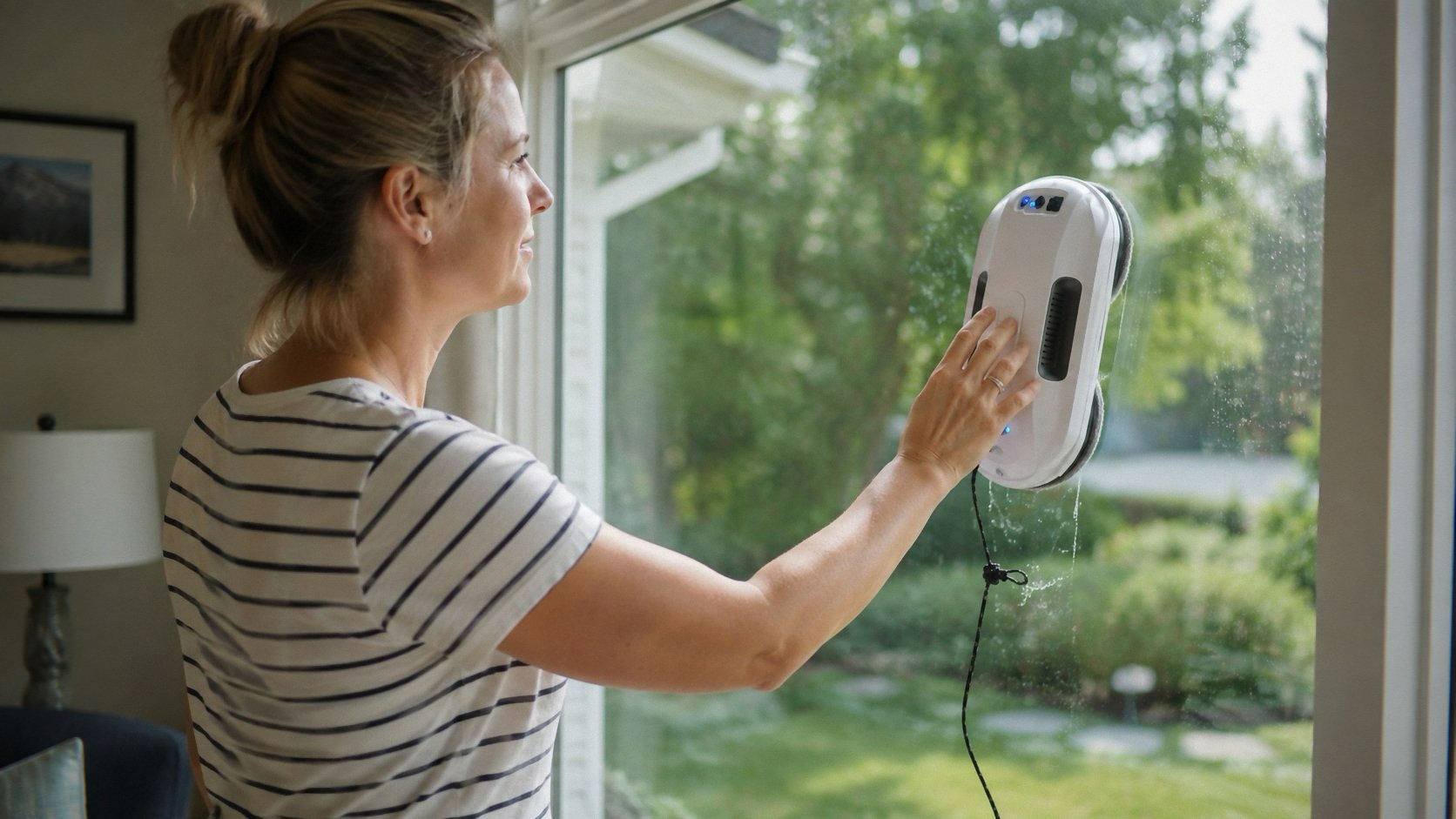
First Run: Sticking It to the Glass See Today’s Deal on Amazon
Here’s a boring sensory detail that nobody puts in marketing copy: when you press this thing against a window and hit the button on top, there’s a half-second of nothing, then a rising whine, then a soft whump as the vacuum seats itself. The button has a mushy click, not a crisp one — like pressing a key on a TV remote from 2004. The rubber feet on the bottom are slightly tacky, almost sticky-feeling, which turned out to matter more than I expected.
First window: my kitchen slider, which I will describe only as “filmed with the residue of a thousand stir-fries.” The robot stuck. It planned a route — up, across, down, the four-stage logic the listing brags about — and it did not wander. That was my first genuine surprise. Cheap robots wander. They drift to the corner and sulk, or they spin in place like a drunk Roomba. This one tracked its rows with the dull confidence of a guy mowing a lawn.
Cleaning speed is rated at about 4 minutes per square meter. In practice, my 1.5-meter slider took a little over six minutes per pass. You will want two passes on neglected glass. One pass gets you “presentable from inside.” Two gets you “did you hire someone.”
The Water Spray, a.k.a. The Feature That Decides Everything
Window robots live or die by their spray system, and I’ve been burned — the ECOVACS Winbot Mini2 taught me that a misting nozzle can be the difference between “sparkling” and “muddy arcs.” The ERICAT’s automatic water spray is… fine? Better than fine, actually. It mists ahead of the cleaning path, the microfiber pads scrub through it, and on ordinary dust-and-pollen grime the result is legitimately streak-free. I stood there with my arms crossed, waiting to catch it leaving arcs, and it mostly didn’t.
Grease is another story. That stir-fry film on the kitchen glass needed a pre-spray with actual window cleaner and a damp pad to start. The robot’s own mist is light — designed for maintenance cleaning, not archaeological excavation. If your windows haven’t been touched since you moved in, do the first pass yourself or accept three robot passes. I did the three-pass route because I was eating chips on the couch and the robot was doing the work, and honestly that’s the whole pitch of this product category.
The UPS Thing, Which I Actually Tested
Every window robot claims power-outage protection, and every time I read the claim I picture the thing letting go of a third-story window like a cartoon anvil. The ERICAT has a 650mAh lithium battery inside and claims 25 minutes of hold time after power loss. So I tested it. Mid-clean, I yanked the plug from the wall.
An alarm started beeping — loud, insistent, a genuinely unpleasant little shriek that you will absolutely hear from the next room — and the robot just… kept sucking. It stayed pinned to the glass. I got bored waiting and plugged it back in at around the six-minute mark, but it didn’t sag, didn’t slip, didn’t so much as shudder. Combined with the safety rope (rated to 150kgf, which is more than my body weight, a fact I confirmed while leaning on the tether like an idiot), this is the feature that let me run it on the outside of my second-floor windows without standing there with my heart in my throat.
And look — if you grab one through the links here, I might get a small cut — costs you nothing extra and keeps the lights on. But I’d be linking the ERICAT Window Cleaner Robot even without that, because the safety setup is the part of this purchase that stopped feeling like a gamble.
One owner-only detail you won’t find in the listing: after you unplug the robot, its little status light stays lit for a weirdly long time — close to a minute — like it’s reluctant to admit the session is over. First night, I thought it was broken. It wasn’t. It’s just dramatic.
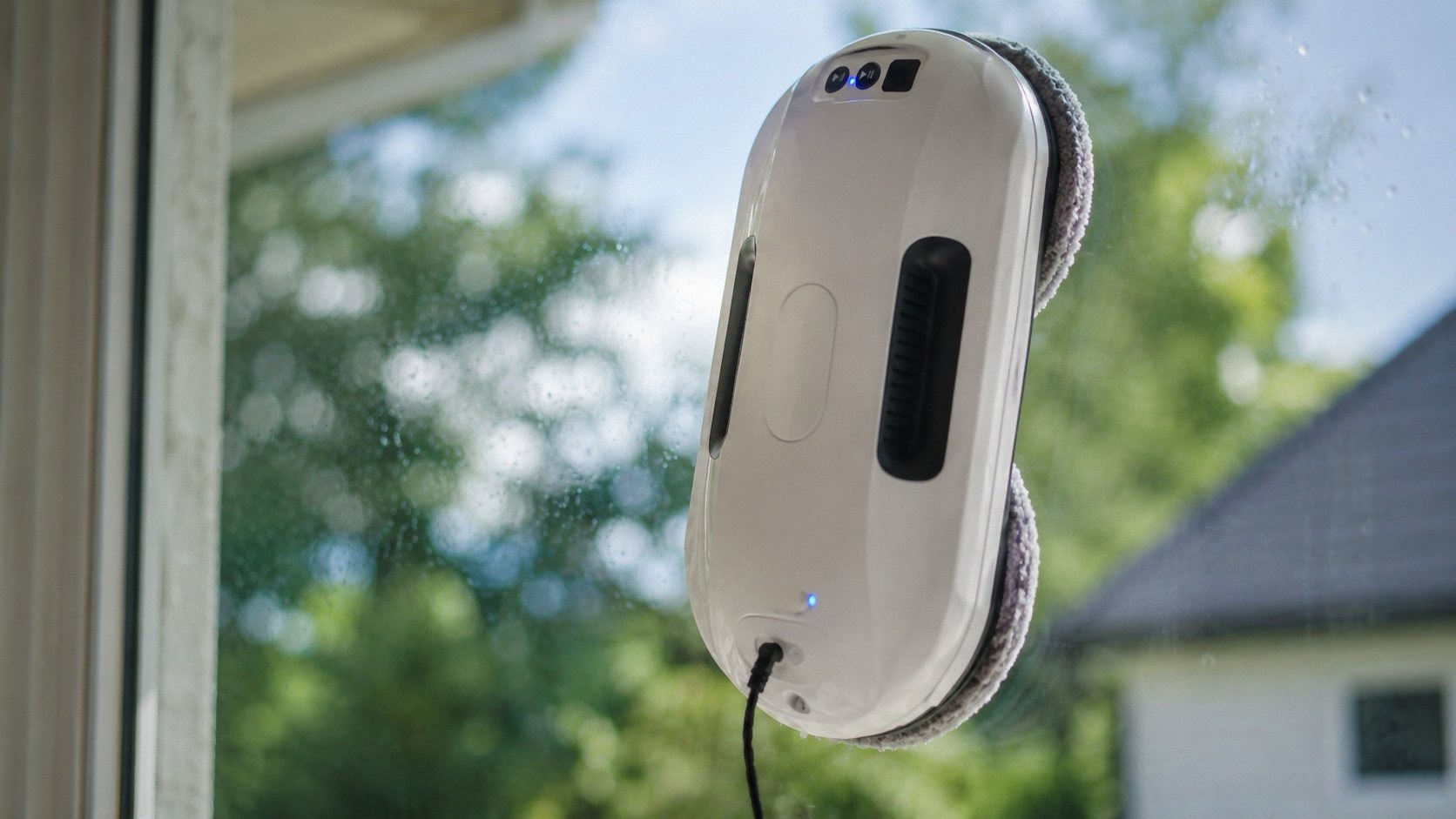
The Remote and the Modes
Three auto modes: up-then-down, left-then-down, right-then-down. The remote works from across the room, through the sliding door, once from the kitchen while I was making tea. There’s no app. I keep going back and forth on whether I miss the app. Apps for these things are usually a war crime of bad UX — looking at you, several brands I won’t name tonight — and there’s something peaceful about a gadget that just has buttons. My dad could use this. My dad could absolutely use this.
The remote does feel like it came from a different, cheaper product, though. Hollow plastic, sharp seam along the side, and the battery door flexes when you squeeze it. It works. It has worked every time. It just doesn’t feel like it should.
Noise, and the Neighbor Problem
It’s loud. Not blender loud, not shop-vac loud — more like a hair dryer having an argument in the next room. The listing doesn’t quote a decibel figure, which is how you know. Running it at 7 a.m. on a Sunday will produce consequences. Running it at 2 p.m. on a Tuesday produces a different phenomenon entirely: the retired neighbor across the alley standing on his balcony, arms folded, watching a robot clean my windows for ten solid minutes. He eventually gave me a thumbs up. I don’t know what to do with that information, but it happened, and now every time I deploy the thing I check the alley first, like some kind of window-cleaning fugitive.
Tangent while we’re here: the dog from the ladder story — the one that almost killed me — watched the robot through the sliding door on day two, barked once, lost interest, and fell asleep. Even the dog rated it “not a threat.” Make of that what you will.
The Downsides, Because You Know I Have Some
The box contains almost nothing. One robot, one manual. That’s the product list. No spare microfiber pads — or at least none were called out, and mine arrived with just the set already mounted. Pads are consumables. You will need more. Budget for them, and good luck identifying the right third-party size, because the manual is not helpful here.
The manual reads like it was translated by someone who learned English from appliance warranties. It gets the job done, barely, but there were two steps I only figured out by watching a stranger’s YouTube video about a different robot. If you’ve never used a window robot before, expect a learning curve that the documentation will not soften.
2800Pa is enough, not more. It held fine on every window I own, including the big ones. But when I think about the GNOVEL’s absurd 8000Pa overkill, I do wonder how the ERICAT would handle truly filthy, textured, or slightly imperfect glass over the long term. On my smooth modern windows: flawless. On your wavy 1920s farmhouse glass: I genuinely don’t know, and I’d test the return window aggressively.
Zero reviews. I said it up top and I’m saying it again. You’re trusting my grumpy word and a seller named LongChiKeJi. There’s also the usual no-name-brand question of what customer service looks like if the pump dies in month seven. The listing mentions a warranty link. Click it before you buy, not after.
The minimum window size is 400×400mm. Small bathroom panes and skinny sidelights are out. Measure first. My hallway porthole window mocked me the entire three weeks.
Maintenance, Which You Should Not Skip
The pads pick up a gray film fast — wash them after every two or three sessions or you’ll just be smearing diluted grime around and blaming the robot unfairly. The whole ritual takes four minutes: pads off, rinse, wring, lay flat, wipe the suction ring, check the rope buckle. If you want the full sermon on keeping these machines alive past year one, I wrote up how to properly maintain a window cleaning robot and extend its lifespan, and the ECOVACS Winbot maintenance guide has a pad-care section that applies to basically every robot in this category, ERICAT included. Also: there’s a faint warm-plastic smell off the motor for the first week or so. It fades. Nobody mentions this stuff. Now you know.
Three Weeks Later See Today’s Deal on Amazon
The windows in this apartment are the cleanest they’ve been since I signed the lease, and I have done almost nothing to deserve that outcome, which is my favorite kind of outcome. The ERICAT is not the strongest robot I’ve tested. It’s not the smartest, or the prettiest, or the one with the app ecosystem and the firmware updates. It’s a mid-priced workhorse with a sensible safety system, a spray that does its job, and a manual that should be legally required to carry an apology.
Would I have paid $224.25 for it on day one, with zero reviews staring back at me? Probably not — I’d have hesitated, and the hesitation would’ve been fair. Would I buy it now, knowing what I know? Yeah. Grudgingly, yeah. It earned its shelf spot in the closet, which is more than I can say for the mop under the couch.
The tea I mentioned earlier went cold forty minutes ago. Drinking it anyway. The windows look great from here.