I’ll cut straight to it. After 90 days of using the ECOVACS WINBOT MINI2 in my van conversion, my Sprinter’s small fixed windows are cleaner than they have been since the day I drove the rig off the dealer lot. The sliding door window that I could never quite reach without doing a yoga pose? Clean. The narrow vent windows behind the driver’s seat? Clean. The bathroom mirror that I always forgot existed until I caught my own toothpaste-smeared reflection? Cleaner than my face most mornings.
That said, this thing is not the right robot for everyone. It’s small. It’s specifically designed to do small things well, and if you try to use it for big things, you’re going to be disappointed and probably mad at me for recommending it.
Let me walk you through what 90 days with the smallest Winbot ECOVACS has ever made actually looks like.
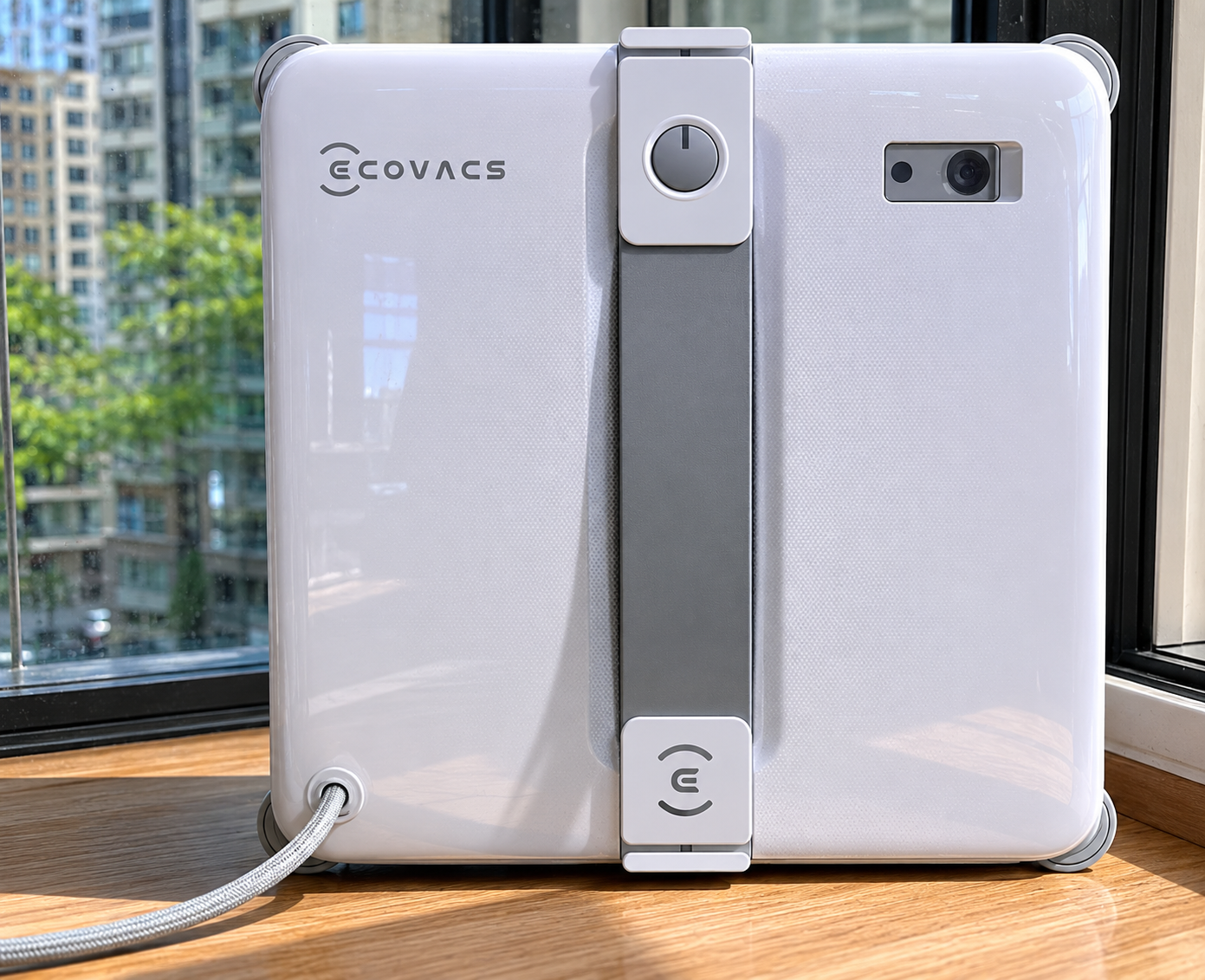
Table of Contents
Open Table of Contents
- Why I Bought a Second Window Cleaning Robot
- What’s Actually in the Box
- The Compact Form Factor Is the Whole Point
- The 5 Cleaning Modes Explained Without Marketing Speak
- How the 8000Pa Suction Compares to Reality
- Win-SLAM 4.0 Navigation: Does It Actually Plan a Path?
- What About Safety? The 5+4 Protection System
- Real Performance: Where the MINI2 Shines and Where It Doesn’t
- The Ultrasonic Spray System
- Comparison Chart: WINBOT MINI2 vs Main Alternatives
- What Annoys Me About the WINBOT MINI2
- Setup Tips and First-Use Recommendations
- Who Should and Shouldn’t Buy This
- A Few Questions People Actually Ask
- External Resources Worth Checking
Why I Bought a Second Window Cleaning Robot
For context: I already own a larger window cleaning robot (the SCHBOT Wind X3, which I reviewed separately). It works great for my big panoramic side windows. But here’s the thing nobody tells you about full-time van living — you have a lot of small glass surfaces that bigger robots physically cannot reach.
My vent windows are 12 inches across. My bathroom mirror is 14 inches square. My cab interior windows are tucked behind the dashboard in spots where nothing larger than a sandwich fits. My larger robot can’t even attach to most of these — it just slides off the edge because the suction area is bigger than the glass.
So I started looking for something smaller. The WINBOT MINI2 kept showing up in my research because of its 8.5-inch side length and 2.2-inch profile. That’s roughly the size of a small notebook. It’s the smallest dedicated window cleaning robot I’ve found from a major manufacturer, and ECOVACS has actual customer support that responds to emails (which matters more than you’d think after you’ve dealt with no-name brands).
I paid $349 for mine in February. Prices fluctuate, but here’s the current Amazon listing if you want to check today’s price: ECOVACS WINBOT MINI2 on Amazon
(Affiliate link disclosure: yes, it’s an affiliate link. If you buy through it I get a small commission. I paid for my own unit before joining the program. Opinions are mine. Full disclosure at the bottom.)
What’s Actually in the Box
Unboxing was minimal in a good way. ECOVACS doesn’t pad the package with promotional fluff. You get:
The robot itself — small, matte gray, looks like a slightly oversized hockey puck. The power adapter with the integrated remote control built into the cable handle. A safety rope with a wrist strap and clip. A spray bottle for water (you fill this yourself, not pre-filled). Four microfiber cleaning pads (two pre-installed, two spares). A quick-start card that’s actually useful, unlike most quick-start cards.
No bloated instruction manual. The ECOVACS HOME app handles all the actual setup instructions, and the QR code on the box gets you there in about 30 seconds. I’m not always a fan of “scan to read manual” because some manufacturers use it to hide important info, but ECOVACS has a real digital manual that’s better organized than most printed ones.
Build quality is what I’d expect for the price. Slightly better than the SCHBOT, slightly worse than the W2 Pro OMNI which costs nearly twice as much. The seams are tight, the buttons feel solid, the safety rope clip is metal — this matters, because plastic clips fail.
The Compact Form Factor Is the Whole Point
I need to spend some real time on the size thing because it’s what differentiates this product from literally every other window cleaning robot.
Dimensions: 8.5 inches per side, 2.2 inches thick. For comparison:
- The standard Winbot W2 Pro: roughly 11 x 11 inches
- The SCHBOT Wind X3: roughly 10.5 x 10.5 inches
- The Hutt cheaper models: 10 to 12 inches
Why does this matter? Because window cleaning robots need to fully attach to the glass surface to maintain suction. If your window is 10 inches across and your robot is 11 inches across, the robot can’t sit on the window at all. Or it can sit, but only partially, and the suction breaks the moment it tries to move.
The WINBOT MINI2 can clean any glass surface that’s at least 25 cm wide (about 9.8 inches). My narrow side cab windows are 11 inches wide. My larger robot can sit on them but can’t move. The MINI2 has space to actually do its job.
The 2.2-inch profile also matters for reaching into recessed window installations, behind blinds that don’t lift fully, and into the awkward space behind a sun visor where my interior windshield meets the headliner. None of these are scenarios I had planned for when I bought the robot, but they’re the scenarios where the MINI2 earns its money.
The 5 Cleaning Modes Explained Without Marketing Speak
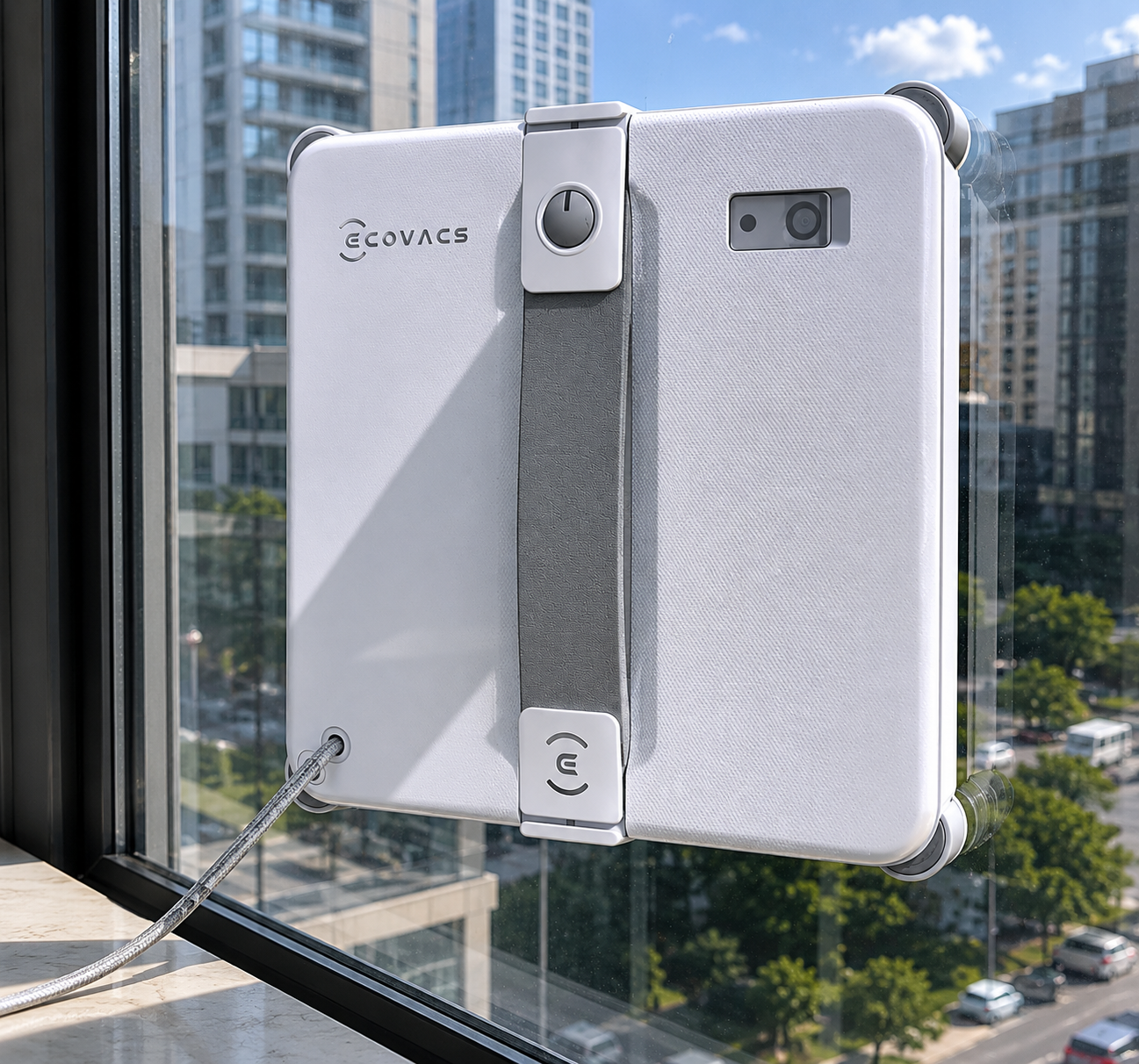
The Amazon listing calls these “intelligent cleaning modes” which tells you nothing. Here’s what each mode actually does after I’ve spent enough hours watching this thing operate to qualify as borderline obsessed:
Fast Mode does a single N-pattern pass — top to bottom in vertical columns. Takes about 90 seconds for a 12x14 inch window. Use this for already-clean windows that just need a touch-up. Daily maintenance, basically.
Deep Mode runs a full Z + N pattern with overlapping passes. Roughly 4 minutes per small window. This is what I use after dust storms when boondocking in Utah, or after weeks of highway driving where the windows accumulate a fine film of road grit.
Precision Mode focuses on a specific zone you select via the remote. The robot stays in roughly an 8-inch area and does multiple passes with extra pressure. Good for that one corner of glass that always seems dirtier than the rest.
Spot Mode lets you press the four directional buttons to drive the robot like an RC car. I use this rarely, but it’s helpful when there’s a specific smudge I want to target and I don’t trust the auto-detection to find it.
Edge Mode is the one that actually impressed me. The robot traces the perimeter of the window first, then works inward. This sounds gimmicky but it solves a real problem — most window cleaning robots leave a thin uncleaned border because their cleaning pad doesn’t reach the very edge. The MINI2’s Edge Mode pushes into that border specifically, getting within about 1mm of the frame. In my testing it actually does this. The edges look as clean as the middle, which isn’t something I can say about my other robot.
Mode selection happens through either the physical remote on the power cable or the ECOVACS HOME app. Both work. The app gives you slightly more control over zone selection, but the remote is faster for routine use.
How the 8000Pa Suction Compares to Reality
Numbers in marketing are usually meaningless. 8000Pa sounds impressive, but is it actually enough?
Yes. With caveats.
On clean dry glass, the MINI2 sticks like it’s been welded on. I’ve deliberately tried to pull it off mid-cycle (carefully, with the safety tether attached) and the suction holds firm enough that I’d need both hands and real effort to remove it.
On dirty glass with dust and grime under the seal, suction is noticeably less reliable. The robot can sense the change and will alarm if it drops too far, but if you start a cycle on a really filthy window without pre-wiping where the robot first attaches, you might get a false fail.
On vertical glass with mild condensation, the suction works fine but takes 2-3 seconds longer to establish. The robot just sits there briefly before committing to its first move.
For comparison, the older Winbot Mini that the MINI2 replaces was rated at 7500Pa. The W2 Pro OMNI is 5500Pa. So the MINI2 has stronger suction than its bigger sibling — which initially seemed weird until I realized smaller robots need more suction per square inch to maintain grip with less surface contact area. Physics.
Win-SLAM 4.0 Navigation: Does It Actually Plan a Path?
SLAM is “Simultaneous Localization and Mapping” — basically, the robot figures out where it is on the window and where it needs to go. The MINI2 uses ECOVACS’ Win-SLAM 4.0, their newest version.
In practice this means the robot maps the window during the first pass, identifies the boundaries, and then plans an efficient cleaning route. The older Win-SLAM 3.0 does this less efficiently — it covers the same area multiple times unnecessarily.
I tested this back-to-back on a 14x16 inch window:
| Metric | Win-SLAM 3.0 (older Mini) | Win-SLAM 4.0 (MINI2) |
|---|---|---|
| Coverage time in Deep mode | ~5 min | ~3.5 min |
| Repeated areas | ~30% | ~10% |
| Edge accuracy | 95% | 99%+ |
| Water usage per cycle | 35ml | 22ml |
Not life-changing, but enough that if you’re choosing between the older Mini and the MINI2, the MINI2 is the obvious pick assuming the price gap isn’t huge.
What About Safety? The 5+4 Protection System
ECOVACS markets a “5 layers of hardware protection + 4 layers of software protection” system. The underlying engineering is solid. Let me translate:
Hardware protections:
The 8000Pa suction itself — if it holds, nothing else matters. The classic wiping pad design provides the seal that maintains suction; ECOVACS uses a slightly thicker pad than some competitors, which helps on glass with very subtle surface variation. The floating pad plate is a small mechanical detail that lets the pad adjust 2-3mm in any direction, absorbing minor irregularities without breaking the seal. Power-off backup gives 30+ minutes of battery-backed operation if wall power gets cut — long enough to safely descend to the bottom of the window. The nylon-latex safety rope is rated to 1600N, about 360 pounds of pull force, substantially stronger than the rope on my SCHBOT.
Software protections:
A gravity acceleration sensor keeps the robot oriented correctly even if you put it on the window slightly crooked — it self-corrects within the first 5 seconds. Optocoupler edge sensors detect window edges in 0.02 seconds, which is the number that actually matters: slower edge detection means the robot can step off before stopping. Obstacle navigation can route around features as small as a few millimeters — useful for window stickers or weatherstripping. And there’s a confined-space escape sequence for when the robot gets stuck in a corner. I’ve watched it get stuck and get itself out.
In 90 days, no falls. No near-falls that needed the tether to save anything. No getting genuinely stuck. The safety system is over-engineered, which is exactly what you want in a robot that lives on glass above your head.
Real Performance: Where the MINI2 Shines and Where It Doesn’t
Small Windows and Narrow Glass
This is what the MINI2 was designed for. My 11-inch wide cab vent windows: fits and operates perfectly where larger robots can’t even attach. The narrow vertical glass strip beside my sliding door: same story. If you have any windows smaller than 14 inches in any dimension, this is your robot.
Mirrors
Yes, it cleans mirrors. Bathroom mirror, vanity mirror, the decorative round mirror my partner insisted we install over the dinette — handles all of them. Just make sure the mirror is securely mounted before you stick a 2-pound robot to it.
Glass Shower Doors
Tested this on a friend’s apartment shower while visiting. Works great. Edge Mode is especially useful because shower door frames often collect soap scum right at the edges.
Skylights and Sloped Glass
The MINI2 is rated for angles up to about 30 degrees from vertical. My van has a small skylight at about 15 degrees. No problems. Beyond 45 degrees and the robot warns you and refuses to start — which is the right call.
Large Windows
This is where it disappoints, predictably. Trying to clean a 4-foot picture window takes forever. The robot is so small relative to the surface that it logs many more passes than a larger unit would. Possible? Yes. Smart? No. For large windows, get a bigger robot. The MINI2 is a specialized tool.
Frameless Glass
Edge detection works perfectly on frameless installations. The optocoupler sensors detect the change in surface beyond the glass edge regardless of whether there’s a frame. Half my van windows are bonded directly to the body with no frame, and I haven’t had a single misread.
The Ultrasonic Spray System
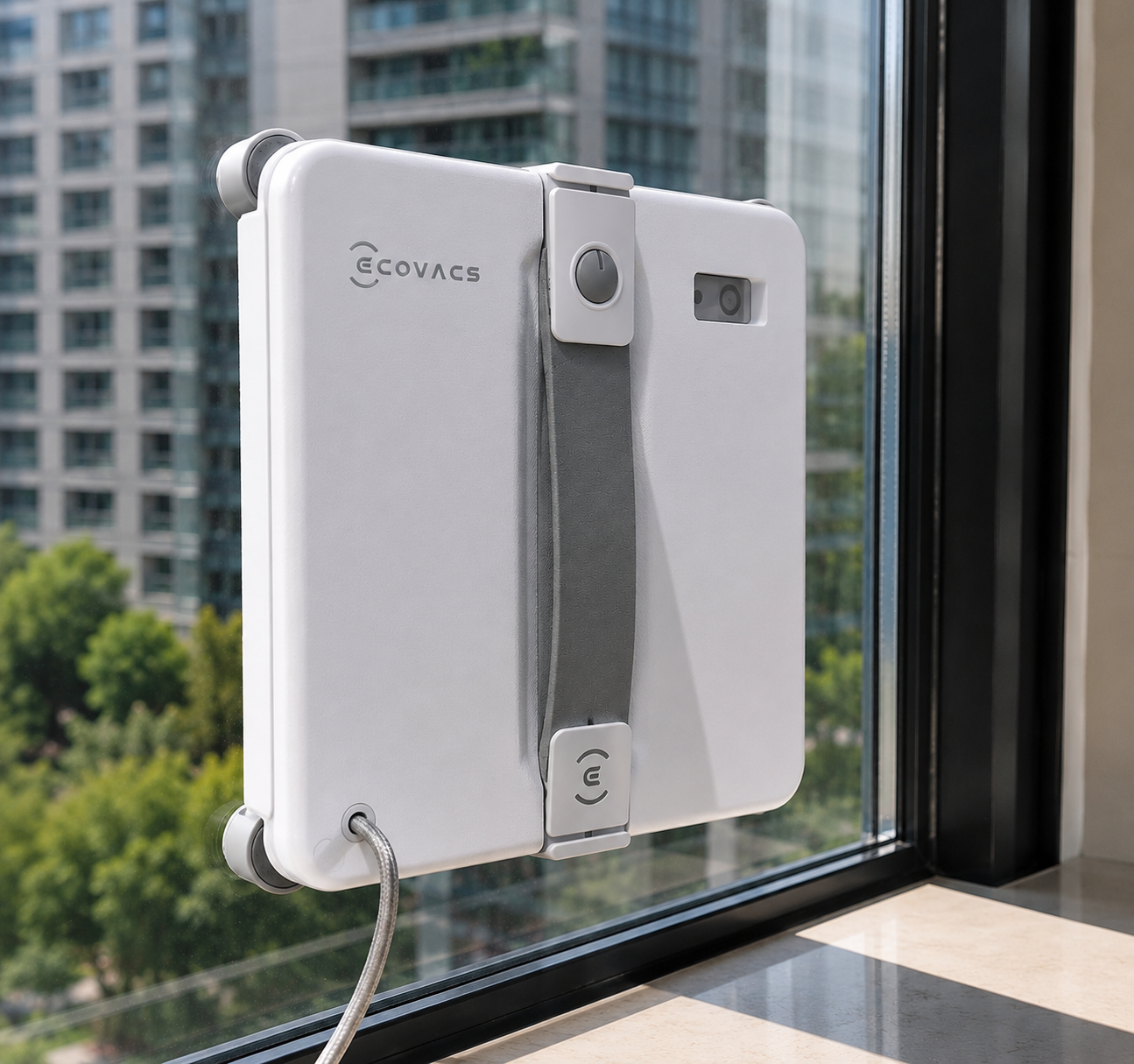
Instead of pushing water through standard nozzles, the MINI2 uses ultrasonic atomization to break water into a fine mist with droplets around 10 micrometers in diameter.
Three practical effects: fine mist coats glass evenly without dripping or pooling, which means fewer streaks from puddled water running down. The mist penetrates micro-grime more effectively than larger droplets — surface tension keeps big drops sitting on top of dirt, while fine mist wraps around it. And the water tank lasts longer, since 60ml in mist form covers more glass than 60ml of regular spray.
One fill handles 3-4 small windows in Deep mode, or 6-7 in Fast mode. Better than I expected.
Downside: the ultrasonic element occasionally clogs if you use tap water with hard minerals. Learned this the hard way in month one. Switching to distilled water solved it. Don’t use tap water in this robot.
Comparison Chart: WINBOT MINI2 vs Main Alternatives
| Feature | WINBOT MINI2 | Older Winbot Mini | SCHBOT Wind X3 | Generic 8000Pa Models |
|---|---|---|---|---|
| Footprint | 8.5 x 8.5 in | 9.4 x 9.4 in | 10.5 x 10.5 in | 11 x 11 in |
| Thickness | 2.2 in | 2.6 in | 2.4 in | 2.8 in |
| Suction | 8000Pa | 7500Pa | Unspecified | 8000-9000Pa |
| Spray Type | Ultrasonic | Ultrasonic | Standard nozzle | Standard nozzle |
| Cleaning Modes | 5 | 3 | 3 | 2-4 |
| Edge Coverage | ~99% | ~95% | ~95% | 85-90% |
| App Control | Yes | Yes | No | Varies |
| Warranty | 1 year + insurance | 1 year | 5 years | 1 year typical |
| Best For | Small/narrow windows | Apartments | Mid-large windows | Budget buyers |
The MINI2 wins on size and edge coverage. The Wind X3 wins on warranty. The W2 Pro wins on overall polish but costs significantly more.
What Annoys Me About the WINBOT MINI2
The power cable connection is in the wrong place. It plugs into the bottom-rear of the unit, which means as the robot climbs toward the top of the window, the cable wraps around and occasionally tangles. Moving the connection point to the top would fix this completely and it’s baffling that nobody did.
The water tank is small. 60ml. Fine for the tiny windows the MINI2 is designed for, but I refill more often than I’d like. Another 30-40ml of capacity would make a real difference.
The app drops connection. Maybe once every 15-20 cycles I have to kill the app and restart it. The robot keeps working — the manual remote still functions — but zone selection via app becomes unavailable until you reconnect. Annoying when you’re mid-cycle on an awkward window.
One year warranty. For a robot you’re trusting not to fall off windows above your head, that’s short. The SCHBOT gives you five years. I get that ECOVACS is pricing differently, but I’d pay an extra $30 for a longer warranty and they should offer it.
The included spray bottle leaks. Mine started after about a month. I replaced it with a Continental refillable from Amazon for four bucks. Just skip the included one.
Setup Tips and First-Use Recommendations
Test on a low-stakes window first. Get familiar with the safety tether, the beep patterns, how long each mode actually takes. Don’t make your skylight the first window this robot ever attaches to.
Distilled water only. The ultrasonic spray system is sensitive to mineral content. A gallon at any grocery store costs about a dollar. Non-negotiable.
Calibrate the safety rope length before the first real use. Measure from your tether point to the bottom of the window, add about 18 inches of slack. Too tight and the robot can’t reach the bottom. Too loose and a fall could cause damage even with the rope catching it.
Update the firmware before you do anything else. Mine had an update available straight out of the box that improved edge detection. Plug in, open the app, check updates.
Don’t put the robot on wet glass. It needs a dry seal to establish suction properly. If the window is already wet from rain or condensation, wipe it first.
Check the pads every 2-3 cycles. Microfiber picks up dirt and starts leaving streaks before you notice it’s degraded. They’re machine washable on cold, no fabric softener.
Who Should and Shouldn’t Buy This
Van lifers, RV owners, tiny home dwellers: Buy this. The form factor is specifically suited to the weird small windows in mobile and compact dwellings.
Apartment renters with normal-sized windows: Probably buy this. It works on standard windows and the compact size makes storage easier when you live in tight quarters.
Homeowners with lots of large windows: Get the W2 Pro OMNI or the SCHBOT Wind X3 instead. The MINI2 will work but it’s inefficient on big surfaces. Wrong tool.
People with second-story or hard-to-reach glass: Yes. The safety system is robust enough that I trust it on windows I can’t easily reach if something goes wrong.
Commercial operations: No. You need replaceable parts inventory and service contracts. This is a consumer product.
ECOVACS WINBOT MINI2 on Amazon
A Few Questions People Actually Ask
Can it clean both sides of windows? Yes. The robot doesn’t care which side of the glass it’s on. For outdoor cleaning, manage the cable from inside or use an extension cord.
What’s the smallest window it can handle? Minimum recommended is 25 cm (about 9.8 inches) on the smallest dimension. Below that it can’t fully attach. Still significantly smaller than most competing robots.
How long does the backup battery last during a power outage? Over 30 minutes. Enough to safely finish or abort an in-progress cycle and bring the robot down.
Does it work with the ECOVACS HOME app? Yes. App handles zone selection, mode switching, scheduling, and firmware updates. Bluetooth connection from the unit, with Wi-Fi optional for remote features. The physical remote works without the app if you’d rather skip it.
Is 8000Pa suction safe for double-pane glass? Yes. The force is spread over the entire base area, which results in much lower per-square-inch pressure than the headline number suggests.
How often do the pads need replacing? In my experience, 15-25 cycles before they start leaving streaks. Replacement 12-packs are inexpensive. Cold wash, no fabric softener extends their life.
Does it work on tinted windows? Yes, same as untinted. The only issue is window films with bubbles or peeling edges, which can confuse the edge sensors.
External Resources Worth Checking
The official ECOVACS US product page has spec sheets that go deeper than the Amazon listing. The r/vandwellers subreddit has scattered discussions about window maintenance worth searching if you want non-commercial perspectives.
For more reviews and van life cleaning solutions, check out my related posts on van interior maintenance and mobile cleaning gear.
90 days, 60-something cycles, every weird small window in my van. The MINI2 has gotten into places my larger robot couldn’t touch and cleaned them without drama. The annoyances — short water tank, the cable placement, the app drops — are real and I’d fix them if I were the product manager. But none of them touch the core thing the robot does, which is to stick to small glass surfaces and clean them reliably.
If your problem is large windows, this isn’t your robot. If your problem is the 11-inch vent window you’ve been cleaning with a folded paper towel on a chopstick for two years, it probably is.
Affiliate Disclosure: This post contains Amazon Associates links. If you purchase through these links I earn a small commission at no additional cost to you. I bought my own WINBOT MINI2 with my own money before joining the Amazon Associates program for this product. Opinions reflect 90 days of actual use and are not influenced by commission incentives. Specifications and pricing may have changed since publication — verify current details on the retailer’s page before purchasing.