The ladder incident is why we’re here. Me, eleven feet up, one foot on the gutter bracket, reaching across the upstairs bedroom window with a squeegee tied to a broom handle — a rig I was genuinely proud of until the broom handle flexed and I spent four full seconds contemplating my own funeral. My wife watched the whole thing from the garden. She didn’t gasp. She just said, “So we’re getting the robot then.”
So we got the robot. Not the fancy one. The ERICAT Electric Window Cleaner, a 72W little square that Amazon kept shoving at me at a price that felt like a typo. I’d already burned money on a “premium” squeegee system, an extension pole that bent like a pool noodle, and a spray bottle with a built-in wiper that I now use exclusively to clean nothing, ever, because it lives in the garage as a monument to my optimism. My expectations for the ERICAT were somewhere around “it will fall off the window within a week and I’ll write something mean about it.”
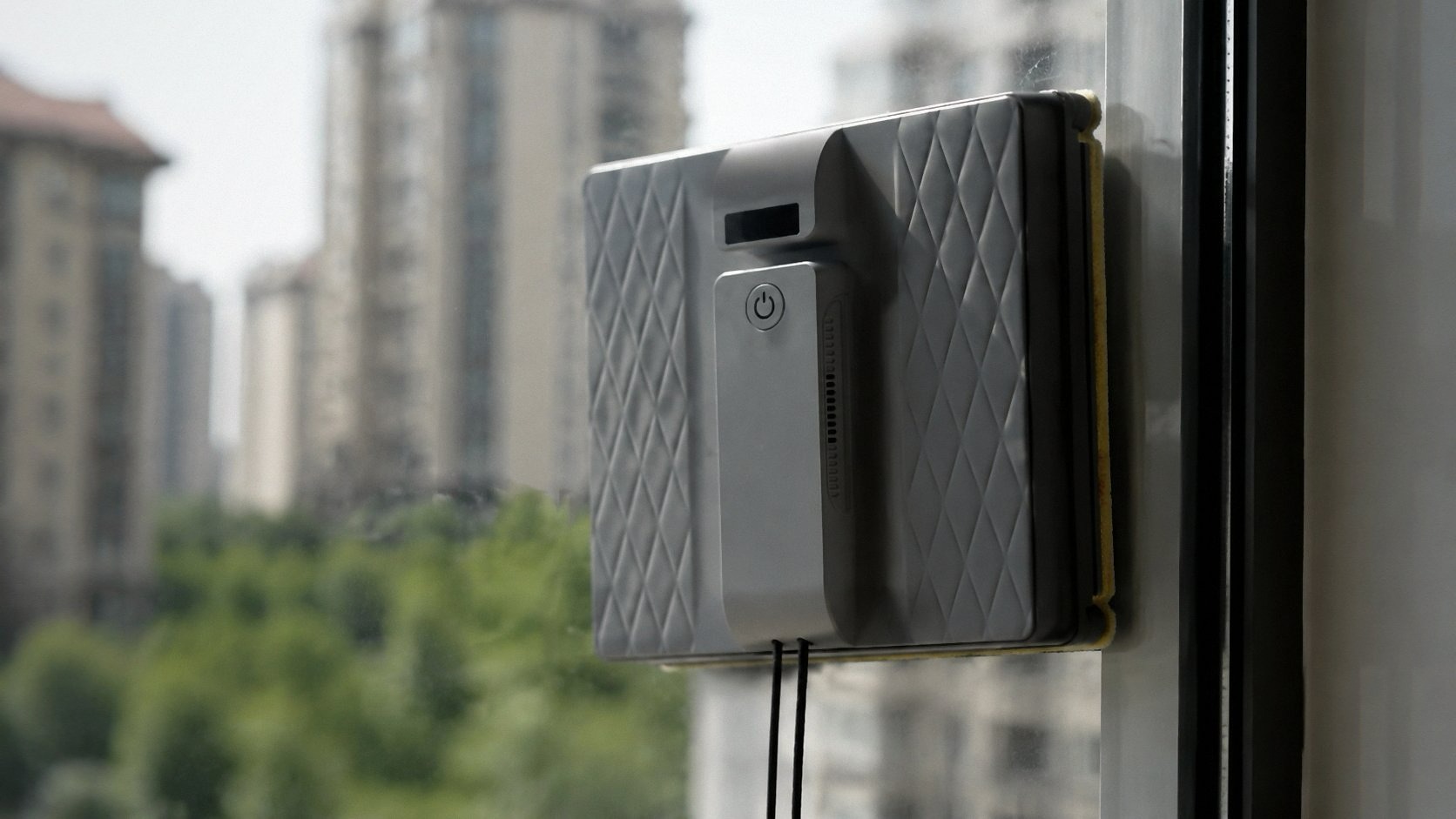
I’m writing this at the kitchen table, tea gone cold forty minutes ago, and the robot is on the patio door behind me doing its slow little lawnmower laps. Keep that in mind. That’s the spoiler.
What This Thing Actually Is See Today’s Deal on Amazon
The ERICAT is a window cleaning robot in the budget tier — the bracket where I usually assume everything is a rebranded fire hazard. Square body, about 216mm a side, light enough that holding it one-handed while you press it onto the glass isn’t a whole event. It sucks itself onto the window with 2600Pa of suction from a brushless motor, crawls around in planned paths, and sprays water at the glass through two nozzles while microfiber pads scrub behind it.
The spec sheet reads like every other listing in this category, which is exactly why I trusted none of it. 50ml water tank. Three cleaning modes. AI path planning. Remote control. A 500mAh backup battery so it doesn’t drop off your window the instant the power blips. Rated noise around 65dB. You can read my window robot buying guide if you want the full lecture on which of those numbers matter and which are decoration — short version: suction and the backup battery matter, “AI” is doing a lot of heavy lifting in that sentence.
One thing before we go further. The listing says the unit size is 216 × 216 × 870mm. Eight hundred and seventy millimeters. That would make this robot taller than my neighbor’s toddler. It’s a typo — it’s obviously 87mm thick — but I measured it with an actual tape measure when it arrived, partly for this review and partly because a small part of me wanted it to be comically huge.
Sticking It On the Window for the First Time
Here’s a boring detail nobody puts in a review: the treads. The rubber caterpillar tracks on the bottom have this fine crosshatch texture, and when you run a thumb across them they feel like the sole of a decent hiking shoe. That mattered to me more than it should have. It’s the first physical thing you touch, and it’s the difference between “this was designed” and “this was extruded.”
Setup took maybe four minutes, and two of those were me hunting for a spray bottle because I refused to read the manual first. Wet the pads slightly, fill the little tank, hold the robot against the glass, hit the power button on top. The fan spins up with this rising whine and then — thunk. That soft, settled sound of suction taking hold. You let go, and it’s just there, hanging on a vertical sheet of glass, and your lizard brain goes “that’s wrong” even though you’ve read the specs and watched the videos and know exactly what’s happening.
Then it beeps and starts crawling.
The first window I gave it was the kitchen one over the sink — the one that collects a film of cooking grease and steam until you could write your name in it, which I had, which is how I knew. I sprayed nothing. I pre-treated nothing. I wanted it to fail honestly.
It did not fail. It did that slow N-pattern walk, up and across and down, dual nozzles misting ahead of the pads, and the first pass left these clean stripes through the grime like a snow plow at 6 a.m. Two passes and the window looked better than it had since we moved in, and I had done literally nothing except stand there holding my cold tea like an idiot.
The Dual Spray Thing, Because It’s the Actual Story
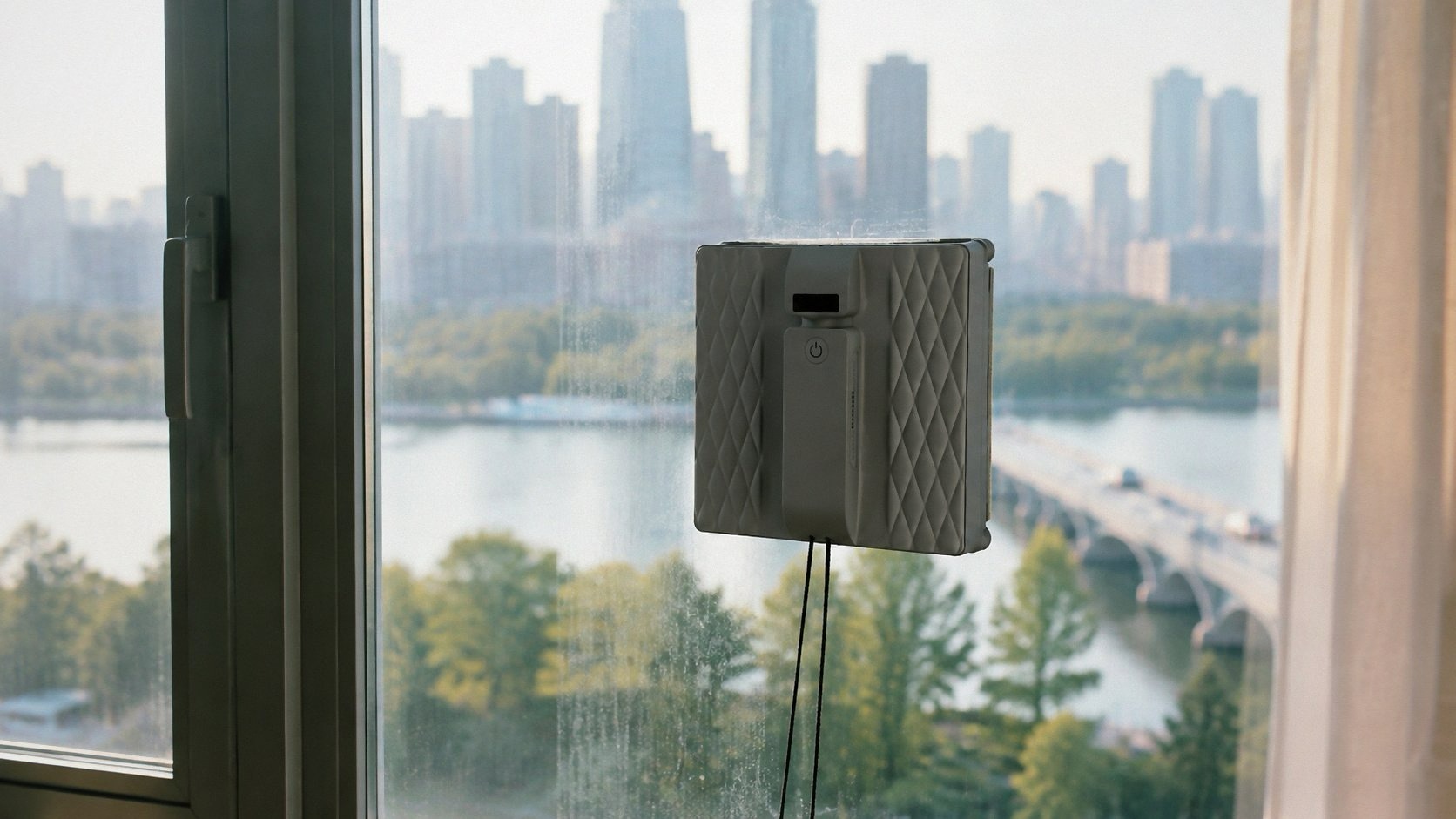
Most budget window robots make you spray the window yourself or rely on damp pads, and the pads dry out halfway through a big pane and start dragging dust around in arcs like a bad Zamboni. The ERICAT sprays bi-directionally — it mists ahead of itself whichever direction it’s traveling — and the 50ml tank sounds tiny until you realize it’s misting, not hosing. One fill got me through the patio door, the kitchen window, and half the big living room pane before it ran dry.
The listing claims the spray increases cleaning area by 68%. I have no idea what that sentence means. Sixty-eight percent more than what, a dry robot? A sad man with paper towels? What I can tell you from ownership is the unglamorous version: the pads stay evenly damp across a full window instead of wet-dry-wet, so you don’t get those dried water arcs at the end of each pass. That’s the whole benefit and it’s a real one.
If you grab one through the links here, I might get a small cut — costs you nothing extra and keeps the lights on. The ERICAT Electric Window Cleaner is usually one of the cheaper dual-spray robots on the page, which is the entire reason I bought it instead of just threatening to.
Suction, Modes, and the Beep
2600Pa. Numbers are cheap, so here’s the translation: when this thing is on the glass, it is on the glass. I poked it mid-run — gently, I’m not a monster — and it didn’t shift. There’s a safety rope in the box you clip to something solid indoors, and I use it on the upstairs windows because I enjoy sleeping at night, but on ground-floor glass I’ve stopped bothering, which is its own kind of review.
Three modes, controlled from the remote: N pattern, Z pattern, and N+Z, which is the one you’ll actually use because it does a full pass both ways and then returns to roughly where it started. Roughly. There’s no app, no WiFi, no firmware updates, no account creation, and I cannot stress enough how much of a feature that is. It beeps when it finishes. It beeps when the tank is empty. It beeps when it’s confused. Communication via buzzer, like a 2004 microwave, and honestly? Peaceful.
The owner-only detail: when it finishes a run, the status light stays lit for a while after it stops — long enough that the first evening I owned it, I kept glancing over thinking it was about to start moving again, like it was thinking about something. It wasn’t. It just does that. And the buzzer on the “tank empty” alert is loud enough to hear two rooms away, which is useful and also means my cat has filed a formal complaint.
Where It Earns Its Keep
Big flat panes are its whole life. Patio doors, picture windows, the full-length glass in the hallway that I had cleaned exactly never because it required moving a bookcase. Frame detection works off current sensing — it bumps the edge, feels the resistance, turns around — so frameless glass like our shower screen doesn’t send it tumbling off the edge, it just detects the lip and reverses. I watched it do that six times in a row because I didn’t believe it the first five.
The bathroom mirror. The glass balustrade on the landing, which I didn’t even know was a job until the robot made it one. The listing says it handles tile, marble, stainless steel, frosted glass — I tried it on the kitchen backsplash tiles and it cleaned them fine, though crawling a robot across your backsplash makes you feel like you live in a mildly unhinged future. There’s a whole psychology to this, and I wrote about it in why people love window cleaning robots — the short version is that the job you outsource to a robot is the job that finally stops being negotiable with yourself. Windows went from “twice a year, resentfully” to “whenever I notice a smudge,” and the noticing-to-cleaning pipeline is now about four minutes long.
Noise, since everyone asks: about 65dB, which is vacuum-cleaner-adjacent but higher-pitched. You can’t watch TV next to it. You can absolutely ignore it from the next room. The dog stopped caring by day three, which is my standard benchmark for household appliance acceptance.
The Stuff That Annoyed Me See Today’s Deal on Amazon
Corners. Round pads on a square robot means the last centimeter of every corner stays dirty, and you will see it, and it will bother you out of proportion to its size, or maybe that’s just me. I do a thirty-second wipe with a cloth on the corners afterward. Thirty seconds. I survived. But know it going in.
Very small panes are a no. The divided-light window in the study — it can’t turn properly in a pane smaller than itself, it just sits there bumping edges like a confused Roomba in a closet. French-door grids, forget it. This is a big-glass machine.
The manual reads like it was translated by someone who was also simultaneously defusing a bomb. “Please to make the pad humid before work commence.” Fine. You figure it out. And the 500mAh backup battery is genuinely good — it held suction through a full power flicker during a storm — but it also means the robot will cling to your window beeping its low-battery panic beep until you come rescue it, so if the power dies mid-run you are getting up off the couch. Ask me how I know. Twice.
How It Stacks Against the Expensive One
I tested the Winbot W2 Pro Omni earlier this year — the one with the big docking station and the price of a decent flight. That thing is nicer. App control, a station that reels the cable in, wider spray, better edge coverage, the works. It’s also several times the price, and when I ran the same patio door with both machines a week apart, the end result was close enough that I had to get petty with a flashlight at an angle to find the difference.
The gap isn’t clean windows. Both produce clean windows. The gap is ceremony — the Winbot feels like an appliance, the ERICAT feels like a tool. You fill a tank, you stick it on glass, it beeps, you take it down. No dock living on your floor. No app asking for permissions it doesn’t need. For a second floor of windows or a glass-heavy rental, I’d take the Winbot. For a normal house with normal windows and a normal budget, the ERICAT does the job for a fraction of the money, and the fraction matters. The ERICAT Electric Window Cleaner is sitting on Amazon right now at that suspicious price, and my suspicious price turned into two months of clean glass.
Who Should Skip It
If your windows are mostly small divided panes, skip it — you’ll be cleaning the robot’s path around muntins and hating your life. If you want to schedule cleanings from your phone while you’re at work, this isn’t that machine; there’s no app, remember, which I framed as a feature two sections ago because for me it is, but maybe it isn’t for you. And if you genuinely enjoy cleaning windows by hand — if that’s your meditative thing — keep your squeegee and your peace. This isn’t for you either.
Everyone else with big flat glass and a ladder they’d rather not die on: it’s a budget robot that acts like a mid-range one, minus the corners, minus the app, plus a beep.
The patio door just beeped. Done, apparently, which means the light will glow for a while like it’s contemplating its choices, and the corners will have that one dirty centimeter, and I’ll wipe them with the cloth that’s still draped over the chair from yesterday. Anyway, the tea’s cold and there’s leftover rice with my name on it.