As an Amazon Associate, Window Robot Lab earns from qualifying purchases. This does not affect our reviews.
The HOBOT S7 Pro sits in a strange spot in the window robot market. It costs nearly as much as the Ecovacs W2 Pro Omni ($459 vs $499), has fewer reviews (35 vs 223), and a lower star rating (3.7 vs 4.0). On paper, that looks like a losing hand.
But there’s one thing the S7 Pro does that no round-pad robot can physically match: it cleans corners.
That single feature makes it the right robot for a lot of people — and completely irrelevant for others. Here’s how to figure out which camp you’re in.
What makes the S7 Pro different
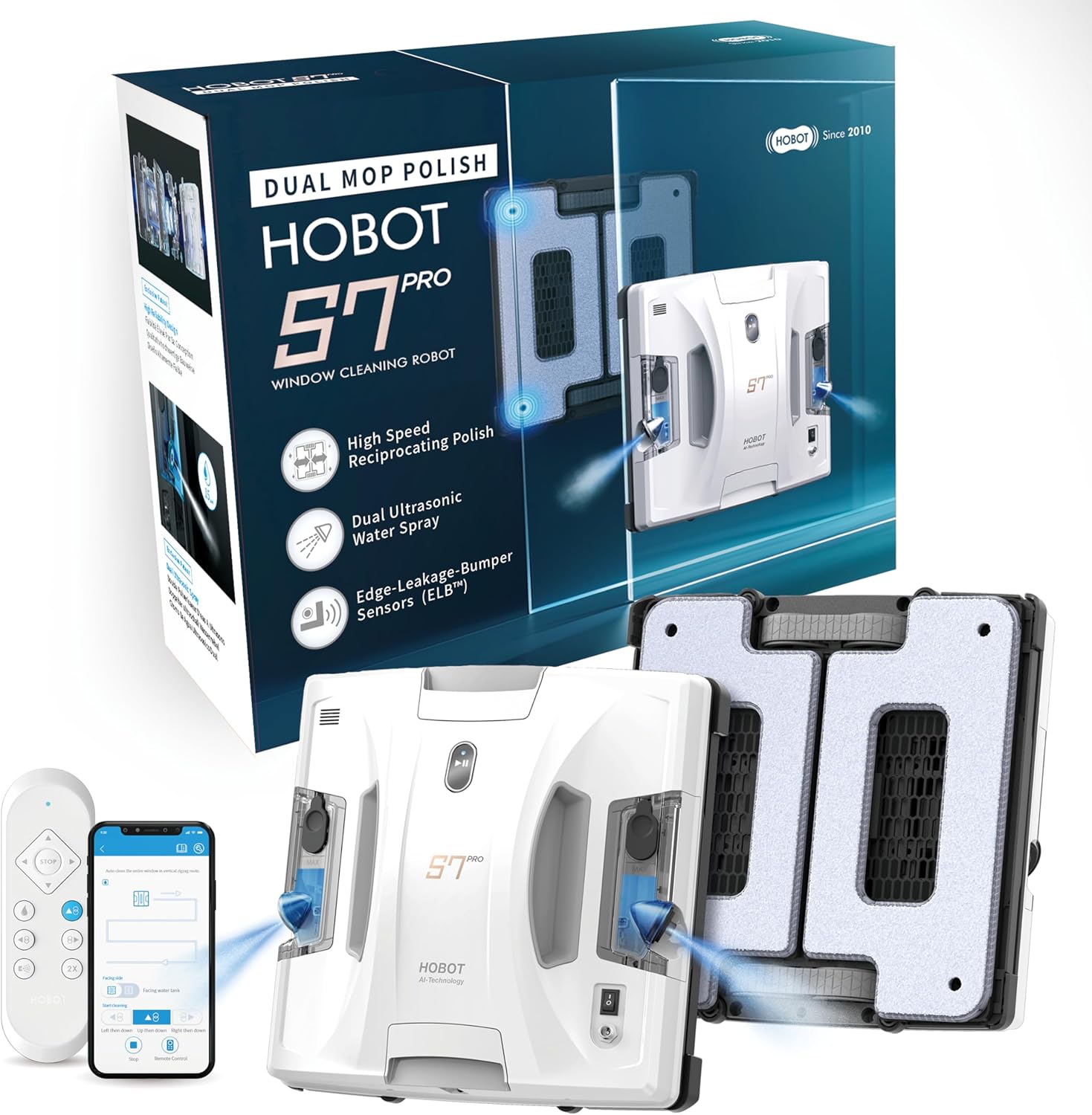 The S7 Pro. Square body, dual mop pads, dual ultrasonic spray. © HOBOT
Most window robots are circular. That’s fine for the middle of a large window, but a circle physically cannot reach a 90-degree corner — the geometry doesn’t work. The robot gets close and stops.
The S7 Pro is square. Its dual cleaning pads reach all the way to the edges. Combined with the ELB edge sensors (more on those shortly), it cleans the parts of your windows that every other robot misses.
That’s the entire pitch. If your windows have corners you care about, this matters. If you mostly have large frameless glass panels without sharp corners, it matters less.
Specs
| Feature | Detail |
|---|---|
| Price | $459.99 |
| Rating | 3.7 stars / 35 reviews |
| Suction | 4800Pa — highest tested |
| Cleaning system | Dual mop, 600 strokes/min, 4mm stroke |
| Water spray | Dual ultrasonic, 15μm mist particles |
| Coverage speed | 1m² in 2.6 minutes |
| Safety rope | 4.5 meters, rated 230kgf |
| UPS backup | 20 minutes |
| Power cord | 4 meters |
| Weight | 3.7 lbs |
| Surfaces | Framed, frameless, laminated, multi-layer, decorative glass, mirrors, balcony panels, solar panels |
The 4800Pa suction is the highest number we’ve seen in this category. For context, the Ecovacs W2 Pro Omni doesn’t publish a suction figure — HOBOT does, and 4800Pa with a 40% larger suction ring is a meaningful engineering claim.
The dual mop system — 600 strokes per minute
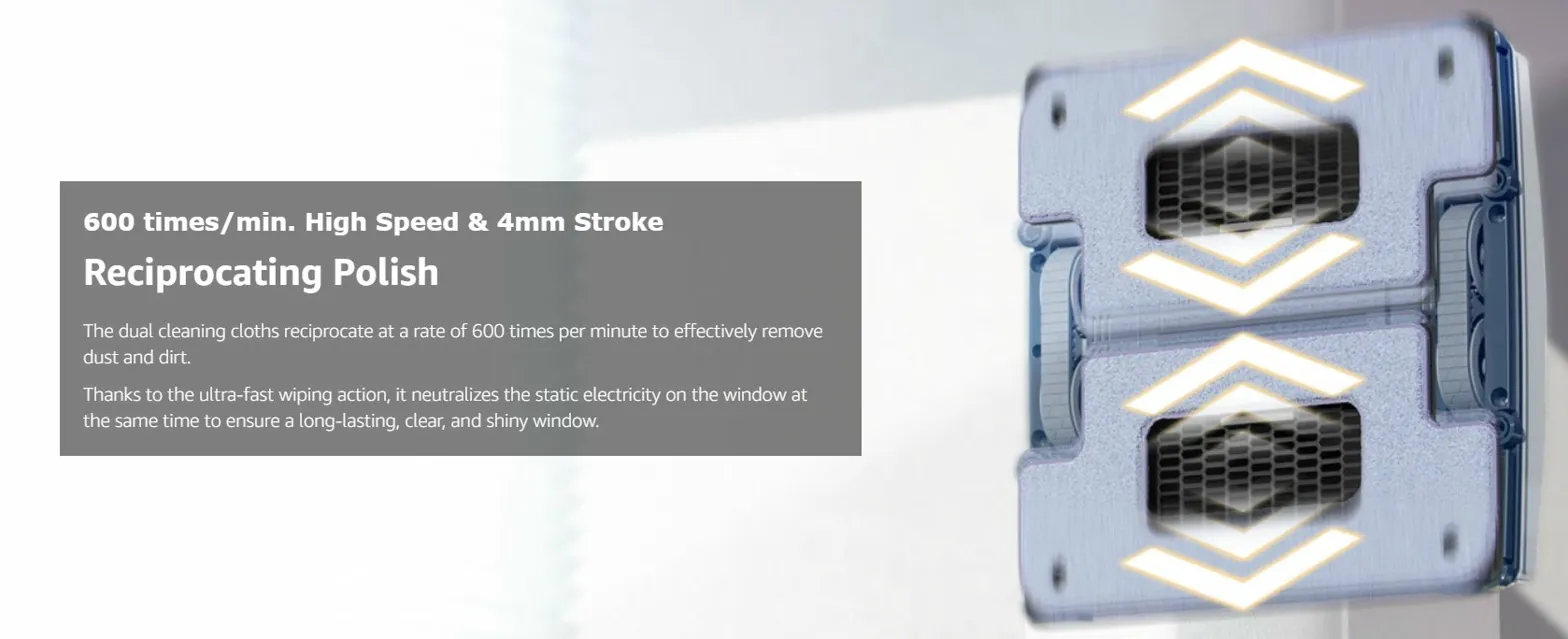 600 reciprocating strokes per minute neutralizes static electricity while cleaning. © HOBOT
This is what separates the S7 Pro from spray-and-wipe robots. The dual pads don’t just drag across the glass — they reciprocate at 600 strokes per minute with a 4mm stroke length, simulating the back-and-forth motion of hand-wiping.
The practical effect: static electricity on the glass gets neutralized during cleaning. Dust that normally re-settles on glass after cleaning sticks around less.
One hotel owner who tested the robot through a friend’s recommendation described it as cleaning “much like a detailed hand-wipe, though it can occasionally miss very hardened dirt.” That’s an honest assessment from someone who watched it work on six second-story windows that face a main road and get dirty quickly.
Dual ultrasonic spray — why 15μm matters
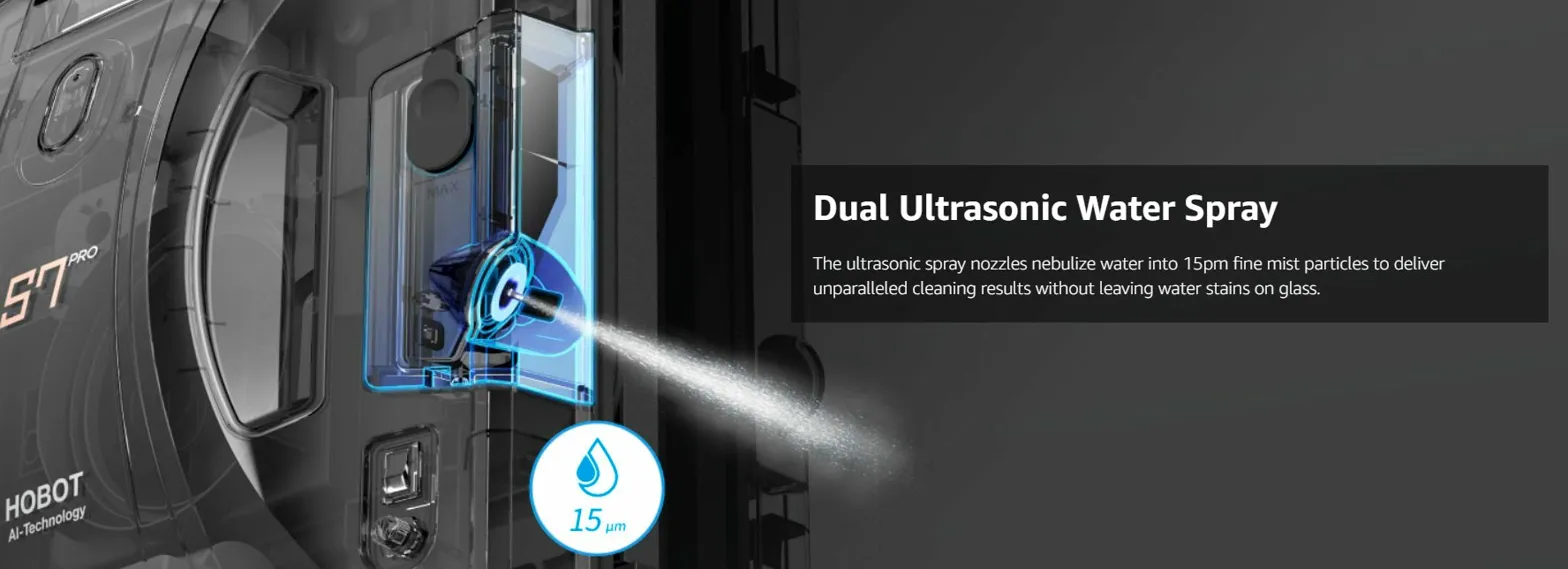 15μm mist particles — finer than standard spray nozzles. Dissolves stains without leaving water marks. © HOBOT
Standard spray nozzles release water droplets that can leave mineral deposits when they dry. The S7 Pro’s ultrasonic nozzles atomize water into 15μm mist particles — fine enough to dissolve dirt on contact and evaporate cleanly.
The spray covers three directions simultaneously. Combined with the reciprocating mop action, the cleaning cycle is: mist → scrub 600x/min → wipe. That’s a more thorough process than most robots in this price range.
ELB edge sensors — the frameless glass solution
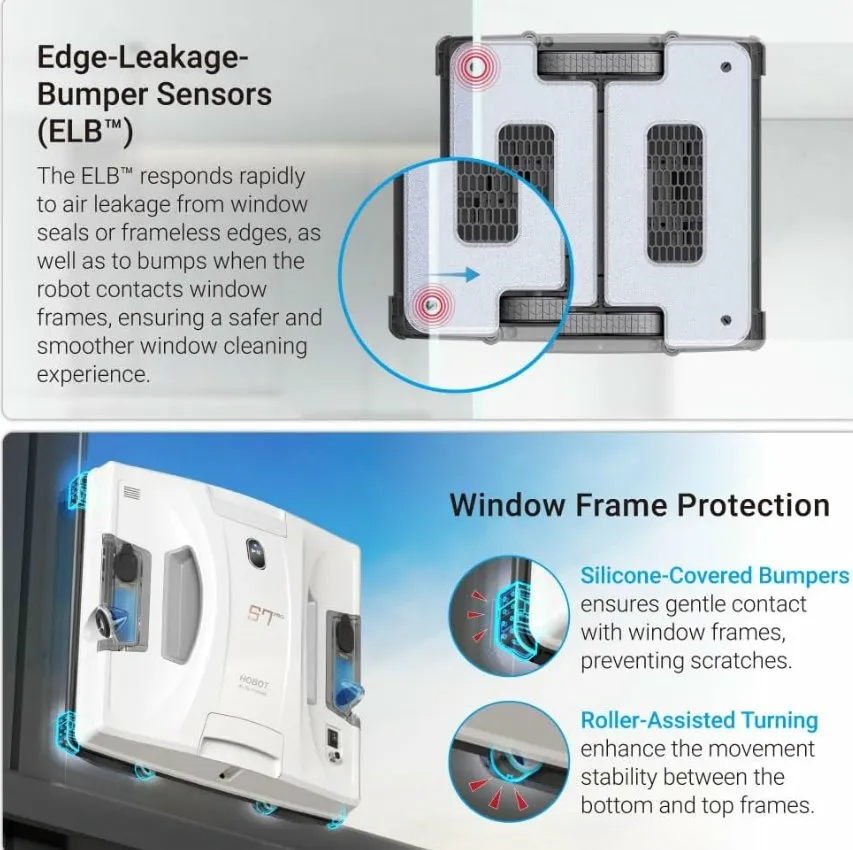
 ELB sensors detect air leakage at frameless edges in real time. Silicone bumpers prevent scratches on frames. © HOBOT
The ELB (Edge-Leakage-Bumper) sensor system is HOBOT’s patented answer to a problem every window robot faces: how do you know when you’ve reached the edge of the glass?
On framed windows, the robot hits the frame and reverses. Simple. On frameless glass, there’s no frame to hit — which means without edge detection, the robot just keeps going until it falls off.
The ELB sensors detect air leakage in real time. When the suction seal starts to break at a frameless edge, the robot reverses before it loses grip. It also detects physical frame contact and reverses to prevent scratching — the silicone-covered bumpers handle gentle frame contact safely.
In practice: Brenden, who owns large picture windows and tested the robot across 20 panes of glass, reported it fell off once and caught itself once via the tether. At ground level, no damage. His verdict: use the tether on anything above ground floor, full stop.
Safety — UPS, tether, and the cord question
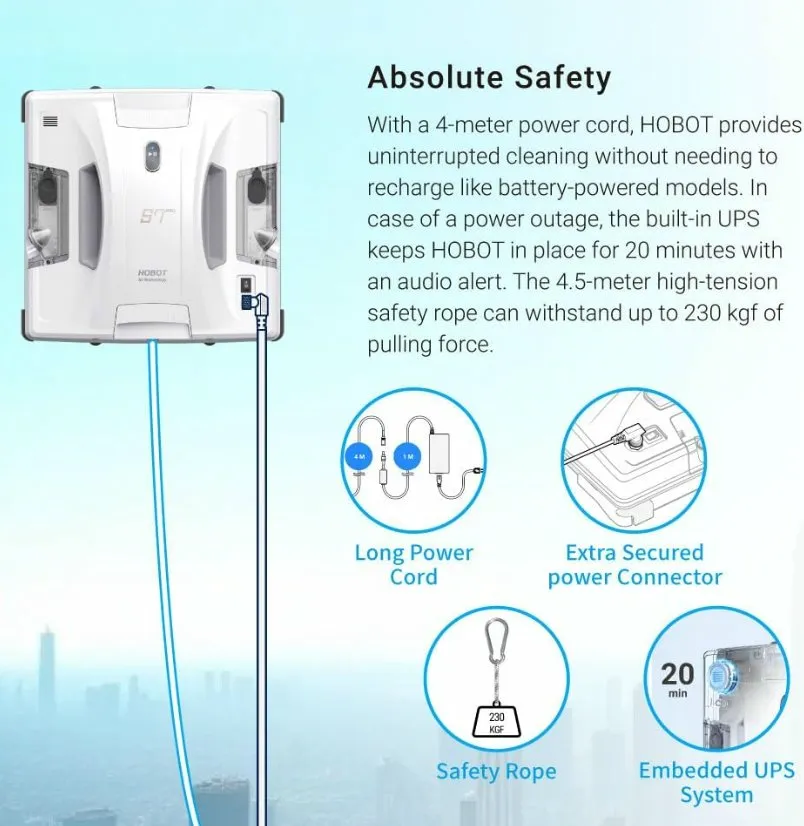
 Four layers of safety: long cord, secured connector, 230kgf tether, 20-min UPS. © HOBOT
The safety system has four components worth understanding:
4-meter power cord — longer than average, reduces the extension cord situation for most rooms. Still a cord though; no battery mode like the Ecovacs W2 Pro Omni.
Extra secured power connector — the DC jack is designed to stay connected during cleaning. Accidental disconnection mid-cycle on a high window is a serious risk with cheaper robots; HOBOT addresses this specifically.
230kgf safety rope (4.5 meters) — this is the tether. 230 kilograms of pulling force rating. Lisa, in her Amazon review, asked the right question: where do you attach it? Answer: you need an anchor point — a hook, a handle, something solid above the window. If you’re using this on exterior windows above ground floor, figure out your anchor point before you start.
20-minute UPS backup — if power fails, the robot holds position for 20 minutes with an audio alert. That’s enough time to realize what happened, get the robot down safely, and avoid a falling incident.
What real owners say
The honest 4-star review (Brenden):
The most useful review in the set. Brenden cleaned 20 panes of glass. His 6.5’ × 6.5’ window took 21 minutes. His 5.5’ × 3’ window took 9 minutes. The robot fell off once (caught by tether, no damage) and self-caught once.
His rating: 8 out of 10. His manual cleaning is a 7. Professional cleaning would be 9-10. He plans to buy a second unit to speed up the process.
His key warning: “I would not recommend this for smaller windows as you need to reset the machine for every pane of glass. This is also not a set and forget it product.”
That’s the most important thing to understand about the S7 Pro. Every window is a separate operation — remove the robot, reposition, restart. If you have 30 small windows, that’s 30 repositioning cycles. If you have 8 large picture windows, that’s 8.
The hotel test (IT professional, 5 stars):
A buyer with 25 years in IT and robotics industry experience gave this to a friend who manages several large motel complexes. Six second-story windows facing a main road, getting dirty constantly. Result: sparkling clean, saves staff significant time. His friend’s verdict: “It has done a better job with far less effort, saving my team a tremendous amount of time.”
The practical tip from this review: give the window surface a light misting before starting, and follow the setup videos on Amazon before your first use.
The 5-star simple review (Latisha):
“The dual mop and spray work great, and it sticks to both framed and frameless glass without any problems. Easy to use and very efficient.”
Short, but that’s what most satisfied buyers report — it does what it says.
The one big catch
Nobody mentions this prominently, but it matters: the S7 Pro runs on a power cord, not a battery.
The 4-meter cord helps, but if you have windows far from outlets — balconies, large sunrooms, upper floors without nearby sockets — you’re managing an extension cord every time. The Ecovacs W2 Pro Omni’s portable station solves this; the S7 Pro doesn’t.
If cord management isn’t a problem for your windows, this doesn’t matter. If it is, it’s the decisive factor.
S7 Pro vs Ecovacs W2 Pro Omni — which one?
| HOBOT S7 Pro | Ecovacs W2 Pro Omni | |
|---|---|---|
| Price | $459.99 | $499.99 |
| Reviews | 35 (3.7★) | 223 (4.0★) |
| Suction | 4800Pa | Not published |
| Corner cleaning | ✅ Square pad | ❌ Round pad |
| Power | Cord only | Battery + cord |
| UPS backup | 20 minutes | Built into station |
| Speed | 1m² / 2.6 min | 14 cm/s |
| Best for | Corners, frameless glass | Far from outlets, high-rise |
Choose the S7 Pro if:
- Your windows have corners you need cleaned properly
- Your windows are near power outlets
- You have frameless glass and want ELB edge detection
- You have large picture windows (fewer repositioning cycles)
Choose the W2 Pro Omni if:
- Power outlets are far from your windows
- You want cordless flexibility on balconies
- You have many smaller windows to clean in one session
- You prioritize a longer track record (223 vs 35 reviews)
The verdict
The HOBOT S7 Pro is not for everyone. It’s slower than you’d expect, requires repositioning for every window, and doesn’t solve the cord problem that the Ecovacs W2 Pro Omni addresses. If you need cordless operation, look elsewhere.
But if your windows have corners, if you’re dealing with frameless glass, or if you’re running a commercial property with large fixed windows that get dirty regularly — the S7 Pro’s dual-mop system and ELB edge detection justify the price. The hotel owner who tested it said it saves his staff significant time. Brenden rated it 8/10 and is buying a second one.
That’s a meaningful endorsement from people using it for real work, not a one-time test.
Lab score: 4.0 / 5 — best corner cleaning in class, with a learning curve and a cord.
Also consider: Ecovacs Winbot W2 Pro Omni at $499 for cordless operation.
FAQ
Does the HOBOT S7 Pro work on frameless glass?
Yes — the ELB edge sensors detect air leakage at frameless edges and reverse the robot before it loses suction. In real-world testing across 20 panes, the robot managed frameless edges reliably, with one fall caught by the tether.
How do you attach the safety rope?
You need an anchor point above the window — a hook, door handle, or ceiling mount. The rope is 4.5 meters long and rated at 230kgf. On anything above ground floor, figure out your anchor point before you start cleaning.
How long does it take per window?
About 2.6 minutes per square meter. A 6.5’ × 6.5’ window (roughly 3.9m²) takes around 21 minutes on the double-wash setting. A 5.5’ × 3’ window (roughly 1.5m²) takes about 9 minutes. These are real numbers from an owner who timed it.
Is it set-and-forget?
No. You need to reposition the robot for every individual pane of glass. If you have many small divided windows, that’s a lot of manual handling. It works best on large, single-pane picture windows.
What happens if the power goes out?
The built-in UPS keeps the robot in place for 20 minutes with an audio alert. The safety rope provides backup. Use the tether on any window above ground floor.
Does it work on solar panels?
HOBOT lists solar panels as a compatible surface. The 4800Pa suction with dynamic pneumatic technology works on various glass thicknesses and surface types including laminated and multi-layer glass.