The JSDROBOT S9PRO (also sold under the SATUO name) is a $349 window cleaning robot that leans hard on one differentiator: a 5-in-1 portable base station that stores the robot, reels in its cords, and acts as a safety anchor. On paper it checks every box the category has trained us to expect — dual water spray, edge detection for frameless glass, intelligent path planning, multiple cleaning modes. But with a 3.9-star rating across 29 global reviews, there’s clearly a gap between the spec sheet and some living rooms. I’ve spent time going through the product details and every buyer review I could find to figure out where that gap actually is.
If you’re still deciding whether a window robot makes sense for your home at all, our window robot buying guide covers the broader category before you spend this kind of money on a single model.
Table of Contents
Open Table of Contents
- What the 5-in-1 Base Station Actually Does
- Setup: More Steps Than the Marketing Suggests
- How the Dual Water Spray Handles Stubborn Stains
- Edge Detection on Frameless Glass
- The Cord Situation Nobody Wants to Talk About
- What the 3.9-Star Rating Is Really Telling You
- S9PRO vs. Tosima W5 vs. Winbot W2 Pro Omni
- Who Should Buy the JSDROBOT S9PRO — and Who Shouldn’t
What the 5-in-1 Base Station Actually Does
Most window robots in this price bracket ship as a robot, a power brick, and a tangle of cables you stuff into a drawer. The S9PRO instead ships with a carrying-case-style base station that combines storage, a 2-in-1 power cable, one-touch automatic cord winding, and the anchor point for the safety rope. Both the wall cord and the robot’s tether retract into the case when you press small panels on the front.

Buyers consistently singled this out as the best part of the package. One reviewer described the retractable cables as “long enough” and appreciated that “there are no unsightly cables to tidy up,” while another called the two-in-one power cord and safety rope combo “neat and tangle-free.” It’s a genuine quality-of-life advantage if you plan to move the robot between rooms or store it between uses — which, realistically, is most owners.
One clarification worth making: the base station is not a dock in the robot-vacuum sense. It doesn’t charge the robot, refill it, or clean its pads. It’s a very well-designed storage and cable-management case. That’s still useful, just calibrate expectations.
Setup: More Steps Than the Marketing Suggests
The setup ritual, pieced together from several detailed buyer accounts, goes like this: place the base on a completely flat surface, turn the rear knob clockwise to “O,” fill the small included bottle with water (one owner uses distilled), insert the bottle nozzle into the robot’s fill port and squeeze, attach the safety rope, plug into AC, and check for a green light — red means the backup battery needs charging and you shouldn’t run it. Then you dampen both round mop pads with 15–20 spritzes from the spray bottle, hold the power button for three seconds until the suction fan spins up, and stick the robot to the glass.
None of this is difficult. But it’s a five-minute pre-flight checklist per session, and one owner with triple side-by-side windows concluded they could hand-clean all three faster than supervising the robot through its cycle. That’s the recurring tension with this machine: it doesn’t save effort so much as relocate it. You stop scrubbing and start supervising.
Worth noting: this robot is corded for operation. The internal battery exists only to maintain suction for roughly 15–20 minutes (manufacturer-claimed, per a reviewer who flagged it as untested) if power cuts mid-clean, so the unit doesn’t drop off your window. It won’t finish a cleaning run on battery.
How the Dual Water Spray Handles Stubborn Stains
The S9PRO carries a small onboard tank — about 60 ml, per one buyer’s measurement — feeding spray nozzles on each side. The spraying is directional: the right nozzle sprays when moving right, the left when moving left, which keeps the mist ahead of the pads instead of soaking already-cleaned glass. The robot ships with 10 round mop pads and offers multiple cleaning modes: a fast mode for daily maintenance, a deep mode that wipes twice in a full automatic pass, and a spot mode that works a small stain up and down repeatedly.
The results buyers describe split cleanly by dirt type. For dust, pollen film, bathroom mirrors, glass-top tables, and — mentioned by two separate owners — dog nose prints on patio-door glass, the robot does well, with several reporting streak-free results. One owner of an 18-foot-tall great room window called it a genuine replacement for ladders and extension poles, which is exactly the use case this category exists for.
Heavier contamination is where it stalls. Post-storm mud defeated the deep mode for one buyer, who had to redo the window by hand. Another noted the robot can’t dig dirt out of deep corners — a geometry problem shared by every round-pad robot, not unique to this one. A few mentioned small water patches left behind that need a quick manual wipe. If you’re curious why some households find these robots transformative and others find them fussy, our piece on why people love window cleaning robots digs into that divide — the S9PRO is a textbook example of it.
Edge Detection on Frameless Glass
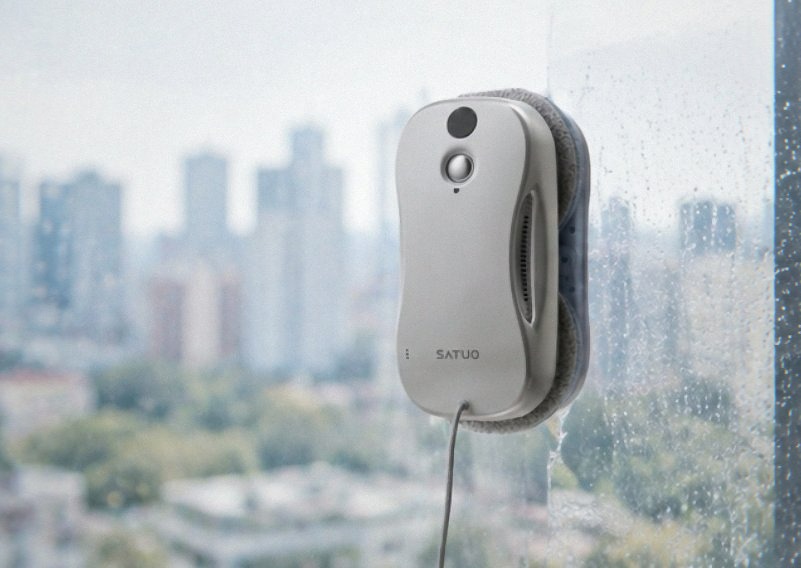
Edge detection is the feature that determines whether you can trust the robot on frameless shower enclosures, balcony glass, or picture windows without a border to bump against. The feedback here is cautiously positive. One Canadian reviewer said the edge detection “works great, even on frameless glass,” and another described watching the robot recognize and reverse at the window’s edge during its first run.
That said, one owner reported the robot “has come off of my windows a couple of times, and that was a mess” — a reminder that the safety rope is not a formality. Attach it. Every time. The robot also carries an anti-fall designation in its spec sheet, and between the vacuum suction, the backup battery, and the tether, the failure chain has three links. You want all three intact before sending it up to a second-story pane.
The Cord Situation Nobody Wants to Talk About
Here’s the complaint that shows up in review after review: the cord. Not because it’s poorly designed — the retractable system is genuinely tidy — but because it exists at all. “The cord is a hindrance, and at this price, it should be wireless,” wrote one buyer, before answering their own question: a battery big enough to run the vacuum motor would likely make the robot too heavy to stay stuck to vertical glass.
That’s the physics of the category in 2026, and the S9PRO doesn’t escape it. The practical consequence is range and supervision. Your cleaning radius is tethered to the base station, exterior windows are only realistic at ground level or within easy reach, and you need to be present to move the unit between windows. One owner put it bluntly: “you have to watch this and remove it when done.” If your mental model is “set it and leave the house,” recalibrate.
What the 3.9-Star Rating Is Really Telling You
The distribution behind that 3.9 average is more informative than the number itself: 48% five-star, 25% four-star, 15% three-star, and 12% one-star, with no two-star reviews at all. That’s a polarized product. People who match its ideal use case — large or tall panes, light-to-moderate grime, willingness to supervise — write glowing reviews. “An extra pair of hands,” said one owner who’d run it for about ten months across bathroom mirrors, a palladium window, and a glass-top table.
The one-star cluster is dominated by a different story: a unit that attached fine but refused to start, flashing green once then beeping red through more than a dozen attempts over two days. That’s one documented unit in the sample, but at 29 total ratings, a single dead-on-arrival robot moves the average. There’s also a subtler middle ground of buyers who found it “more of a novelty than a necessity” — works as advertised, they’d just rather use a squeegee. Several of the detailed reviews, it’s worth noting, are Vine reviews of free product, which doesn’t invalidate them but is context you should have.
S9PRO vs. Tosima W5 vs. Winbot W2 Pro Omni
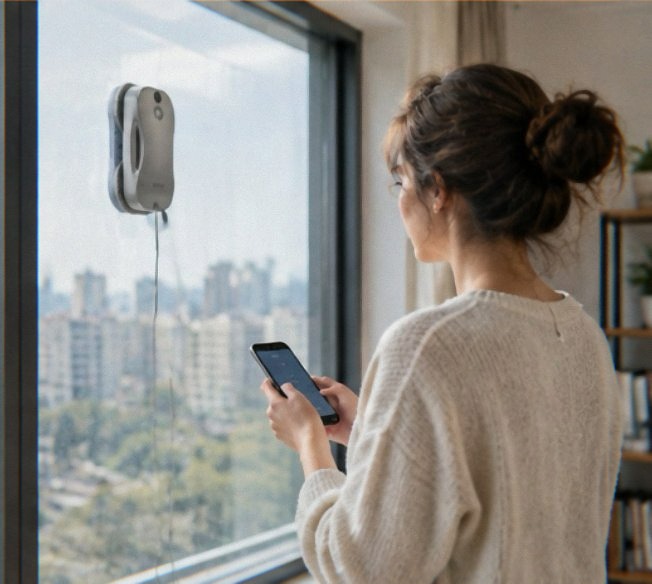
Cross-shopping at this price puts you against two obvious alternatives we’ve already covered. The Tosima W5 comes in meaningfully cheaper and covers the same round-pad, spray-assist fundamentals, though without anything like the S9PRO’s base station system. If cable management and storage don’t matter to you, the W5’s value argument is hard to ignore.
The ECOVACS Winbot W2 Pro Omni sits at the other end — it was showing around $379 on promotion at the time of writing, with a more established brand behind it and a far larger review base. ECOVACS has iterated through several window-robot generations, and that maturity shows in the app and path planning. The S9PRO’s counter is its base station design and aggressive pricing against the Winbot’s $499.99 list price. Against both, the S9PRO’s thinner review history is the honest risk: you’re betting on a product with 29 ratings rather than hundreds.
Who Should Buy the JSDROBOT S9PRO — and Who Shouldn’t
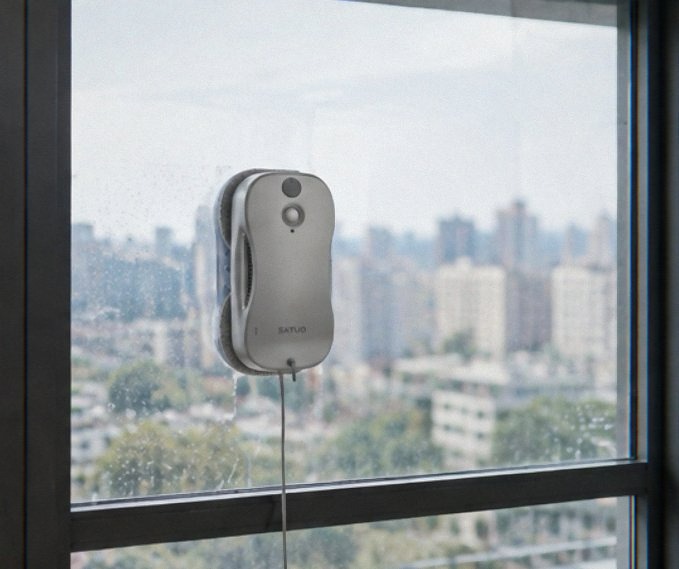
The S9PRO makes sense if you have tall or hard-to-reach interior glass — great room windows, stairwell glazing, frameless shower panels — and you value the base station’s storage and cable management enough to pay for it. Buyers with limited mobility got specific praise out of it; one reviewer explicitly recommended it for people who find ladders or sustained arm work difficult.
Skip it if your windows are few and easily reached, if your typical grime is baked-on or post-storm heavy, or if the idea of a five-minute setup per session sounds worse than ten minutes with a squeegee. At $349 it sits in an awkward middle: cheaper robots do the same core job with less ceremony, and the Winbot W2 Pro Omni offers more brand maturity for slightly more money during sales.
If the tall-window use case fits you, the JSDROBOT S9PRO is available on Amazon with free returns and a 30-day refund window — which, given the 12% one-star rate and at least one documented dead unit, is a safety net worth knowing about before checkout rather than after.