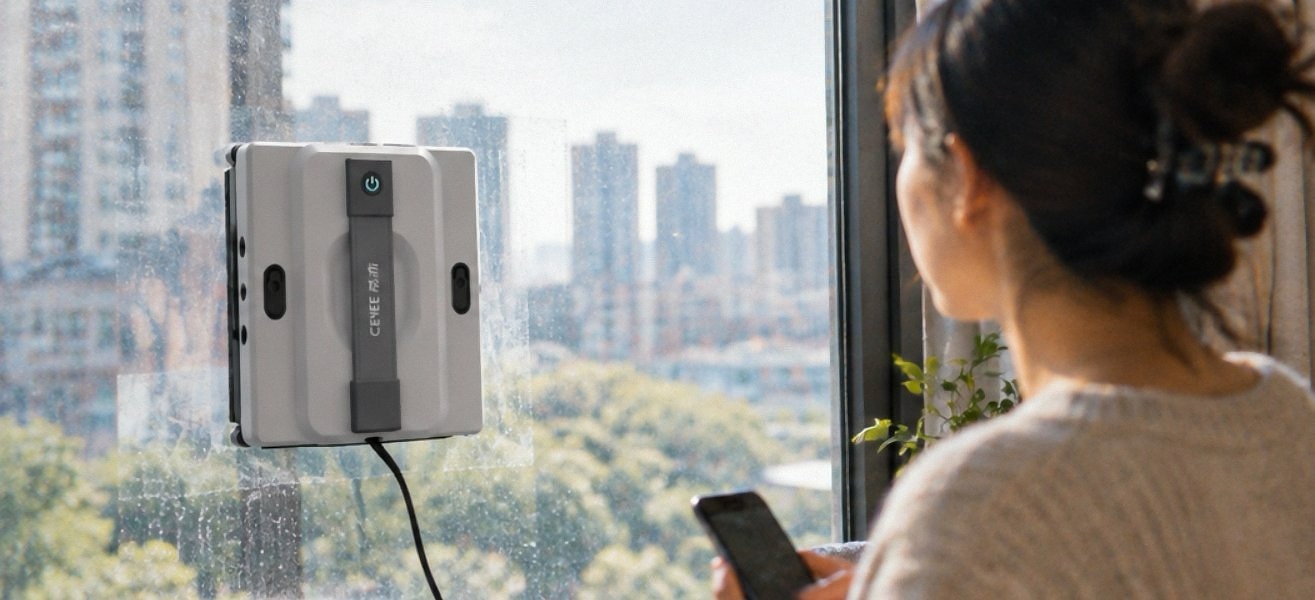
The CEYEE W1 is a sub-$300 window cleaning robot that tries to check every box the premium models do: dual-side spray, AI path planning, six cleaning modes, and an 8-level safety system — all for $279.99 at the time of writing, down from a $349.99 list price. That’s aggressive pricing in a category where Ecovacs charges $500+ for its flagship Winbots. The obvious question is what CEYEE cut to get there. We went through the full spec sheet, the manufacturer’s documentation, and every early buyer report available to figure out where this robot genuinely delivers and where the compromises show up.
Check the CEYEE W1 current price on Amazon
Table of Contents
Open Table of Contents
- Where the CEYEE W1 Sits in the Market
- The Dual 3-Nozzle Spray and Those Small 50ml Tanks
- Is 8000Pa Suction More Than You Actually Need?
- The 6 Cleaning Modes, Ranked by Real Usefulness
- AI Path Planning on Frameless Glass
- The 8-Level Safety System and the 25-Minute Power-Loss Window
- Noise, Setup, and the Daily Annoyances
- What Early Buyers Are Reporting
- How It Compares to Other Window Robots We’ve Covered
- Who Should Buy the CEYEE W1 — and Who Should Skip It
Where the CEYEE W1 Sits in the Market
CEYEE is not a household name in window robots the way Ecovacs or HUTT is, and the W1’s spec sheet reads like it was written specifically to undercut both. Dual-side spray, 8000Pa suction, six cleaning modes, remote control included. At $279.99 it lands in the same bracket as the HUTT S7 we reviewed earlier ($269.99, 6500Pa), while undercutting the Ecovacs Winbot W2 Pro Omni by roughly $200.
One honest caveat up front: this is a very new listing. The review pool on Amazon is thin — three verified reviews at the time of writing, all five stars. That’s encouraging but nowhere near statistically meaningful, so everything below weighs the specs and design more heavily than the ratings.
The Dual 3-Nozzle Spray and Those Small 50ml Tanks
The spray system is the W1’s most interesting design decision. Instead of a single nozzle misting ahead of the pads, it carries three nozzles on each side, fed by two separate 50ml water tanks. The idea is that whichever direction the robot travels, the leading edge gets pre-wetted — dust, fingerprints, and light film get loosened before the pad passes over them rather than being smeared around dry.
That dual-direction layout is a genuine advantage over single-nozzle designs, because the robot doesn’t waste passes turning around to keep the spray on the leading edge.
The trade-off is capacity. 100ml total is on the small side. CEYEE doesn’t publish a per-tank coverage figure, and the available information doesn’t tell us exactly how many square feet a fill lasts — but based on comparable dual-tank robots, expect to refill partway through a large glass wall or a full floor of windows. It’s a minor chore, not a dealbreaker, though it’s worth knowing before you buy.
One more thing the manufacturer is upfront about, and it’s worth repeating: if your windows have heavy sand or stubborn grime, you should pre-clean the surface before letting the robot loose. Dragging grit across glass under 8000Pa of suction is how scratches happen, and no robot is immune to that.
Is 8000Pa Suction More Than You Actually Need?
On paper, 8000Pa is a strong number. It’s more than the 6500Pa on the HUTT S7 and well above what budget robots like the Mamibot W120-DP offer.
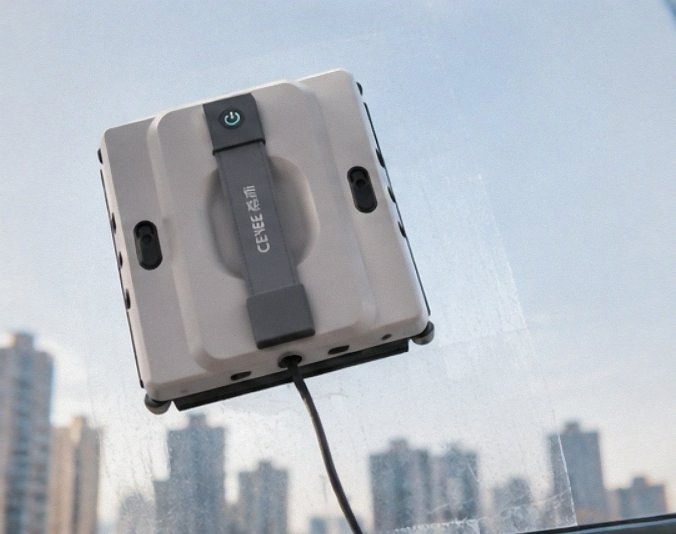
Here’s the skeptical take: suction on a window robot does two jobs. It holds the machine to the glass, and it presses the pads against the surface for cleaning friction. Beyond a certain threshold, more suction doesn’t make glass visibly cleaner — it mostly adds adhesion margin for dusty exteriors, slightly textured glass, and vertical slides where the robot’s weight works against it. For a robot that also promises to handle frameless glass and mirrors, that extra margin is meaningful, because frameless edges are exactly where lower-suction units get nervous.
So 8000Pa isn’t a gimmick, but it also isn’t the reason to buy this robot. It’s headroom. You’ll appreciate it on exterior panes and frameless shower glass; you won’t notice it on an easy interior window.
The 6 Cleaning Modes, Ranked by Real Usefulness
Six modes sounds like marketing padding, and some of it is. Here’s how they shake out in practice:
- Auto Mode — the one you’ll actually use 90% of the time. The robot picks its own route and covers the pane.
- Edge Cleaning Mode — the most genuinely useful secondary mode. Edges and corners are where window robots traditionally leave a dirty frame-line, and one early buyer specifically mentioned the W1 handling edges and corners well.
- Spot Cleaning — for bird droppings and localized marks. Useful occasionally, though heavily soiled spots still need a manual pre-wipe.
- N-Path and Z-Path — manual pattern overrides. N-path suits tall narrow panes, Z-path wide ones. Nice to have, rarely essential.
- Smart Cleaning Mode — the vague one. It appears to be an adaptive variant of Auto, but the documentation doesn’t clearly separate it from standard Auto behavior.
Everything is selectable from the included remote control, which matters more than it sounds: there’s no app dependency here. No pairing, no firmware-update anxiety, no account. Some buyers will see that as refreshingly simple; others will miss scheduling and app notifications. The remote ships without batteries, so have a pair ready.
AI Path Planning on Frameless Glass
The W1 runs an AI-assisted navigation chip that plans routes in all four directions, detects edges, and adjusts coverage to reduce missed spots. CEYEE claims compatibility with frameless glass — a claim worth treating carefully, because frameless detection is the hardest problem in this product category. Edge sensors have to recognize “the glass ends here” without a frame to bump against.
The spec sheet says the robot handles it, and the minimum working surface is a pane of at least 15.75 × 15.75 inches. What the available information can’t yet confirm is how confidently it behaves on large frameless panels over many sessions. If your home is mostly frameless glass railings and shower enclosures, we’d suggest supervising the first few runs closely — with the safety rope attached, always — until you’ve seen how it behaves on your specific glass.
The 8-Level Safety System and the 25-Minute Power-Loss Window
Safety is where you should never accept a compromise on a window robot, and the W1’s stack is reassuringly conventional: strong suction with a secure pad design, anti-slip climbing control, edge detection, and a backup battery that keeps the robot stuck to the glass for up to 25 minutes after a power cut, alarm presumably sounding while it waits for you to retrieve it. There’s also a physical safety rope, which the manufacturer explicitly tells you to use every time.
Twenty-five minutes of backup hold is decent — enough time to notice and fetch it, assuming you’re home. Which points to the real rule of owning any window robot: don’t run it on exterior glass when you’re out. The safety tether is the last line of defense; the backup battery is the second-to-last. CEYEE also warns against operating it with people standing directly below the working area, which should be obvious but apparently needs saying.
Noise, Setup, and the Daily Annoyances
CEYEE rates the W1 at ≤72dB. That’s not quiet — it’s roughly the level of a normal conversation happening right next to you, sustained. One early buyer described the noise as “low,” which suggests it’s at least on the tolerable end of the window-robot spectrum, but don’t plan to run it during a nap or a work call in the same room. The good news is that a single window takes minutes, not hours.
Setup, by buyer accounts, is genuinely simple: fill the tanks, dampen the pads, attach the rope, place it on the glass, press start on the remote. There’s no app onboarding to fight through. The recurring chores are the ones common to every window robot — washing the microfiber pads, refilling the twin tanks, and pre-cleaning gritty exterior panes so the robot doesn’t grind debris into the glass.
What Early Buyers Are Reporting
Three verified reviews exist as of this writing, all five stars:
- Ismail (August 2026) called out the strong suction, smooth AI navigation with good edge handling, and specifically praised the dual spray for loosening dust and fingerprints before the pads arrive. His one criticism: heavily soiled windows may need pre-cleaning — which matches the manufacturer’s own warning.
- Valeria (August 2026) highlighted easy operation, low noise, and solid dust and mark removal.
- Troy Cawley (August 2026) praised the simple setup and noted it cleans edges and corners well, leaving glass clear.
The pattern across all three is consistency on the basics — adhesion, navigation, edges — with pre-cleaning heavy grime as the recurring caveat. A promising start, but three data points is three data points. We’ll update this section as the review pool grows.

How It Compares to Other Window Robots We’ve Covered
We’ve spent time with a growing list of window robots, and the W1 slots into the lineup in a specific way:
- Against the HUTT S7 ($269.99): The closest price rival. The S7 counters with its HydroJet spray and 3D floating chassis; the W1 answers with more suction headroom (8000Pa vs 6500Pa) and dual-side nozzles. Effectively a coin flip on price — the deciding factor is whether you value HUTT’s more established track record.
- Against the JSDRobot S9Pro: The S9Pro plays in a similar value-conscious space. The W1’s dual-direction spray layout is the more elegant solution of the two.
- Against the MOVA T1 Station: Different philosophies. The T1’s station-based approach adds convenience at a higher price; the W1 is the grab-and-go option with no dock to store.
The short version: the W1’s distinguishing cards are the dual 3-nozzle spray and the 8000Pa adhesion margin, at a price that keeps it competitive with everything in the sub-$300 tier.
Who Should Buy the CEYEE W1 — and Who Should Skip It
Buy it if: you have a house or apartment with lots of glass — big windows, mirrors, glass doors, skylights — and you want dual-direction spray and strong adhesion without paying Ecovacs money. The no-app, remote-control simplicity is a genuine plus if you don’t want another smart-home account. High-rise dwellers get a proper safety stack (backup battery, tether, edge detection) rather than a token one.
Skip it if: you want a proven brand with years of owner feedback — the W1’s review history is three reviews deep, and that uncertainty is the real cost of the low price. Also skip it if app control and scheduling matter to you, if your windows are heavily soiled exterior panes you’re unwilling to pre-rinse, or if your panes are smaller than 15.75 inches on a side.
At $279.99, the CEYEE W1 makes a credible case for itself. The design decisions it made — dual-side spray, suction headroom, a serious safety stack — are the right ones. What it hasn’t yet earned is a track record. If you’re comfortable being a relatively early adopter in exchange for a meaningfully lower price, it’s one of the more interesting window robots in its bracket right now.
See the CEYEE W1 Window Cleaning Robot on Amazon
Disclosure: This article contains affiliate links. If you buy through them, we may earn a commission at no extra cost to you. Our analysis is based on manufacturer specifications, documentation, and verified buyer reports — not sponsored placement.