If you’ve been following this site for a while, you already know we have a soft spot for machines that take over the chores nobody wants to do. We’ve covered why people love window cleaning robots in depth, and we’ve tested everything from budget-friendly units to premium flagships like the Ecovacs Winbot W2 Pro Omni. Today we’re looking at a model that sits in a very interesting spot in the market: the Tosima W5 Window Cleaning Robot.
The W5 promises a lot on paper — 6400Pa of variable-frequency adaptive suction, a triple safety system, intelligent navigation, dual-spray cleaning, and a remote control, all wrapped in a compact body aimed at apartments, condos, and smaller homes. At a street price around $159–$169 (down from a $179.99 list price), it undercuts the big-name flagships by several hundred dollars. But does it actually clean well, and is it safe to trust on a window twenty stories up?
We dug through the full spec sheet, the verified purchase reviews, and our own experience with Tosima’s lineup — including the Tosima W3 and the X6 window cleaning robot — to give you the complete picture. Here’s our full Tosima W5 review.
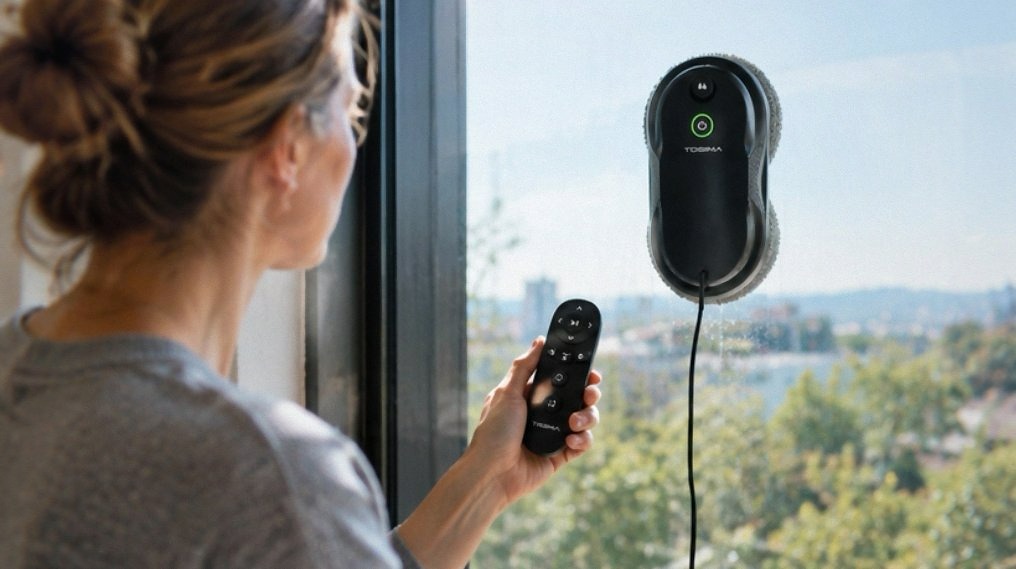
Quick verdict: The Tosima W5 is one of the best value window cleaning robots you can buy in 2026. It cleans aggressively, sticks to glass like glue, and its triple safety system makes it a reasonable choice for high windows. It’s loud and has no app, but at this price, it’s hard to beat.
Tosima W5 at a Glance: Key Specifications
Before we get into the details, here’s a quick overview of what the Tosima W5 brings to the table:
- Max suction power: 6400Pa, variable-frequency adaptive suction
- Cleaning system: Dual-spiral cleaning design with dual-spray water delivery
- Navigation: Intelligent path planning with automatic cleaning routes
- Edge detection: Sensitive air pressure sensor (works on frameless glass)
- Safety system: Triple protection — strong suction, 220kg-rated safety rope, 25-minute emergency backup battery
- Control: Remote control with multiple cleaning modes and manual override
- Surface compatibility: All smooth surfaces — windows, glass doors, mirrors, frameless glass
- Design: Compact and lightweight, built for apartments and smaller homes
- Maintenance: Replaceable spray nozzle and water tank cap; washable pads
- Packaging: Fully recyclable
- Price: ~$169.99 (frequently discounted to ~$159.99 with coupon)
- Rating: 4.4 out of 5 stars from 100+ Amazon reviews, with 200+ units bought in the past month
If you’re still in the research phase and not sure what any of these specs actually mean for real-world cleaning, our window robot buying guide walks through every feature category and tells you what to prioritize based on your home.
Unboxing and First Impressions: Small Size, Big Convenience
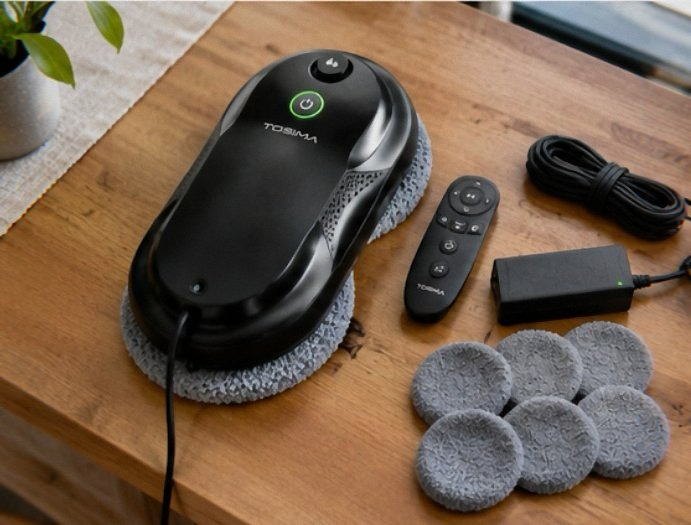
The first thing you notice about the Tosima W5 is how compact it is. Tosima clearly designed this unit with apartments, condos, and smaller homes in mind. It arrives in fully recyclable packaging — a nice touch that’s still rare in this category — and inside the box you’ll find the robot itself, a remote control, cleaning pads, a safety rope, a power adapter, and the water tank components.
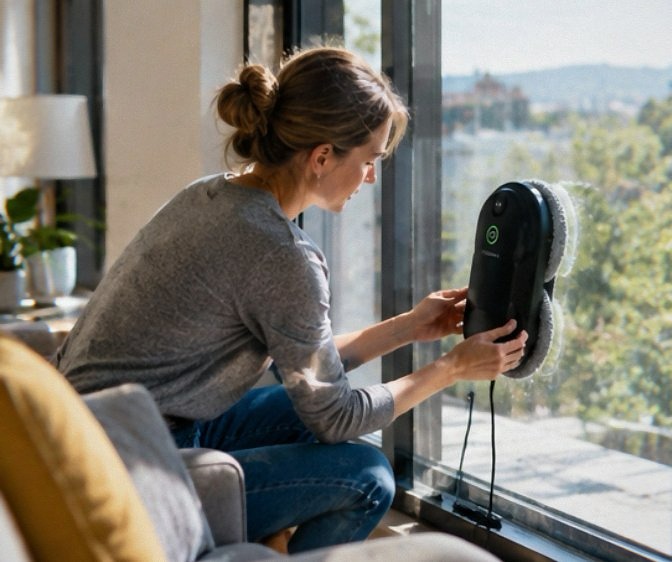
The compact footprint matters more than you might think. Larger window robots can be awkward to store and genuinely difficult to place on narrow window panes, small bathroom windows, or glass shower doors. The W5’s lightweight body means you can hold it against a second-story window with one hand while you press the power button with the other. If you live in an apartment with a mix of window sizes — a big living room pane, narrow bedroom windows, a glass balcony door — the W5 handles that variety better than bulkier machines.
There’s also no assembly to speak of. Attach a cleaning pad, fill the water tank, connect the power, place it on the glass, and turn it on. That’s genuinely the entire setup process.
Ease of Use: No App, No Learning Curve, No Problem?
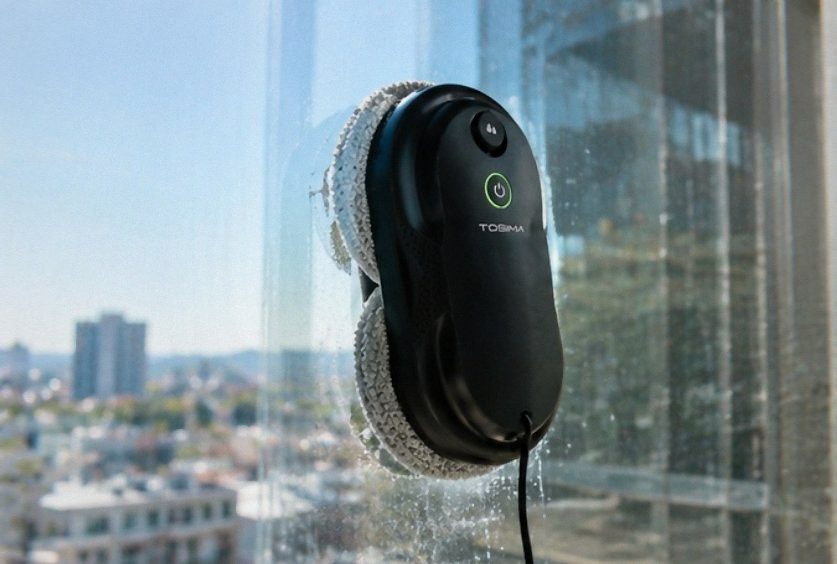
Here’s where the Tosima W5 makes a deliberate — and somewhat controversial — design choice: there is no smartphone app. You connect the W5 to a power source, place it on the glass, and turn it on. The robot immediately begins cleaning along an intelligent navigation path, and the included remote control lets you select cleaning modes or steer it manually when you need to spot-clean a particular area.
For a lot of users, this is a breath of fresh air. One verified Amazon reviewer put it perfectly: “I also didn’t need to install an app or sync another device to my network to use this thing.” If you’ve ever fought with a smart home device that demanded a 2.4GHz Wi-Fi network, a firmware update, and three account registrations before it would turn on, you’ll appreciate a robot that just works out of the box.
The trade-off, as that same reviewer noted, is that you don’t get app-based notifications when a cleaning cycle finishes. The W5 does emit audible alerts, but if you’re in another room — or if you’ve left the room because of the noise, which we’ll get to — you might miss them. Whether this is a dealbreaker depends entirely on how you plan to use it. For most people cleaning windows on a Saturday morning, the remote is plenty.
Compared to premium models like the Winbot W2 Pro Omni, which leans heavily on its app ecosystem and multi-function station, the W5’s approach is refreshingly simple. You’re trading smart features for simplicity and price — and for many households, that’s the right trade.
Cleaning Performance: 6400Pa Adaptive Suction and Dual-Spray in Action
Now to the part that actually matters: does it clean? The short answer is yes — impressively well for the price.
The dual-spiral cleaning system
The Tosima W5 uses a dual-spiral cleaning design paired with a dual-spray system. In plain English: two rotating cleaning pads scrub the glass in overlapping spiral paths while two spray nozzles mist water (or cleaning solution) precisely where it’s needed, ahead of the pads. This combination is what loosens dust, fingerprints, bird droppings, and stubborn dried-on stains rather than just smearing them around.
The spray system deserves special mention. Cheaper window robots — and honestly, some expensive ones — rely on you pre-dampening the pads, which means the first half of the window gets cleaned wet and the second half gets cleaned nearly dry. The W5’s auto-spray keeps moisture consistent across the entire pane, which is a big part of why its results are so uniform.
Variable-frequency adaptive suction
The headline spec is 6400Pa of maximum suction, but the more important word is “adaptive.” The W5’s variable-frequency suction system automatically adjusts its grip based on the surface it’s on. On smooth, clean glass it can ease off — reducing noise and protecting delicate surfaces — and on textured or heavily soiled areas it ramps up to full power to maintain a secure hold.
This adaptive behavior solves two real problems at once. Fixed-power robots either run at maximum suction all the time (loud, and harder on the glass and the motor) or run at a compromise level that struggles on difficult surfaces. The W5’s approach means it grips securely when it needs to and relaxes when it doesn’t. For a deeper explanation of why suction design matters more than the raw Pa number, see our window robot buying guide.
Real-world results from verified owners
Specs are one thing; dirty windows are another. Here’s what actual buyers report. One verified purchaser with very hard water and 100°F outdoor temperatures — about as hostile a cleaning environment as you’ll find — wrote: “My windows were FILTHY. This thing got them all the way to acceptable… my windows looked like they were frosted when I started.” They noted the pads came off the first run carrying actual chunks of wood, dirt, old paint, and grime. Another reviewer reported the robot removed roughly 80% of dirt on badly soiled windows, with only deeply stuck-on grime and extreme corners needing a manual touch-up.
That “acceptable, with a touch-up” pattern is consistent across reviews, and it matches what we’ve seen from every window robot we’ve tested, including flagships costing three times as much. If you’re expecting a robot to replace a professional window cleaner with a squeegee and 20 years of experience, reset those expectations — our piece on why people love window cleaning robots covers what these machines genuinely do well. What the W5 does is take windows from “embarrassing” to “looks great from any normal viewing distance” with zero effort and zero ladder time, and it keeps them that way with regular runs.
 One honest caveat from user feedback: corners are the weak point, as they are with virtually every round-pad window robot. The spiral pads can’t physically reach into a tight 90-degree corner, so expect a small untouched triangle in each corner of the pane. A quick wipe with a cloth every few months handles it.
Safety Systems: Can You Trust It on a High Window?
Safety is the number one concern for anyone considering a window robot for an upper floor, and it’s the area where the Tosima W5 punches well above its price class. The W5 ships with what Tosima calls a triple safety system:
1. Strong adaptive suction. The 6400Pa maximum suction is the first line of defense. The robot monitors its own grip continuously and adjusts power to stay firmly attached.
2. Air pressure sensor for edge detection. A sensitive air pressure sensor detects edges in real time, which is what allows the W5 to safely clean frameless glass — think glass balcony panels, frameless shower enclosures, and modern floor-to-ceiling windows with no frame to bump against. When the sensor detects an edge, the robot turns away instead of sailing off it. This is a feature that used to be exclusive to premium models, and it’s genuinely important if your home has frameless glass anywhere.
3. High-strength safety rope plus emergency backup battery. The included safety rope is rated to support up to 220kg — an enormous margin over the robot’s weight, meaning even a total suction failure results in a dangling robot, not a falling one. And if the power goes out mid-clean (or someone trips over the cord), a built-in emergency backup battery keeps the robot suctioned to the glass for up to 25 minutes, giving you plenty of time to retrieve it. One reviewer specifically called this out as a “nice touch,” admitting they were too lazy to use the safety harness and put a pillow on the ground instead. We obviously recommend actually using the safety rope — but it’s reassuring that the backup battery works as advertised.
How does this stack up against the competition? The safety package is comparable to what we’ve seen on the X6 window cleaning robot, Tosima’s model aimed squarely at high windows, and it’s not far off the Winbot W2 Pro Omni either. For a sub-$170 machine, a 220kg-rated rope plus a 25-minute backup battery is an excellent safety foundation.
Noise: The One Thing Every Reviewer Mentions
Let’s not sugarcoat it: the Tosima W5 is loud. Multiple verified reviews describe it as “LOUD, very LOUD. As in, I have to leave the room loud.” That’s the single most common complaint about this machine, and it’s consistent enough that you should treat it as a fact rather than a possibility.
Why is it loud? Suction motors powerful enough to hold a robot against vertical glass are inherently noisy — physics doesn’t care about your comfort. The adaptive suction does help, since the W5 isn’t running at maximum power constantly, but even its moderate power levels produce a sound somewhere between a vacuum cleaner and a hair dryer.
The practical impact depends on your home. If you’re cleaning exterior windows, you’ll be inside while the robot works outside — the glass itself muffles a lot of the noise, and it’s perfectly tolerable. If you’re cleaning interior glass like shower doors or mirrors in a small bathroom, you’ll want to start the robot and close the door behind you. Most owners land on the same routine: set it up, start it, walk away, come back when it’s done. Given that the whole point of a window robot is not having to watch it work, the noise is annoying but rarely a dealbreaker. If silent operation is a must-have for you, be aware that no window robot on the market is truly quiet — some are just slightly less loud than others.
Maintenance and Long-Term Ownership
The Tosima W5 is designed to be kept running for years, not replaced after a season. The spray nozzle and water tank cap are replaceable components, so the two parts most likely to wear out or clog can be swapped rather than forcing a whole-unit replacement. The cleaning pads are washable and reusable, and replacement pads are cheap and widely available — Amazon sellers offer multi-packs compatible with the W5, W2, X5, X6, X7, X8 and similar models for around $17.
A few maintenance tips based on owner feedback:
- Change pads between very dirty windows. One reviewer noted the pads had to be swapped after the first pass on filthy windows. Dirty pads smear rather than clean, so keep spares on hand.
- Mind your water. If you live in a hard water area, consider using distilled water or a proper window cleaning solution in the tank. Hard water dries fast and leaves spots — one reviewer with very hard water found their windows dried with residue before the pads could finish.
- Wipe the edge sensors occasionally. The air pressure sensor and navigation sensors work best when clean.
For a broader maintenance checklist and accessory recommendations, the window robot buying guide has a dedicated section.
Tosima W5 vs. the Competition See Today’s Deal on Amazon
Tosima W5 vs. Tosima W3
We’ve already reviewed the Tosima W3, and the W5 is a clear generational step up in Tosima’s own lineup. The W5’s 6400Pa adaptive suction is stronger and smarter than the W3’s fixed-power setup, the dual-spray system delivers more consistent moisture than the W3’s approach, and the compact body is noticeably easier to handle on small panes. If you already own a W3 and it’s serving you well, there’s no urgent reason to upgrade — but if you’re choosing between the two today, the W5 is the better buy unless the W3 is deeply discounted.
Tosima W5 vs. Tosima X6
The X6 is Tosima’s answer for high-window specialists, marketed for inside/outside use on tall glass. Both robots share the 6400Pa suction figure, but the X6 is built larger and more rugged, while the W5 is optimized for compactness and everyday apartment use. If your primary challenge is a wall of floor-to-ceiling exterior glass on a high floor, the X6’s design targets exactly that. If you have a typical mix of windows, glass doors, and mirrors in an apartment or condo, the W5’s smaller footprint and lower price make it the more practical daily driver.
Tosima W5 vs. Ecovacs Winbot W2 Pro Omni
The Winbot W2 Pro Omni is the premium benchmark in this category, with a 10,000Pa suction rating, TruEdge 2.0 edge cleaning, a multifunction station, and a full app ecosystem. It’s also typically $379–$400 on sale — more than double the W5’s price. The Winbot cleans slightly better at edges and offers a more polished smart experience, but the gap in core cleaning results is much smaller than the gap in price. If you want the best regardless of cost, get the Winbot. If you want 85–90% of the result for under $170, the W5 is the value champion.
Who Should Buy the Tosima W5?
Buy it if:
- You live in an apartment, condo, or smaller home with multiple glass surfaces
- You have high or hard-to-reach windows and want to retire the ladder
- You want strong cleaning performance without paying $350+ for a flagship
- You prefer simple remote-control operation over app-based smart features
- You have frameless glass that requires proper edge detection
Skip it if:
- You’re highly noise-sensitive and plan to be in the same room while it runs
- You want app notifications, scheduling, and smart home integration
- You expect perfectly clean corners with zero manual touch-up
Price and Where to Buy
The Tosima W5 lists at $179.99 but is almost always discounted — we typically see it at $169.99, and coupon deals regularly drop it to around $159.99. It ships from Amazon, is sold by TOSIMA US, and comes with free 30-day returns, so there’s minimal risk in trying it. With 200+ units sold in the past month and a 4.4-star rating across 100+ reviews, it’s one of the most popular window robots in its price bracket right now.
Get the Tosima W5 Window Cleaning Robot on Amazon →
Frequently Asked Questions
Does the Tosima W5 work on all window types?
The W5 works on all smooth surfaces: standard framed windows, frameless glass (thanks to its air pressure edge sensor), glass doors, mirrors, and glass shower enclosures. It is not designed for textured, frosted-rough, or heavily patterned glass, where suction can’t form a reliable seal.
How long does the battery last?
The W5 is a corded robot — it runs on mains power for unlimited cleaning time. The built-in battery is an emergency backup only, keeping the robot attached to the glass for up to 25 minutes if power is interrupted, so you have time to retrieve it safely.
Is the Tosima W5 safe for high windows?
Yes, with proper use of its triple safety system: adaptive 6400Pa suction, a safety rope rated to 220kg, and the 25-minute backup battery. Always attach the safety rope to a solid anchor point when cleaning exterior or high windows.
Does the Tosima W5 have an app?
No. The W5 is controlled entirely with the included remote control, which lets you choose cleaning modes or drive the robot manually. Many owners consider this a plus — no Wi-Fi setup, no accounts, no firmware updates.
How loud is the Tosima W5?
Loud enough that multiple reviewers mention leaving the room. It sounds roughly like a vacuum cleaner. For exterior windows this barely matters since the glass muffles the noise; for interior glass, plan to start it and step out.
Can it clean corners?
The round dual-spiral pads can’t reach fully into 90-degree corners, leaving a small triangle in each corner that needs an occasional manual wipe. This is true of nearly every round-pad window robot, including far more expensive models.
What cleaning solution should I use?
Plain water works for light dust. For best results — especially in hard water areas — use distilled water or a dedicated window cleaning solution. Replaceable spray nozzles and tank caps are available if mineral buildup ever clogs the system.
How does the W5 compare to the Tosima W3?
The W5 is the newer, stronger model: adaptive 6400Pa suction (vs. fixed power on the W3), an improved dual-spray system, and a more compact body. See our full Tosima W3 review for the detailed comparison.
Final Verdict: The Value Champion of 2026
The Tosima W5 Window Cleaning Robot doesn’t try to be the fanciest machine in the category. There’s no app, no docking station, no voice assistant integration. What it offers instead is the thing that actually matters: it sticks to your glass like it was welded there, scrubs filthy windows down to “looks great,” protects itself with a genuinely robust triple safety system, and costs about half of what the premium brands charge.
Its weaknesses are real but manageable: it’s loud, it misses tight corners, and heavily soiled windows may need a second pass or a quick touch-up. Every window robot we’ve tested — including the Winbot W2 Pro Omni at more than twice the price — shares at least two of those three traits.
If you’ve read our window robot buying guide and concluded that your priorities are cleaning power, safety, and value rather than smart features, the Tosima W5 is the obvious pick. It’s the easiest recommendation we’ve made all year for apartment dwellers, condo owners, and anyone tired of balancing on a ladder with a squeegee.