The last window robot I owned fell off my French doors and hit the deck with a sound I’ll describe as “expensive.” It was the S55 Pro, the S7’s older sibling, and it kept riding up on the vinyl molding around the glass, losing suction, dangling there like a cat stuck on a screen door. Twice I caught it. The third time I didn’t. Back it went, and I told myself I was done with window robots forever, stick to a squeegee and a bad attitude like a normal person.
That was eleven months ago.

So why am I holding another one
Because my windows got disgusting again, and my guy charges $200 a visit, three times a year, and I did that math on the back of an envelope while my tea went cold on the kitchen table. Six hundred bucks a year for glass I still have to squint through by February. A reader emailed me about the GNOVEL 8000Pa unit I reviewed and asked how the new HUTT flagship stacked up, and I realized I had no answer, and that annoyed me more than the dirty windows did.
So I ordered the HUTT S7. Grudgingly. With one finger hovering over the return window date in my calendar the whole first week.
It’s $256.49 on Amazon right now, down from a typical $269.99. Beige. One kilogram. Comes in an actual hard-shell suitcase, which felt absurd until I remembered I once stored the S55 Pro in a grocery bag and then couldn’t find the remote for a month.
The suction thing is not marketing this time
6500Pa. Peak. It adjusts between 2000 and 6500 depending on what it’s stuck to, and I want to be clear that I rolled my eyes at this number because every robot brand is in a suction arms race right now and the numbers mean less every quarter. The GNOVEL claims 8000Pa and it’s a fine machine, but raw Pa is like horsepower in a car ad — what matters is whether the thing stays on the glass when the glass is wet and the frame seal tries to lift an edge.
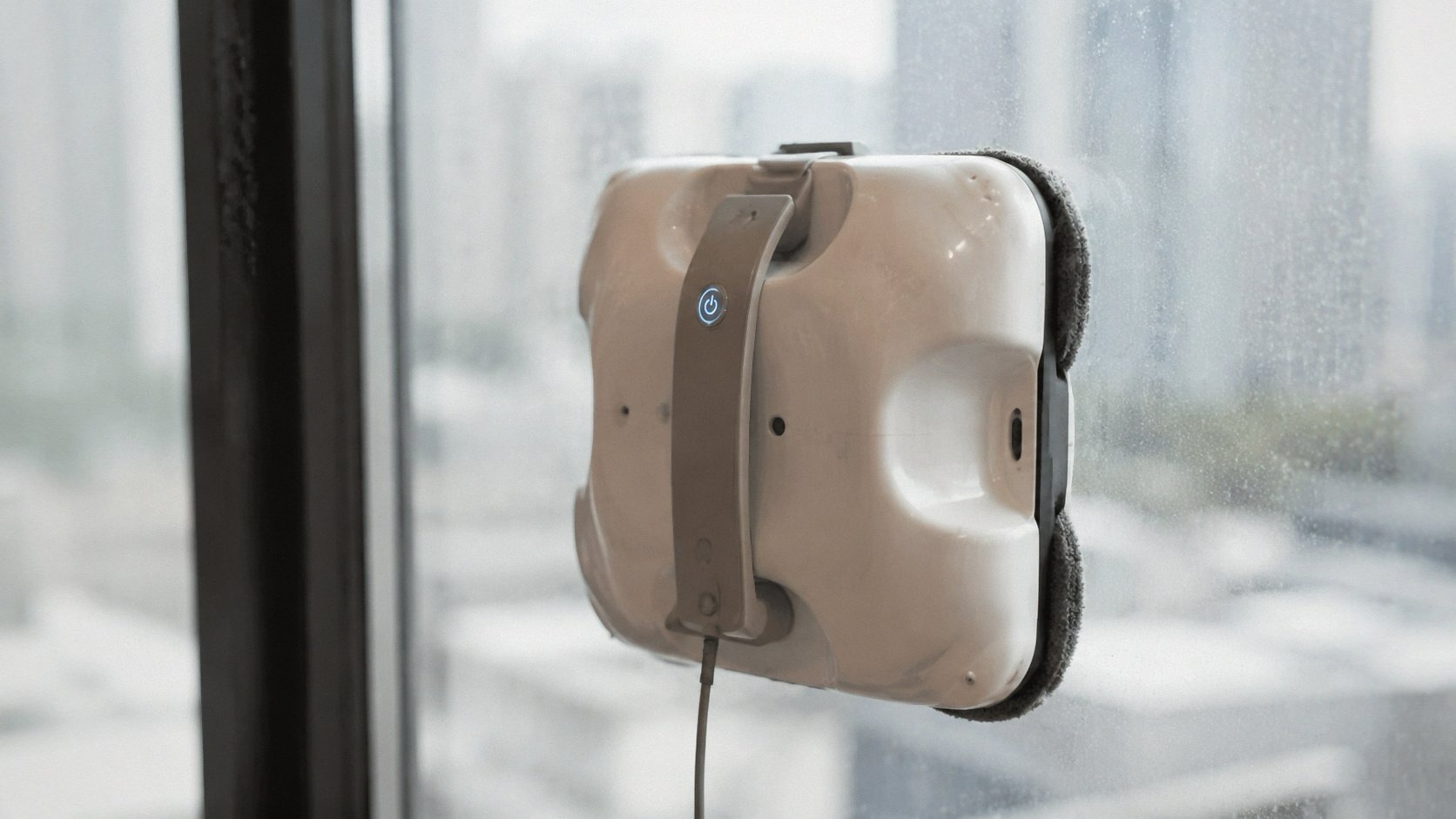
Here’s what the S7 does differently, and this is the part that made me stop composing the return email in my head: the chassis is a triangle tilted inward by two or three degrees. Sounds like nothing. What it means in practice is the outer edges of the two cleaning pads press harder into the glass, so when the robot crosses a window frame seal — the exact spot where my old S55 Pro would hiccup, lift, and begin its death wobble — the S7 just… keeps going. I stood next to the French doors with my hands out like a nervous spotter at the gym for the first three runs. It never even stuttered. The spring-loaded floating pads adjust to the little bumps and the uneven caulk line on my 1980s windows without breaking contact.
First boring physical detail, because I promised myself I’d notice these now: the power button has a firm, clicky thunk to it, not a mushy membrane press, and the rubber ring around the bumper has a slightly tacky texture, like the grip on a decent bike handle. One kilo sounds light until you’re reaching out a second-story window holding it by one edge, and then the weight shifting in your palm is the entire ballgame. It feels dense. Dense is good. Dense is what you want hanging off your house.
HydroJet spray and the little 80ml tank
The spray system fires a 120-degree fan of water at 2000mg per minute, and HUTT claims the 80ml tank covers up to 60 square meters per fill. My whole house’s exterior glass is maybe 40 square meters, and I got through all of it on one tank plus a top-up for the two filthiest windows, so the claim holds up better than most.
Bigger droplets than the last gen. That matters more than it sounds, because fine mist blows away in any wind stronger than a sigh, and my backyard funnels wind between the fence and the garage like it was designed by someone who hates me. The S7’s spray stays put. You fill it with plain water or your own glass cleaner — and this is a small thing I genuinely appreciate, the company doesn’t try to lock you into some proprietary $19-a-bottle fluid. My dish-soap-and-vinegar mix worked fine. There’s a whole recipe thread in the comments of my GNOVEL window robot review if you want the cheap solutions people swear by.
One owner detail you won’t find on the spec sheet: the spray button on the remote is weirdly unresponsive. The robot sprays on its own schedule during auto mode, and that works great, but if you want to manually add an extra spritz on a bird-strike crime scene, you press the button and nothing happens for a beat or two, then it sprays twice. I’ve started just pressing it once and being patient. It goes against every instinct I have.
SLAM 4.0, or: it finally knows where the glass ends
Navigation is where cheap window robots go to die. The S7 maps the window in real time, finds the top corner, works its Z-pattern down, detects frames and edges, and returns to roughly the center of the glass when it’s done so you’re not fishing it off a corner you can’t reach. There are four modes — Z-shape, Double Wipe, Spot Cleaning, and Breakpoint Resume — and I’ve used exactly two of them, because Z-shape handles everything and Double Wipe handles the windows my neighbor’s sprinkler has been mineral-staining for three years.
The edge detection on my frameless bathroom mirror was the real test. Frameless glass is where these things either earn their keep or launch themselves into the bathtub. It tracked the bare edge, slowed, turned, didn’t once overshoot. I watched the whole first mirror run from a crouch with my jaw clenched, like watching a toddler near a pool. Fine. It was fine.
And here is the only-owner-would-know detail, the one I checked three times because I didn’t trust it: when the S7 finishes, it beeps — and if you don’t come get it, it starts the window again. Second full pass. Nobody told me this. The manual doesn’t make a big deal of it. The first time it happened I thought it was malfunctioning, and then I realized it’s actually the smartest dumb feature on the thing, because a second pass on dry-ish cloths is exactly the polishing step I’d otherwise do by hand. You can pull it off after the beep if one pass is enough. But leaving it to double-run the patio doors while I made lunch produced the cleanest glass in my house, full stop.
If that “set it and walk away” loop sounds like the whole pitch, it kind of is. The HUTT S7 is the first window robot I’ve owned where “walk away” doesn’t feel like tempting fate. If you grab one through the links here, I might get a small cut — costs you nothing extra and keeps the lights on.
The safety stack, a.k.a. the part I actually read this time
After the French door incident I don’t skim this section anymore, so here’s the honest rundown. Built-in 650mAh backup battery keeps it suctioned to the glass for up to 25 minutes if the power cuts — I tested this by yanking the plug mid-run, which my wife described as “the most you thing you’ve done all month,” and it just sat there, beeping indignantly, stuck to the window. The chip compensates pressure drops in 0.04 seconds, which is a number I can’t independently verify but can confirm translates to “it didn’t fall off when I bumped the ladder against the frame.” There’s a safety rope. Tie the safety rope. I know the robot is reliable now and I still tie the rope, every time, because gravity only needs to win once.
The power cord and safety tether are integrated into one line, which kills the old two-cable tangle dance. Small mercy. Appreciated.
If you’re the type who wants the full maintenance ritual — how often to wash the cloths, when to replace them, how to store the unit so the pads don’t deform — I wrote a whole guide on maintaining a window cleaning robot to extend its lifespan after killing a set of pads in six weeks through sheer neglect. Read it. Don’t be me.
The suitcase, the cloths, the stuff in the box
Eight microfiber cloths, machine washable, plus four spare nozzles, a remote, the adapter, the rope, an empty spray bottle, and the suitcase. The cloths are the consumable that actually matters, and eight is generous — most brands ship four and let you discover the upsell later. My routine from the GNOVEL days carries over fine: one set wet for the cleaning pass, one set dry for the polish pass, swap when they start streaking.
Swapping them is a finger workout. The pads stretch over the rotating discs with an elastic edge, and if you have large hands you’ll fumble the first few times. It’s the single most fiddly interaction on the whole machine, and it’s the one you’ll do most often. Make of that what you will.
Quick naming note, because it confused me and it’ll confuse you: HUTT is not HOBOT. Different companies, similar names, same product category, and I’ve reviewed the HOBOT S7 Pro separately — the naming collision is not a coincidence anyone will explain to me. The HOBOT is a good machine at a higher price. The HUTT S7 undercuts it by a meaningful chunk and, on my windows at least, matches it on everything except app polish.
The honest complaints See Today’s Deal on Amazon
List time, because I refuse to end up quoted in someone’s marketing deck:
The noise. 73dB, which is “loud dishwasher” territory. You can’t run it in the bedroom window at 6 a.m. unless you’re fighting with someone who sleeps there.
The rounded corners of the pads don’t reach the actual corners of the window. Every square window comes back with four little quarter-moons of grime, maybe two centimeters each. I wipe them with a cloth in nine seconds. It still irritates me out of proportion to the effort involved.
The remote is the weakest thing in the box. Input lag, mushy buttons, and the aforementioned spray delay. The good news is you need it maybe twice ever, because the one-button-on-the-machine workflow covers 95% of use. Charge takes three hours from empty, so don’t plan a whole-house blitz starting at 4 p.m. Ask me how I know.
And on truly filthy glass — years of neglect, pollen cement, the works — one pass is not enough. Two, sometimes three. It’s methodical, not fast. My whole house took a Saturday afternoon of moving it from window to window. That’s still $600 a year I’m not paying a guy, but go in expecting a shift of light babysitting, not a miracle.
Also the manual reads like it was translated by someone who had the product described to them over a phone call. Page four calls the safety rope a “life line,” which is technically accurate and emotionally jarring.
Who should actually buy this
Two-story house, big patio doors, frameless shower glass, a skylight you’ve been ignoring since the Obama administration — yes, this is your machine, and it’s the one I’d point you to over anything else under $300 right now. Renter with four small windows? Get a squeegee and save your money, I’m serious, the setup overhead isn’t worth it. And if your windows have thick vinyl molding proud of the glass, test one window immediately inside the return window, because that’s the edge case that killed its older brother and I will never fully trust any robot there again.
The tea on my desk went cold forty minutes ago. The windows are clean, the robot’s back in its ridiculous little suitcase, and the S55 Pro’s ghost can finally rest. Three weeks, no falls, one smudge I caused myself. The neighbor’s dog has been barking at it through the fence every single run though, so if you have a territorial animal, maybe close the blinds first. Anyway. (See Today’s Deal on Amazon )I’m going to go reheat this and stare smugly at the patio doors.