Short answer: Buy the ECOVACS Winbot W3 Omni if you have a lot of glass, want the pad washed for you between panes, and have floor space for a roughly 10 kg dock. Buy the HOBOT S7 Pro if you want to spend about $240 less, your windows are a handful of large panes near wall outlets, and clean square corners matter more to you than automation. Neither robot is cordless in the way a robot vacuum is: the W3 Omni moves the battery into its dock, and the S7 Pro stays on a 4 m power cord.
This comparison is built from the published specifications of both machines and from the owner reports and hands-on notes already collected in our individual reviews of the W3 Omni and the HOBOT S7 Pro. Where a number comes from a manufacturer claim rather than a measurement, the text says so.
The Two Machines in One Table
| Item | ECOVACS Winbot W3 Omni | HOBOT S7 Pro |
|---|---|---|
| Typical price seen in our reviews | About $699 | About $459 |
| Power | Battery lives in the dock, roughly 130 minutes quoted | Corded, 4 m power lead |
| Dock or station | About 10 kg with clean and dirty water tanks | None |
| Safety tether | 5.5 m composite cord that is also the power lead, quoted at 100 kg pull rating | Separate 4.5 m rope rated 230 kgf |
| Backup if power is lost | Over 30 minutes of hold on battery | 20 minutes UPS hold |
| Holding suction quoted | 10,000 Pa in the safety description | 4,800 Pa |
| Edge method | Liftable TruEdge scrubber, 200 RPM, reaches about 1 mm from the frame | Square body with dual reciprocating pads, 600 strokes per minute |
| Spray | 80 ml onboard tank, pad washed in a vortex cycle of about 1 minute | Dual ultrasonic mist, 15 micron particles |
| Navigation | WIN-SLAM 5.0, quoted 16 cm/s | Edge-leakage sensors for frameless glass, about 2.6 minutes per square meter |
| Weight of robot | See the W3 review for the station breakdown | About 3.7 lb |
Why the suction numbers are not comparable: ECOVACS quotes the W3 Omni figure in the context of fall protection, while HOBOT quotes 4,800 Pa as the working suction of the S7 Pro. Different test conditions mean you should not read the gap as a literal two-to-one strength advantage on your glass.
Where the W3 Omni Wins
The pad washes itself
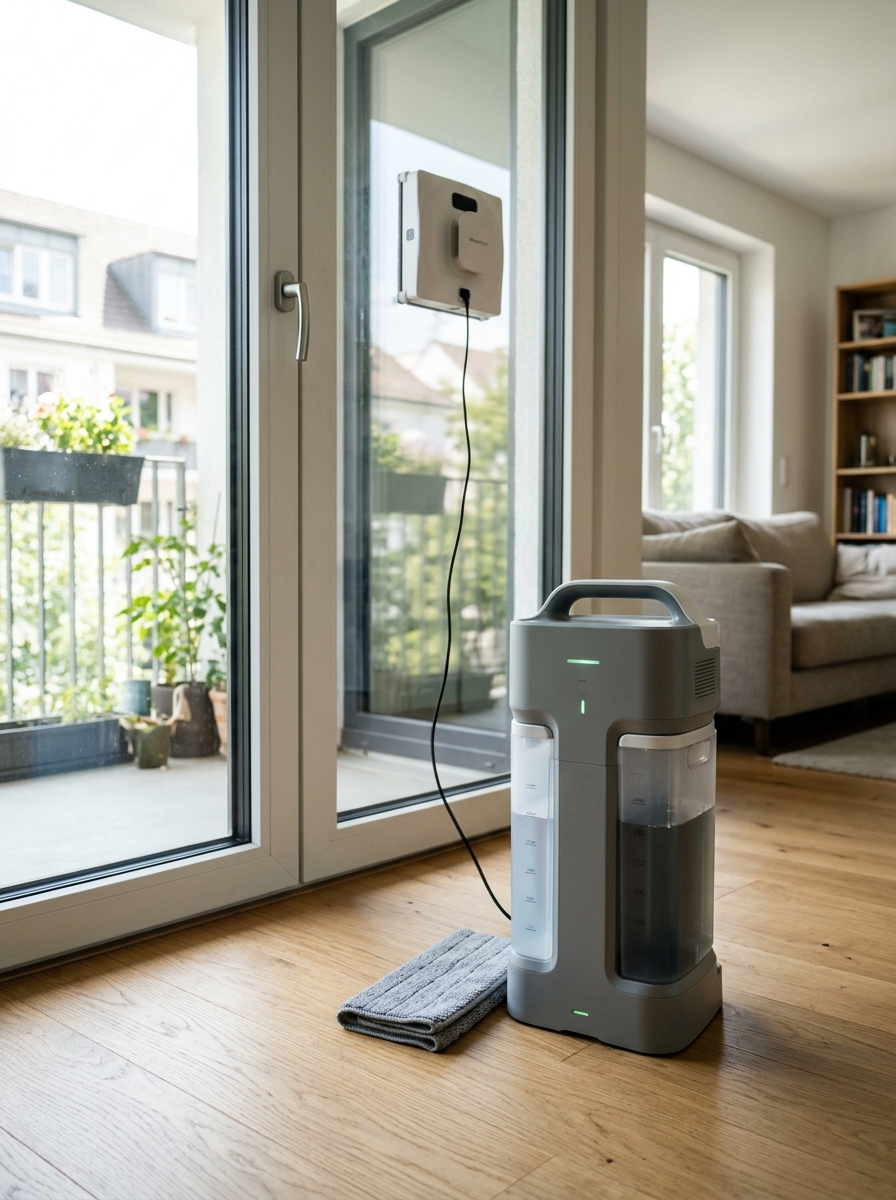
The single biggest workflow difference is the dock. After a pane, the robot returns, and the dock runs a vortex wash with jet nozzles and spinning discs, then squeezes the pad. Our W3 review describes a cycle of about a minute and a realistic rhythm of four to five minutes of dock time per window. If you clean a whole house, that is time you spend doing something else instead of rinsing microfiber in a sink.
The S7 Pro has no such dock. You take the pads off and wash them yourself, which is perfectly fine for six windows and tiresome for twenty.
The battery travels with you
Because the W3 Omni battery sits in the dock, you can place the dock on the floor beside a balcony door without hunting for a socket. The S7 Pro needs an outlet within reach of a 4 m cord, so a sunroom or a far balcony usually means an extension lead. If outlet distance is your real problem, read our cordless window robot runtime guide before choosing either.
One cable instead of two
On the W3 Omni, power and fall arrest share one composite cord. On the S7 Pro you manage a power lead and a rope. The rope needs a solid anchor point indoors, and the S7 Pro owner reviews we collected are blunt that you should always use it above ground floor.
Where the S7 Pro Wins
Price and weight
The S7 Pro costs a good deal less in the offers we tracked and has no dock to store. A robot of about 3.7 lb plus a cord fits in a cupboard. The W3 Omni dock needs a flat, dry, load-bearing spot, and our W3 review points out that you are effectively carrying twelve kilograms once the water tanks and battery are counted.
A different answer to corners
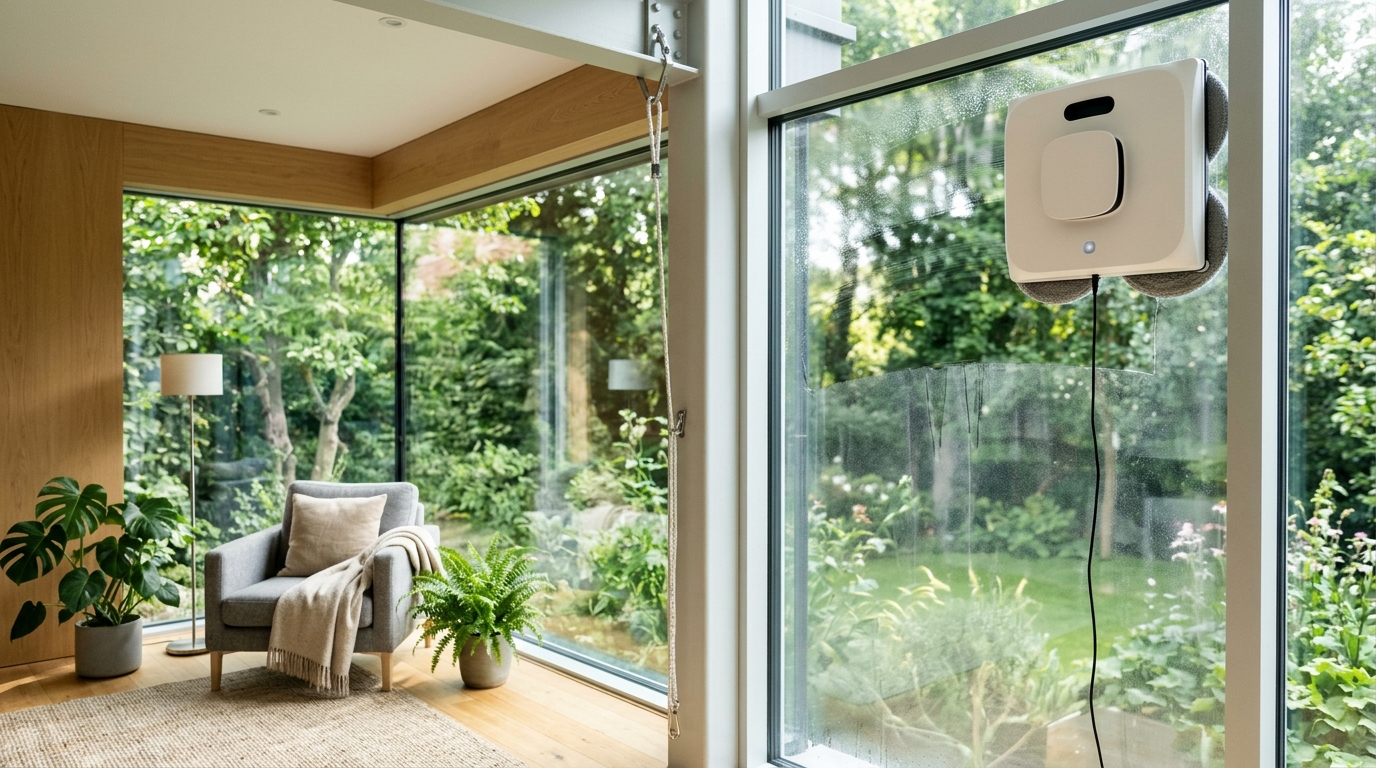
The W3 Omni uses a liftable scrubber that approaches the frame, which is clever and effective on rectangular panes. The S7 Pro simply has a square footprint with dual pads that reciprocate 600 times a minute, so the working area reaches into the corner by geometry. Owners in our review reported that it cleans corners that round-pad robots cannot reach.
Frameless glass handling
HOBOT builds its sensor system around frameless edges, using edge-leakage sensors that react when the seal starts to break at an unframed edge. If your home is mostly frameless balcony glass, our frameless glass test is worth reading alongside this one.
Real Costs You Should Add Up
- Dock footprint. A W3 Omni needs floor space near every window group. Count the places you would actually set it down.
- Extension leads for the S7 Pro. Add the cost and the trip hazard of a lead for any window further than 4 m from a socket.
- Pads and cleaner. Both machines use consumable pads. The W3 review notes that the dock is designed around the manufacturer pad and solution, so third-party substitutes may behave differently.
- Time. The dock saves hand washing but adds waiting at the dock between panes. For three or four windows that wait is not worth a premium; for fifteen it often is.
Which One for Which Home
| Your situation | Better fit | Reason |
|---|---|---|
| Large house with many fixed panes, dock space available | W3 Omni | Automatic pad washing and a battery dock |
| A few big picture windows near sockets | S7 Pro | Lower price, no dock to store |
| Balcony or sunroom with no nearby outlet | W3 Omni | Battery is in the dock |
| Windows with sharp square corners that collect dust | S7 Pro | Square body with reciprocating pads |
| Mostly frameless glass | Either, with the tether | Both have edge detection, S7 Pro is built around it |
| Tight budget | Neither, see below | Both are premium |
If neither fits your budget, our budget window robot guide covers sub-$150 options, and the HUTT A1 review is a corded mid-range alternative.
How These Two Sit in the Wider ECOVACS Line
If you are still deciding inside the Winbot family, the W3 Omni against the W2S Omni and the W3 Omni against the W2 Pro Omni pages show how much of the W3 price is the dock. For the older matchup, see how the W2 Pro Omni stacks up against the S7 Pro. Our overall window robot comparison ranks the whole field.
Questions Readers Ask
Is the ECOVACS Winbot W3 Omni better than the HOBOT S7 Pro?
It depends on what you value. The W3 Omni has the dock, the battery, and automatic pad washing. The S7 Pro is cheaper, lighter, and has a square body that reaches corners. Neither is better for every home.
Is the HOBOT S7 Pro cordless?
No. It runs on a 4 m power lead. It has a 20 minute UPS backup that only holds the robot on the glass if power drops.
How long does the W3 Omni run on its battery?
The figure we quote is about 130 minutes, which is the manufacturer claim reflected in our W3 review. Real coverage depends on spray setting and glass dirtiness.
Do I still need a safety tether?
Yes, on both. Use the tether on any window above ground level and anchor it to something solid indoors.
Which has the easier maintenance?
The W3 Omni washes its own pad but has water tanks to empty and a dock to keep clean. The S7 Pro has nothing to empty but pads you wash by hand. Our maintenance guide covers general care for either style.
Bottom Line
Choose the W3 Omni when automation and outlet freedom are worth about $240 and a dock in your hallway. Choose the S7 Pro when you have a few large panes near sockets and want strong corner coverage for less. Check current prices on Amazon for the W3 Omni and Amazon for the HOBOT S7 Pro before you decide, because both fluctuate.