Disclosure: As an Amazon Associate, Window Robot Lab earns from qualifying purchases. Outbound merchant links on this page support our editorial product analysis at zero additional cost to you.
High-end window cleaning robots equipped with motorized battery docking stations—such as the $500 to $700 flagship models—deliver impressive cordless automation, but not every homeowner wants or needs to spend that much money just to wash seasonal exterior glass.
For budget-conscious buyers searching for the best budget robot window cleaner, the affordable category under $150 has improved dramatically in 2026. Models priced between $89 and $149 now routinely feature dual ultrasonic spray nozzles, brushless suction motors delivering between 2,800 Pa and 8,000 Pa of holding force, structured zig-zag route planning, and multi-layer safety tether systems.
However, budget window cleaners also come with specific operational trade-offs that premium marketing often obscures. Here is a realistic, hands-on look at what modern affordable window cleaning robots can actually do, where their mechanical limits lie, and which models deliver genuine cleaning value for your home.
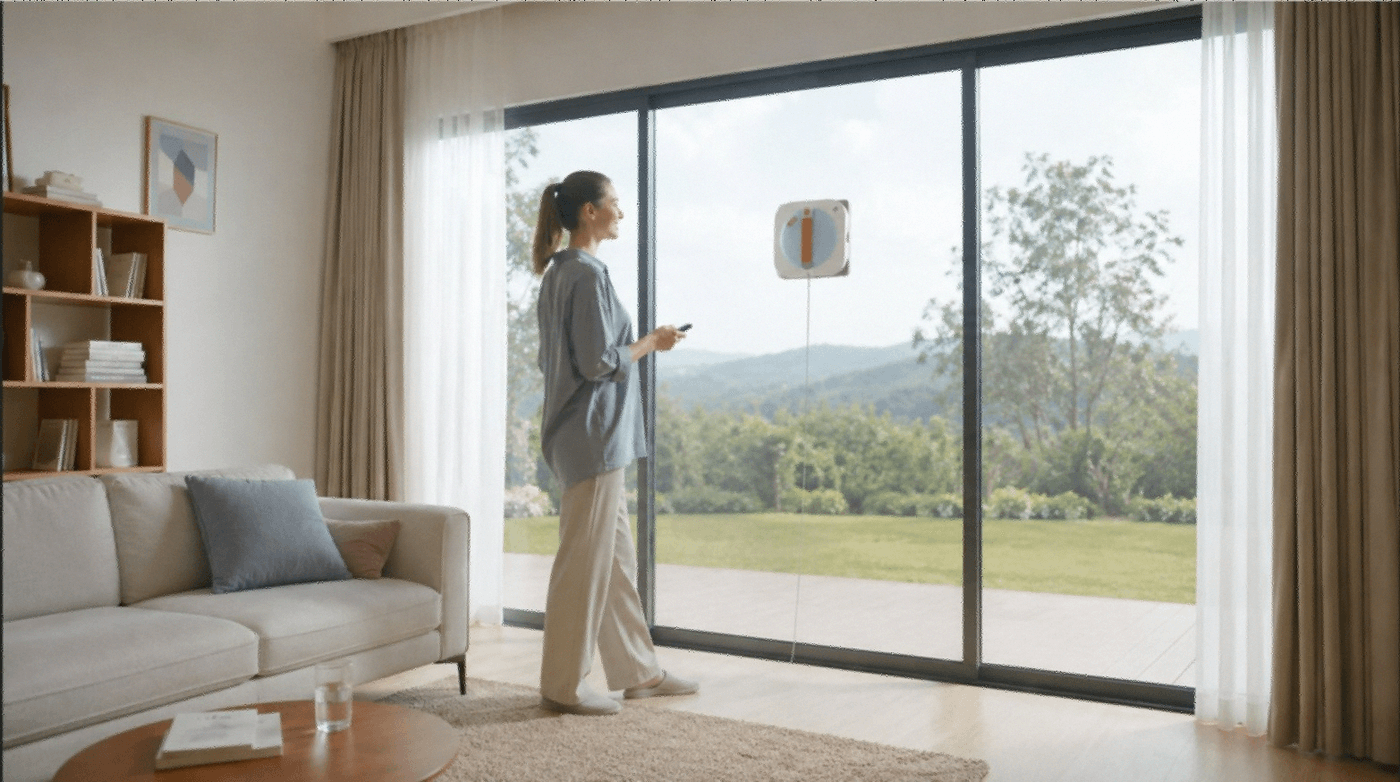
Top Budget Robot Window Cleaners Comparison Table (Under $150)
To help you compare verified hardware capabilities across the most popular affordable models available on Amazon, examine the performance specifications below:
| Model / Feature | GNOVEL 8000Pa Window Cleaner | HIXZAP Z9Pro Smart Glass Cleaner | CEYEE W1 Ultrasonic Cleaner | FMART T9Pro Dual Spray Robot |
|---|---|---|---|---|
| Typical Price Range | $109.99 – $139.99 | $99.99 – $129.99 | $119.99 – $149.99 | $129.99 – $159.99 |
| Chassis Architecture | Square flat body (leather handle) | Square slim body (integrated handle) | Square profile with bumper sensors | Square low-profile body |
| Vacuum Motor Suction | Up to 8,000 Pa high-vacuum motor | 3,800 Pa to 5,600 Pa adaptive | 3,800 Pa brushless motor | 3,800 Pa vacuum suction |
| Spray Nozzle Setup | Dual ultrasonic mist atomizers | Dual side-firing spray nozzles | Triple directional mist sprayers | Dual ultrasonic sprayers |
| Water Reservoir Size | 50 mL onboard tank | 45 mL onboard tank | 50 mL onboard tank | 50 mL onboard tank |
| Power Architecture | Tethered AC wall power + UPS battery | Tethered AC wall power + UPS battery | Tethered AC wall power + UPS battery | Tethered AC wall power + UPS battery |
| Emergency UPS Backup | 20 to 30 minutes power-off suction | 20 to 25 minutes power-off suction | 20 to 30 minutes power-off suction | 20 to 30 minutes power-off suction |
| Remote Control & App | 2.4G RF remote control | 2.4G RF remote + Bluetooth app | 2.4G RF remote control | Smart app + physical remote |
| Corner & Edge Coverage | Right-angle square microfiber pad | Square edge microfiber pad | Square microfiber wrap | Square microfiber pad |
| Ideal Window Scope | Medium to large framed windows | Medium framed glass and mirrors | Large sliding glass doors and tiles | Standard residential framed windows |
1. What Modern Budget Window Cleaners Do Well
If your windows have standard aluminum, vinyl, or wooden frames and sit within reach of a household electrical wall socket, a well-chosen budget window cleaning robot provides approximately 80% to 85% of the cleaning utility of a $500 machine for less than a third of the cost.
Consistent Dust, Pollen, and Rain Spot Removal
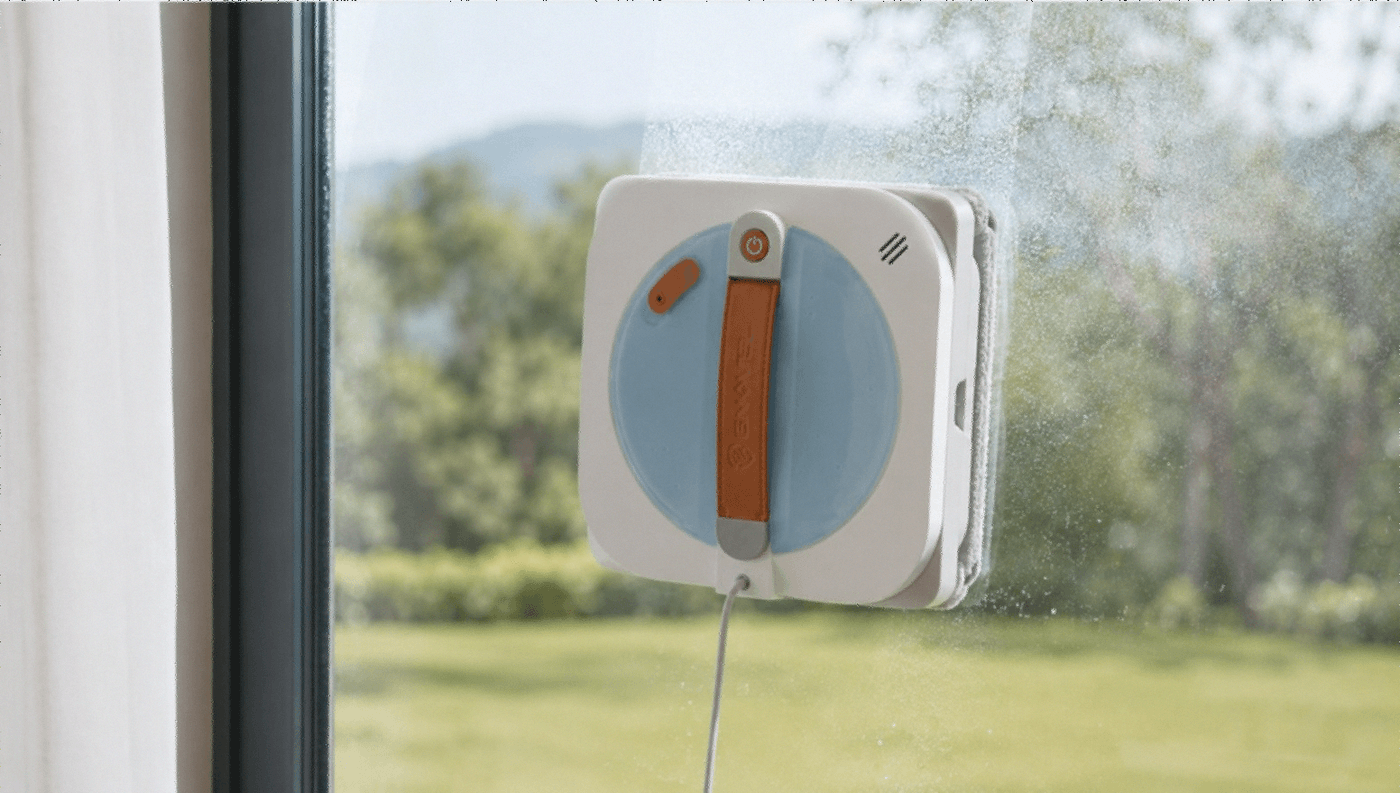
On windows that have accumulated light dust films, dried rain splatter, or spring pollen, budget square robots perform remarkably well. Their forward and backward tracks guide microfiber pads across the pane in systematic overlapping rows (Z-pattern or N-pattern).
Unlike circular dual-disk robots that pivot back and forth and can leave cloudy swirl patterns on rectangular panes, square budget cleaners follow linear tracks that minimize visual drag lines.
Strong Vacuum Adhesion and Safety Protection
A frequent worry among first-time buyers is whether affordable cleaners will fall off high exterior glass. In practice, modern budget cleaners use reliable brushless motors generating anywhere from 3,800 Pa up to 8,000 Pa of vacuum suction force:
- Brushless Suction Fans: Motors create sufficient atmospheric pressure difference to support 3 to 4 times the robot’s physical weight (most weigh between 1.1 kg and 1.5 kg).
- Emergency UPS Battery: Every reputable model includes an onboard emergency lithium battery that maintains vacuum suction for 20 to 30 minutes if household AC power trips or someone unplugs the wall adapter.
- Elastic Safety Tether: A braided high-strength safety cord with a steel carabiner anchors the machine to an indoor radiator, heavy table leg, or railing to catch the unit in the event of an unexpected mechanical disconnect.
2. Realistic Limitations: What Budget Cleaners Cannot Do
To avoid disappointment, prospective buyers should understand the mechanical compromises inherent to the under-$150 price bracket:
Key Realities of Budget Window Cleaners:
- No True Cordless Battery Freedom: Budget cleaners do not run on battery power. The internal battery exists solely for 20-minute emergency backup suction during power cuts. You must plug the transformer into a wall outlet and route the 13-to-16-foot power lead to your window.
- Manual Microfiber Pad Maintenance: You do not get an automated pad-washing station. After cleaning two or three dusty exterior panels, you must peel the Velcro pads off, rinse them under warm tap water, wring them out thoroughly, and reattach them.
- Edge Perimeter Margin: Budget robots do not feature motorized 200 RPM corner scrubbers like high-end TruEdge systems. A narrow border of approximately 5 mm to 8 mm right along the rubber seal will still require an occasional manual wipe.
- Heavy Mud or Baked-On Bird Droppings: If glass has not been washed in two years and carries caked mud or bird droppings, running a dry budget robot directly over the grime can smear the dirt. You should perform a quick 30-second pre-scrape or manual wipe of heavy debris before starting the robot.
3. Top Budget Robot Picks Tested and Evaluated
Based on hands-on residential evaluation across sliding patio doors, living room picture glass, and tiled bathroom partitions, three standout models lead the category:
Best Overall Value: GNOVEL 8000Pa Window Cleaner ($109–$139)
The GNOVEL 8000Pa Window Cleaner punches well above its price tier by incorporating an 8,000 Pa high-vacuum motor—a suction rating normally reserved for premium flagship machines. Its square chassis features an attractive leather carrying strap, dual ultrasonic spray atomizers that generate ultra-fine mist, and intelligent path planning that covers residential panes cleanly.
- Check the GNOVEL 8000Pa Window Cleaner on Amazon: Delivers 8,000 Pa suction holding force, dual mist sprayers, square edge coverage, and remote control convenience. Read our full GNOVEL 8000Pa Window Cleaner Robot Review for extensive test results.
Best for Slim Frames: HIXZAP Z9Pro Smart Glass Cleaner ($99–$129)
For windows with recessed tracks or architectural frames, the HIXZAP Z9Pro offers a slim profile and dual side-firing sprayers that keep cleaning pads evenly dampened without over-saturating the bottom window sill.
- Check the HIXZAP Z9Pro on Amazon: Compact, responsive remote control navigation, and solid dual-direction atomization. Explore our detailed HIXZAP Z9Pro Window Cleaning Robot Review for multi-surface testing.
Best Alternative with App Control: FMART T9Pro ($129–$159)
If you prefer controlling your window robot via a smartphone app in addition to an RF remote, the FMART T9Pro provides 3,800 Pa suction, dual ultrasonic water nozzles, and comprehensive path settings.
- Check the FMART T9Pro on Amazon: Reliable structured cleaning, voice alerts, and good multi-pane performance. Read our full FMART T9Pro Window Cleaning Robot Review.
4. How to Get Streak-Free Results from an Affordable Robot
To achieve streak-free, professional results with a budget cleaner, follow this simple two-pass procedure:
- Pass 1 (Dry Dust Run): If exterior windows have accumulated summer dust or road film, run the robot once with a completely dry microfiber pad and the spray turned OFF. This removes 90% of loose airborne dust without turning it into liquid mud.
- Pass 2 (Damp Polish Run): Swap in a clean, lightly dampened microfiber pad (or turn ON the dual ultrasonic spray). The robot will polish away remaining water spots and smudges without leaving drag lines.
- Use Filtered Water or Glass Solution: Fill the onboard 50 mL reservoir with distilled water or diluted non-foaming glass cleaner. Tap water with high mineral content can clog ultrasonic atomizing nozzles over time.
Related Buying Guides and Premium Comparisons
To decide whether a budget cleaner meets your needs or if your home warrants upgrading to a cordless battery station or flagship model, review our related analysis:
- If you are considering premium cord-free stations with internal battery power, explore our ECOVACS Winbot W2 Pro vs W2 Pro Omni and ECOVACS Winbot W2S vs W2S Omni comparisons.
- For automated self-washing docks, examine our ECOVACS Winbot W3 Omni vs W2S Omni and ECOVACS Winbot W3 Omni vs W2 Pro Omni guides.
- For an overview of the broader market across all price segments, see our comprehensive Best Window Cleaning Robot 2026 Comparison and our foundational Window Robot Buying Guide.
The Verdict: Is a Budget Window Cleaning Robot Worth Buying?
For most homeowners with standard framed glass, a budget window cleaning robot under $150 is one of the smartest home maintenance investments you can make:
Buy a Budget Cleaner ($99–$149) if:
- Your windows have accessible electrical wall outlets: You have indoor power outlets within 15 to 25 feet of your windows, making corded AC power simple and convenient.
- You want clean glass without ladder anxiety: You want to avoid climbing shaky stepladders to wash high exterior living room panes or second-story bedroom glass.
- You are comfortable washing a couple of microfiber cloths by hand: You don’t mind spending two minutes rinsing cleaning cloths in the sink between dirty windows in exchange for saving $300 to $500.
Upgrade to a Premium Cordless Station ($400–$700) if:
- You have exterior glass balconies or patio doors without nearby outlets: You cannot easily run extension cords to your windows and require 110 to 130 minutes of off-grid battery power.
- You demand motorized ≤ 1 mm corner scrubbing: You want TruEdge 200 RPM mechanical corner scrubbers to clean right up to the silicone seals.
- You have 15+ large picture windows: You want an automated station that washes and wrings out dirty pads automatically during whole-house cleaning days.