Quick Verdict: If you can buy the ECOVACS Winbot W2 Pro (or the wall-powered Winbot W2S) within $50 to $70 of the older Winbot W1 Pro, buy the W2 generation every time. While the W1 Pro introduced cross-spray wet cleaning to the Winbot lineup and still cleans flat standard panes reliably, living with it reveals three daily annoyances that the W2 series directly fixed: a separate safety rope and power cord that twist around each other during vertical passes, a 2-nozzle spray pattern that gets blown off-target by exterior wind, and slower corner turns that leave a wider uncleaned border along thick rubber window gaskets. Only choose the ECOVACS Winbot W1 Pro on Amazon if you find it on clearance under $230 for medium indoor windows. For faster coverage, cleaner edges, and tangle-free cabling, step up to the ECOVACS Winbot W2 Pro on Amazon or the ECOVACS Winbot W2S on Amazon.
Why Shoppers Still Compare the Winbot W1 Pro and W2 Pro in 2026
When ECOVACS launched the Winbot W1 Pro (and its regional sibling, the Winbot W1S Pro), it solved the biggest complaint owners had with earlier single-nozzle window robots: dry dragging. By mounting dual cross-spray nozzles on opposite sides of the chassis, the W1 Pro could wet the glass ahead of its path in both horizontal directions.
Because the W1 Pro remains in stock at third-party retailers and warehouse clearance sales for significantly less than flagship station models like the ECOVACS Winbot W2 Pro Omni or Winbot W3 Omni, buyers frequently ask whether the second-generation Winbot W2 Pro (and Winbot W2S) is merely a cosmetic refresh or a genuine mechanical overhaul.
After running both generations side by side on double-glazed apartment casement windows, balcony sliders, and frameless interior partitions, the mechanical gap is much wider than the spec sheet suggests.
Core Specifications: Winbot W1 Pro vs Winbot W2 Pro (and W2S)
Before looking at how they behave on dirty glass, here is how the older W1 Pro stacks up against the current W2 Pro and W2S hardware.
| Specification | ECOVACS Winbot W1 Pro / W1S Pro | ECOVACS Winbot W2 Pro (and W2S) | Practical Impact on Glass |
|---|---|---|---|
| Maximum Suction Power | 2,800 Pa (up to 5,300 Pa on W1S Pro variant) | 5,500 Pa (up to 8,000 Pa on W2S / W2S Omni) | W2 generation grips wet glass and condensation lines with less track slippage |
| Water Spray Architecture | Dual-direction 2-nozzle cross-spray | Dual-side 3-nozzle wide-angle atomization | W2 covers 90% of the pad width per burst and resists wind drift |
| Water Tank Volume | 60 ml | 60 ml (80 ml on W2S series) | Both cover roughly 20 to 25 sq. meters per refill |
| Navigation System | WIN-SLAM 3.0 | WIN-SLAM 4.0 with upgraded brushless motor | W2 turns 30% faster at frame edges without stalling |
| Cable and Safety Line Design | Separate AC power cord + separate braided safety rope | 2-in-1 composite power and safety cable | W1 cords frequently twist together; W2 uses a single smooth line |
| Edge & Frame Clearance | Leaves roughly 10 to 12 mm at corners | Dedicated Edge Clean mode (down to 4 to 5 mm along straight frames) | W2 removes noticeably more perimeter dust buildup |
| Cleaning Modes | Fast, Deep, Spot (3 modes) | Fast, Deep, Thorough, Edge, Spot, Zone (up to 6 modes) | Dedicated Edge mode on W2 is a major advantage for neglected frames |
| Outage Backup Battery | 650 mAh (approx. 30 mins emergency hold) | 650 mAh on plug-in units (or full 110-min station battery on Omni) | Equal 30-minute power-failure hold on wall-powered units |
| Typical 2026 Street Price | $229 to $279 | $299 to $369 (plug-in) / $449+ (Omni station) | W2 costs more upfront but saves 15+ minutes per multi-window session |
Model Naming Note: Depending on your region and retailer, the W2 generation is sold either with the portable battery suitcase (Winbot W2 Pro Omni / W2S Omni) or as a wall-powered unit (Winbot W2 Pro / Winbot W2S). If you want the exact breakdown between the wall-powered and station bundles, read our ECOVACS Winbot W2 Pro vs W2 Pro Omni comparison and our Winbot W2S vs W2S Omni test.
Four Real-World Differences We Found During Testing
1. Dual Cross-Spray (W1 Pro) vs Three-Nozzle Wide-Angle Spray (W2 Pro)
On the Winbot W1 Pro, each side of the robot uses two crossing streams that intersect a few inches in front of the chassis. Indoors on calm glass, this works fine. Outdoors on a breezy third-floor balcony, however, those two high-arcing streams break into fine mist that drifts away before hitting the glass, leaving the outer 3 centimeters of the microfiber pad bone dry. When a dry pad edge drags across dried rain spots, it leaves faint chalky tracks along the top of every horizontal pass.
The Winbot W2 Pro replaces that intersecting dual jet with a three-nozzle wide-angle spray manifold running at higher water pressure with larger droplets. Instead of spraying high into the air, the three nozzles fan out evenly across the full width of the cleaning path. Even in a moderate crosswind, the glass immediately ahead of the leading mop edge gets uniformly dampened. On baked-on pollen and coastal salt film, the W2 Pro cleared panes in a single Deep Clean cycle that required two separate passes with the W1 Pro.
2. Separate Cords vs Composite Single-Line Routing
If you have never used a window cleaning robot before, cable management sounds like a minor detail. In real use, it is the single biggest difference between the W1 Pro and W2 Pro.
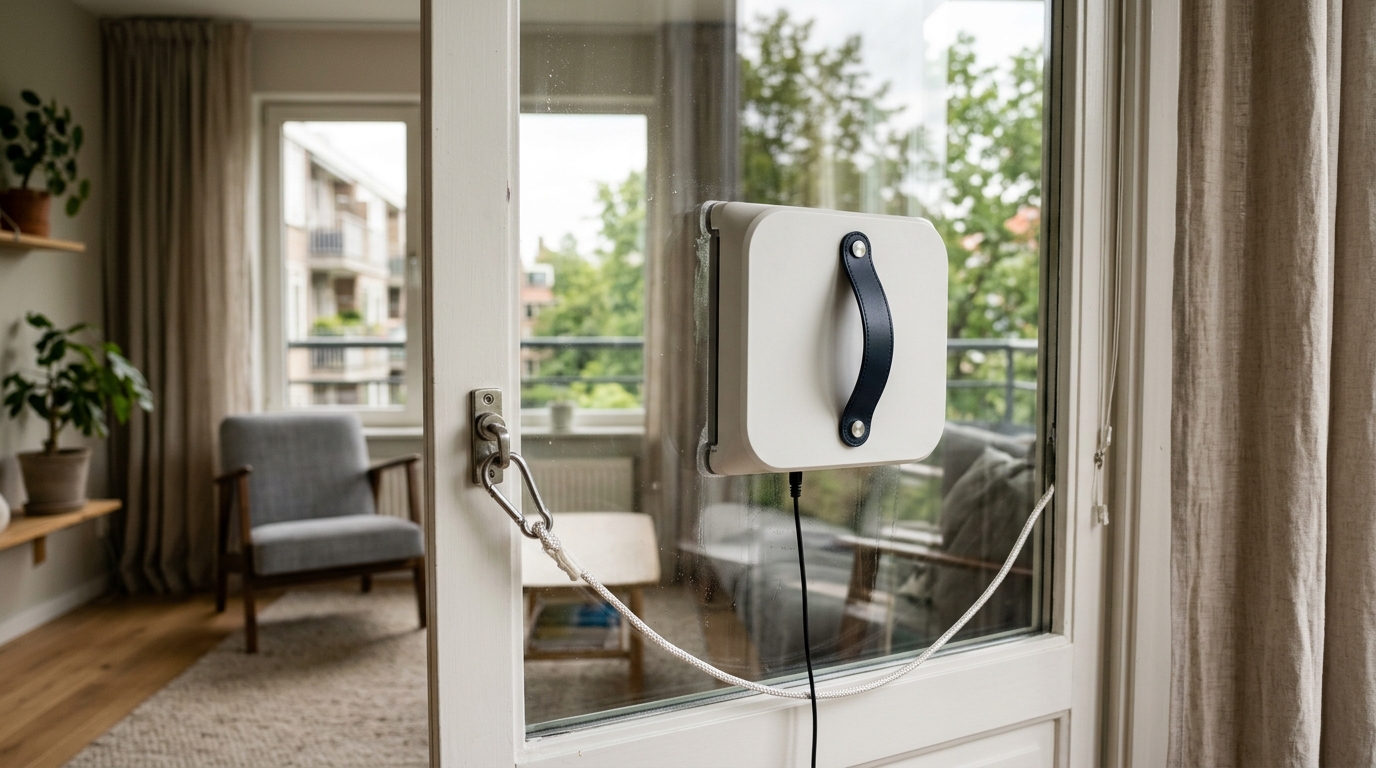
The Winbot W1 Pro has two separate lines coming off the robot: a black power cable and a white braided safety rope. After the robot completes five or six vertical S-turns on a tall patio slider, those two lines inevitably wrap around one another. You end up pausing the robot halfway through a job just to untwist the safety rope from the power brick cord so it stops tugging on the robot’s rear corner.
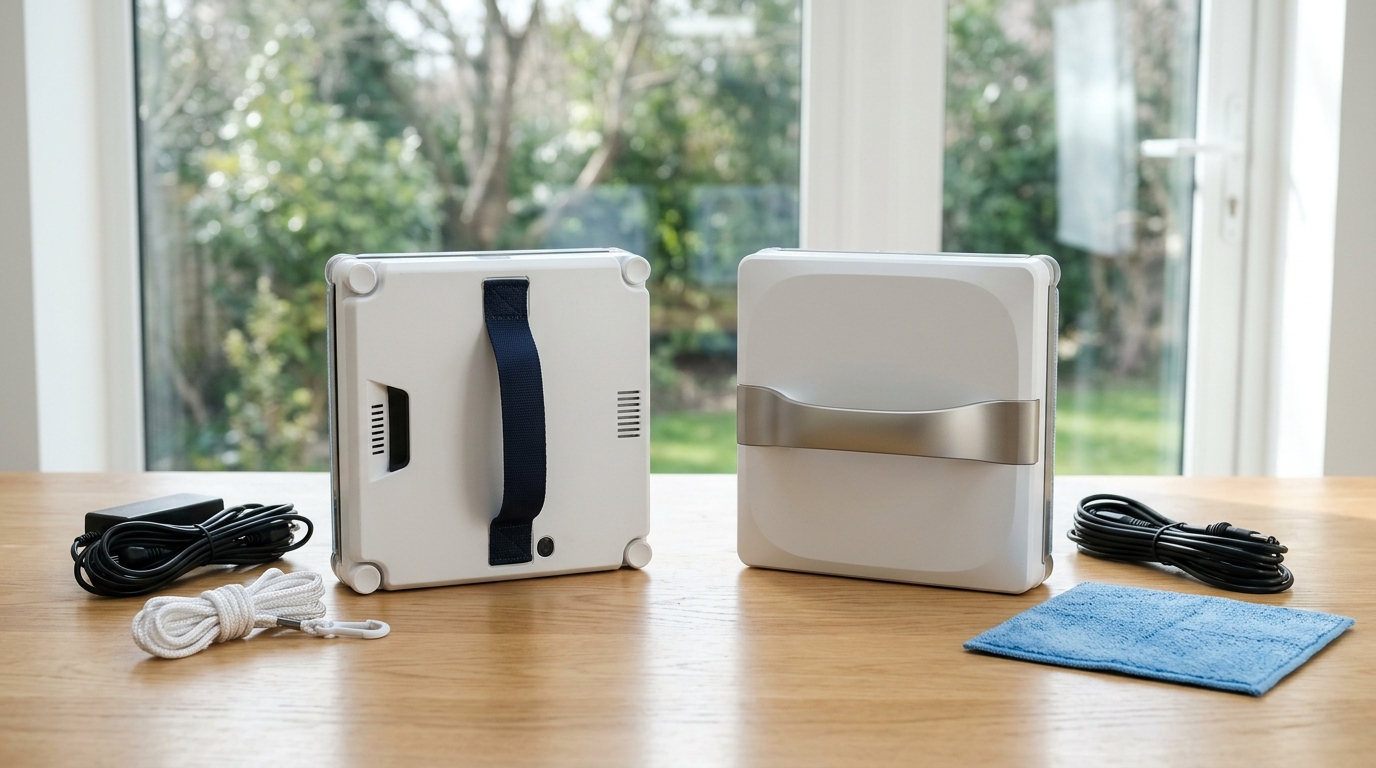
On the Winbot W2 Pro (as well as the Winbot W2S), ECOVACS merged the power wire and the tensile safety line into a single 2-in-1 composite tether. There is only one smooth jacketed cable trailing from the chassis. It never knots around itself, never catches on window latches the way a loose braided rope loop does, and coils up in twenty seconds when you finish cleaning.
3. WIN-SLAM 3.0 vs WIN-SLAM 4.0: Speed and Corner Stalls
Both robots use a square body with dual rubber drive treads and corner optocoupler sensors to detect frameless edges. However, the W1 Pro’s older WIN-SLAM 3.0 logic and drive gearing pause noticeably every time the robot bumps into a vertical window frame. It hits the frame, backs up slightly, waits nearly a full second, rotates 90 degrees, inches down, and rotates again.
With WIN-SLAM 4.0 and an upgraded brushless drive motor, the Winbot W2 Pro executes those frame transitions in a continuous fluid pivot. Across a standard 1.5 m by 2.0 m sliding glass door, the W2 Pro finished a full Deep Clean pass roughly 28% faster than the W1 Pro while making less gear whine during turns.
More importantly, the W1 Pro occasionally loses vacuum seal for a split second when its front bumper rides up onto thick, beveled rubber weatherstripping around older aluminum windows. The W2 Pro’s revised floating mop plate and higher 5,500 Pa baseline suction keep the vacuum chamber sealed tight over uneven perimeter seals.
4. Edge Cleaning and Frame Build-Up
Most residential window dirt accumulates along the bottom 2 centimeters of the frame where rainwater pools and evaporates. The Winbot W1 Pro only offers three cleaning modes (Fast, Deep, and Spot) and treats edges as simple turn-around boundaries.
The Winbot W2 Pro adds a dedicated Edge Clean mode and redesigned corner guide wheels that let the pad ride closer to the window casing without binding the rubber treads. Neither square robot can reach the absolute 1-millimeter dead corner (for recessed vibrating scrub pads, see our ECOVACS Winbot W2 Pro Omni vs HOBOT S7 Pro comparison), but along the straight horizontal and vertical borders, the W2 Pro leaves a 4 to 5 mm margin compared to the 10 to 12 mm dusty strip left behind by the W1 Pro.
Pros and Cons Breakdown
ECOVACS Winbot W1 Pro (and W1S Pro)
Pros:
- Lower clearance price makes it an accessible entry point into dual-spray ECOVACS hardware.
- Solid 30-minute backup battery hold and voice status alerts (much clearer than cheap buzzer-only robots).
- Uses standard rectangular wash pads that are inexpensive to buy in bulk packs.
Cons:
- Separate power cord and safety rope twist together constantly during multi-window sessions.
- Two-nozzle cross-spray loses effectiveness in outdoor breezes and leaves dry outer strips on wide panes.
- Slower corner turns and no dedicated Edge Clean mode.
Check Price: View ECOVACS Winbot W1 Pro / W1S Pro on Amazon
ECOVACS Winbot W2 Pro (and Winbot W2S)
Pros:
- Three-nozzle wide-angle spray wets the entire width of the pad evenly, even on breezy exterior balcony glass.
- Single 2-in-1 composite safety and power cable completely eliminates two-cord tangling.
- WIN-SLAM 4.0 navigation cuts cleaning time by nearly a third and includes dedicated Edge and Zone modes.
- Available either as a lighter wall-powered unit or bundled with the 5.2 kg portable battery station (W2 Pro Omni).
Cons:
- Higher retail price than discounted W1 Pro stock.
- Like all full-size 27 cm square Winbot units, it requires panes at least 30 cm by 40 cm (for narrow bathroom or French panes, read our ECOVACS Winbot Mini vs W2 Pro comparison).
Check Price: View ECOVACS Winbot W2 Pro on Amazon | View ECOVACS Winbot W2S on Amazon
Step-by-Step Buying Recommendation: Should You Buy W1 Pro or Upgrade to W2 Pro?
- Choose the ECOVACS Winbot W1 Pro if: You are shopping on a strict sub-$240 budget, your windows are mostly sheltered indoor or courtyard panes where wind will not blow the 2-nozzle spray off course, and you still want genuine ECOVACS navigation rather than a generic budget clone (see our Best Budget Robot Window Cleaner Guide for sub-$150 options).
- Choose the ECOVACS Winbot W2 Pro (or W2S) if: You are buying your primary home window robot for 2026 and clean 6 or more large panes per session. The 3-nozzle spray, composite tangle-free cable, faster WIN-SLAM 4.0 turns, and Edge Clean mode easily justify a $50 to $80 price premium.
- Should existing Winbot W1 Pro owners upgrade? If your W1 Pro still holds suction and you only clean a few bedroom windows twice a year, keep it and replace the microfiber pads regularly (follow our Winbot Maintenance Guide). However, if you moved into a home with floor-to-ceiling patio glass or outdoor balcony railings without nearby wall outlets, upgrading to the station-equipped ECOVACS Winbot W2 Pro Omni on Amazon is a massive quality-of-life leap.
Frequently Asked Questions (FAQ)
What is the main difference between the ECOVACS Winbot W1 Pro and Winbot W2 Pro?
The four primary upgrades on the Winbot W2 Pro are its 3-nozzle wide-angle spray system (replacing the W1 Pro’s 2-nozzle cross-spray), a unified 2-in-1 composite power and safety cable (replacing the W1 Pro’s separate tangling cords), faster WIN-SLAM 4.0 path planning, and higher baseline suction (5,500 Pa vs 2,800 Pa on standard W1 Pro units).
Can ECOVACS Winbot W1 Pro mopping pads fit the Winbot W2 Pro?
No. While both use square wrap-around microfiber pads attached via hook-and-loop strips, the bottom track spacing, sensor cutouts, and chassis dimensions differ slightly between the W1 Pro and W2 Pro series. Using a W1 Pro pad on a W2 Pro can partially cover the corner edge sensors or reduce vacuum seal integrity.
Does the Winbot W1 Pro or W2 Pro work better on frameless glass?
The Winbot W2 Pro is noticeably safer and more reliable on frameless glass. Its faster WIN-SLAM 4.0 processing and upgraded corner optocouplers react more quickly when approaching an unframed drop-off, whereas the W1 Pro takes slightly longer to brake and pivot. For more details on unframed shower doors and balcony dividers, see our Best Robotic Window Cleaners for Frameless Glass test.
Is the Winbot W2S better than both the W1 Pro and W2 Pro?
The ECOVACS Winbot W2S builds on the W2 Pro platform by adding TruEdge corner brushes and boosting maximum suction up to 8,000 Pa. If the W2S is priced within $20 to $30 of the W2 Pro, the W2S is the better buy for heavy exterior grime.