Disclosure: As an Amazon Associate, Window Robot Lab earns from qualifying purchases. Outbound merchant links on this page support our editorial product analysis at zero additional cost to you.
People who search for “Winbot Mini vs W2 Pro” usually have one specific window in mind. Either it is a narrow bathroom pane that a full-size robot cannot fit on, or it is a wall of glass that a small robot would take forever to cover. The two machines sit at opposite ends of the ECOVACS lineup, and the right pick depends almost entirely on the size and layout of the glass you want cleaned.
Short answer: buy the Winbot Mini line (the current model is the Mini 2) if your windows are small, narrow, or divided into grids. Buy the Winbot W2 Pro with its portable station if you have large panes, sliding doors, or glass that is far from a wall outlet.
Winbot Mini vs W2 Pro: Specifications Side by Side
The figures below come from the manufacturer’s published specifications. Street prices move around with promotions, so treat the price row as a typical range rather than a fixed number.
| Specification | ECOVACS Winbot Mini 2 | ECOVACS Winbot W2 Pro Omni |
|---|---|---|
| Maximum suction | 8,000 Pa | 5,500 Pa |
| Minimum window size | 25 cm × 25 cm | 30 cm × 40 cm |
| Robot weight | About 1.3 kg | About 1.6 kg (± 0.1 kg) |
| Power setup | Corded, adapter on the floor | Portable station with built-in battery, plus plug-in mode |
| Cable arrangement | Power lead plus separate safety rope | Single braided power-and-safety cable on a motorized winch |
| Typical price range | Roughly $240 to $350 | Roughly $380 to $500 |
| Best suited for | Small, narrow and grid-style windows, mirrors, shower glass | Large panes, patio doors, balconies, high glass |
Two things in that table surprise people. First, the smaller robot has the stronger suction rating. Second, the larger robot is the only one of the pair that can run without a wall socket.
Why the Smaller Robot Has More Suction
The Mini 2 is rated at 8,000 Pa and the W2 Pro Omni at 5,500 Pa. That looks backwards until you consider what each machine has to do.
How to read the numbers: Suction has to hold the robot’s weight against the glass, and it has to keep a seal along the edge of the cleaning pad. A smaller, lighter body with a smaller seal perimeter can reach a high rating from a compact fan. The bigger body needs less pressure per square centimeter because it is spread over a larger pad. Both ratings are well above what a 1.3 to 1.6 kg robot needs to hold on vertical glass.
In day-to-day use this means holding power is not the deciding factor. Either robot stays put on a clean double-glazed window. The differences that matter are size, cabling and coverage speed.
Window Size and Layout: The Real Deciding Factor
Where the Mini wins
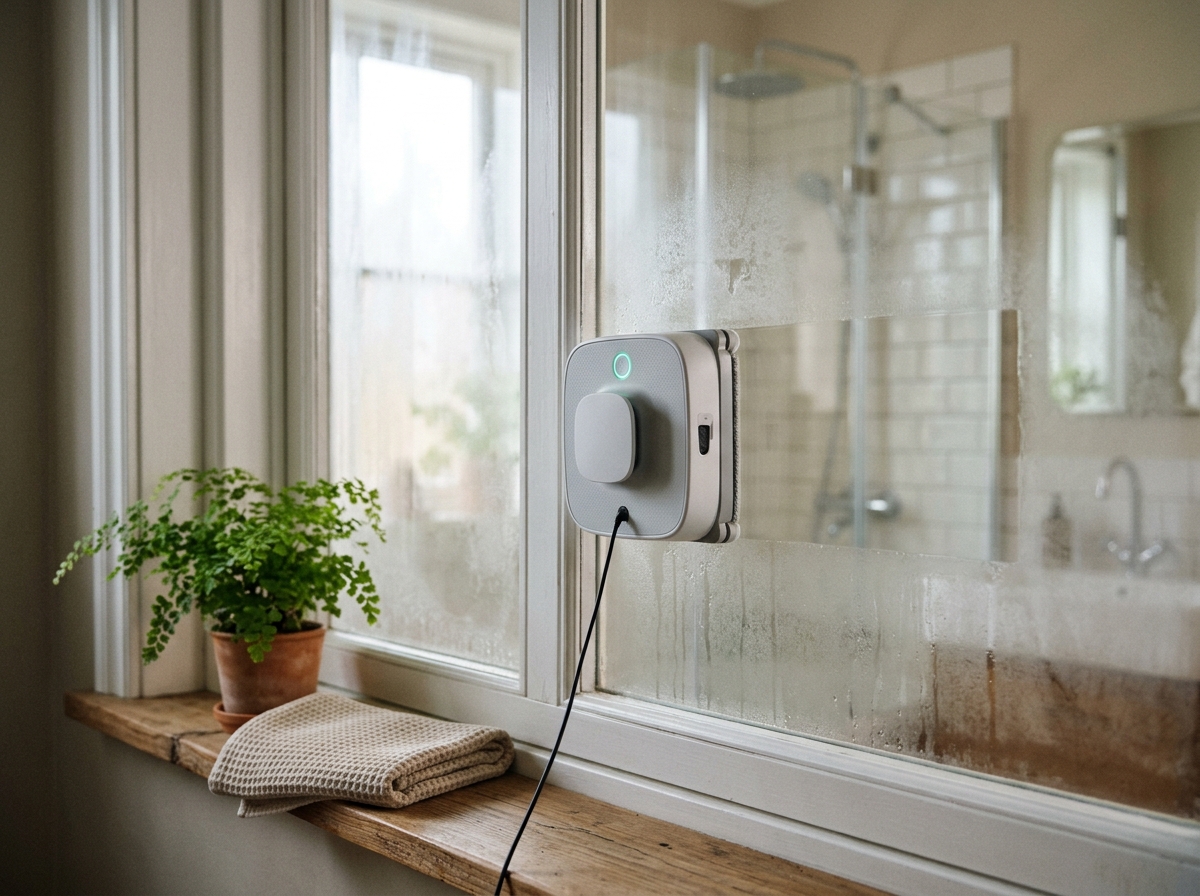
The Mini 2 can operate on glass as small as 25 cm × 25 cm, with a body about 21.5 cm per side. That is small enough for:
- Narrow bathroom windows and frosted vents.
- Grid-style windows with muntins, where each pane is small.
- Shower enclosures and vanity mirrors.
- Narrow side windows in vans, campers and tight stairwells.
The W2 Pro Omni asks for at least 30 cm × 40 cm of free glass. On a 28 cm wide pane it simply will not seat properly, and the edge sensors will refuse to start or keep stopping.
Where the W2 Pro wins
A small robot covers glass slowly. On a big living room pane it has to make many more passes, so a task that takes the W2 Pro a few minutes can run several times longer on the Mini. The W2 Pro also leaves fewer overlap lines because its wider pad covers more width per pass.
Power and Cables: Corded Mini vs Portable Station
This is the second big difference.
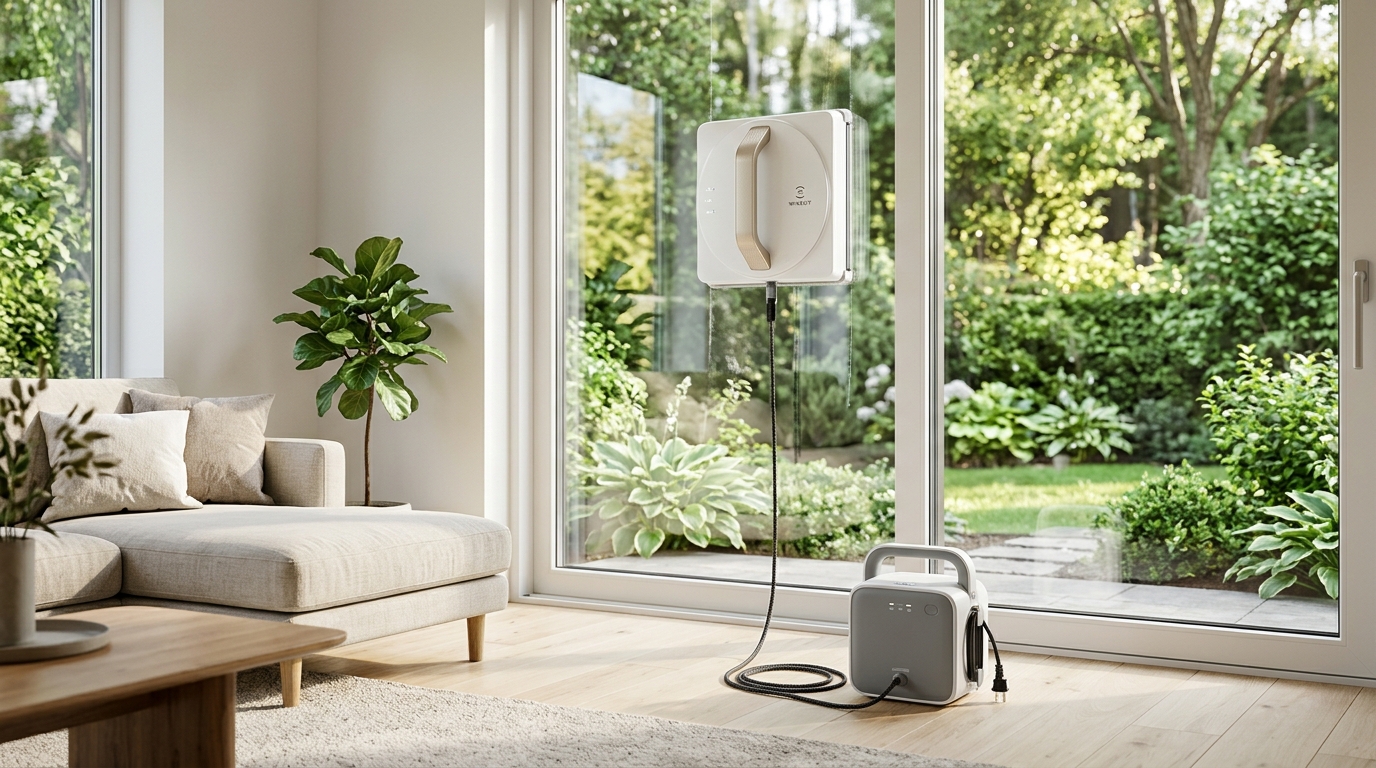
The Mini 2 is a corded appliance. A power adapter sits on the floor, a lead runs up to the robot, and a safety rope clips to something solid above the window. For interior windows that is perfectly fine. For an exterior pane you need an outdoor socket or an extension lead running through an open window.
The W2 Pro Omni ships with a portable station that carries a rechargeable battery and a motorized cable winch. One braided cable carries both power and the load-bearing safety line, so there is no second cord to untangle. You can set the station on a balcony floor and clean without hunting for a socket, or plug it in for unlimited running time. If you want the full picture on how that station behaves, read our ECOVACS Winbot W2 Pro vs W2 Pro Omni comparison and the longer ECOVACS Winbot W2 Pro review.
Edge Cleaning and Finish
Both machines are square-bodied, so they reach corners better than round robots. Neither one is built with the motorized corner scrubbers found on newer models such as the W2S and W3 series. Expect a thin strip right against the frame on either machine, and plan a quick wipe with a microfiber cloth after a run.
If edge strips bother you, the Mini 2 does have a dedicated edge routine that traces the perimeter first. We cover how well it works in our Winbot Mini vs Mini 2 comparison and the Winbot Mini 2 long-term review.
Which One Fits Which Home
| Your situation | Better choice | Reason |
|---|---|---|
| Bathroom, kitchen and stairwell windows under 40 cm wide | Winbot Mini 2 | Only one that fits narrow glass |
| Mostly sliding doors and floor-to-ceiling panes | Winbot W2 Pro Omni | Wider pad, fewer passes, faster |
| Windows with no outlet nearby | Winbot W2 Pro Omni | Battery station, no extension cord |
| Shower glass and mirrors | Winbot Mini 2 | Small footprint, strong seal |
| Mixed home, mostly small windows plus one big pane | Winbot Mini 2, then wipe the big pane or hire help occasionally | Saves roughly $150 to $200 |
| Single tight budget | Winbot Mini 2 | Lower entry price |
If your budget is tighter than both, our best budget robot window cleaner guide lists corded options in the lower price brackets.
Pricing and Where to Buy
Both models are sold through Amazon with manufacturer warranty:
- Check the ECOVACS Winbot Mini 2 on Amazon: the compact corded model for small and narrow windows.
- Check the ECOVACS Winbot W2 Pro on Amazon: the larger robot with the portable battery station for big glass.
Frequently Asked Questions
Can the Winbot Mini clean large windows?
Yes, but slowly. The robot works on any glass larger than 25 cm × 25 cm, yet a big pane means many more passes. For sliding doors and floor-to-ceiling glass the W2 Pro is the better tool.
Can the W2 Pro clean a narrow bathroom window?
Only if the glass is at least 30 cm × 40 cm. Narrower panes are too small for its body and sensors.
Does either robot work without a wall outlet?
Only the W2 Pro Omni, through its battery station. The Mini 2 is corded and needs a nearby socket.
Is the extra cost of the W2 Pro worth it?
If you clean large or hard-to-reach glass, yes, because the time saved and the cord-free operation add up. If your windows are small, the Mini 2 does the job for less.
For a wider view of the field, including newer models with corner scrubbers, see our Best Window Cleaning Robot 2026 comparison and the Window Robot Buying Guide. If the W2 Pro is on your shortlist next to the W2S, our Ecovacs Winbot W2S vs W2 Pro Omni article breaks that decision down.
Final Verdict
Pick the Winbot Mini 2 when your windows are small, narrow or divided into panes, and a corded setup is acceptable. It is the cheaper machine and the only one that fits tight glass.
Pick the Winbot W2 Pro Omni when you have large panes, patio doors or glass far from a socket. It covers ground faster, works cord-free and keeps power and safety lines in one cable.
If your home has both kinds of glass, buy for the glass you clean most often and handle the rest by hand.