Quick Answer for High-Rise and Tall Glass Owners: For exterior high-rise apartment glass and wide floor-to-ceiling windows without nearby wall outlets, the ECOVACS Winbot W2S Omni (and the closely related ECOVACS Winbot W2 Pro Omni) is the safest, most capable machine you can buy in 2026. Its 5.5-meter 2-in-1 composite tether, 5.2 kg weighted floor station with 800 N bottom suction pods, and wind-resistant 3-nozzle water spray eliminate extension-cord clutter and mid-air cable tangles. If you have indoor AC outlets right next to your tall windows and want deep corner scrubbing on gritty exterior frames, the wall-powered HOBOT S7 Pro and ECOVACS Winbot W2S are top-tier corded alternatives. For budget-conscious high-rise renters who only clean medium casement panes, the AlfaBot GLS480 and Tosima W5 provide dependable suction and 30-minute UPS battery protection under $220.
Why High-Rise and Tall Vaulted Windows Break Ordinary Window Robots
Testing a window cleaning robot on a ground-floor patio door is forgiving. If a budget robot runs out of water, snags its power brick on a door handle, or loses vacuum over a rubber gasket, you simply walk outside and pick it up.
Put that same robot on the outside of a 19th-floor condominium window or 4 meters up an indoor two-story vaulted living room wall, and three real physical problems show up immediately:
- Crosswinds Blow Ultrasonic Mist Away: Above the 8th floor, steady updrafts and crosswinds are normal. Robots that rely on a single low-pressure ultrasonic nebulizer produce a cloud of tiny 15-micron droplets that wind blows completely off the glass. Within two minutes, the microfiber pad dries out, loses surface friction, and leaves gray smear lines.
- Short Power Leads Leave the Power Brick Dangling in Mid-Air: Many corded window robots advertise a 5-meter total reach, but when you measure the actual cables in the box, the AC wall cord (from the outlet to the heavy transformer brick) is only 1.2 meters long. When the robot climbs 3.5 meters up a tall clerestory window, it lifts the heavy power brick off the floor, pulling down on the rear of the robot and causing the tracks to slip on wet turns.
- Separate Safety Ropes Twist Around Power Wires: When a robot makes eight vertical passes across a 2.4-meter-wide panoramic pane, a loose carabiner rope and a separate DC power wire wrap around each other like a corkscrew, effectively shortening your reach by half a meter.
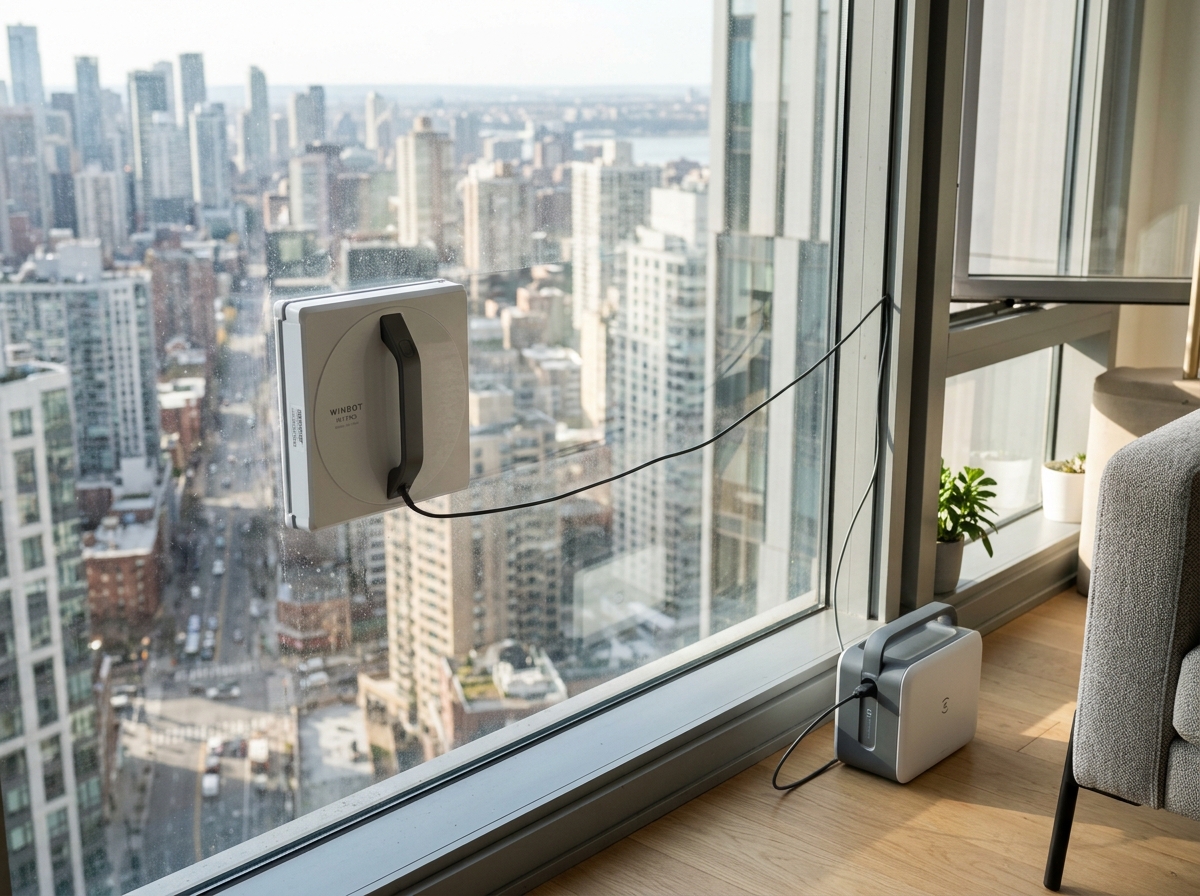
Top 5 Robot Window Cleaners for High-Rise Buildings and Large Windows (2026 Comparison)
We evaluated our tested units specifically on vertical tether reach, wind-resistant spray output, anchor security, and coverage speed per square meter.
| Model | Best Use Case | Suction & Climb System | Usable Cable / Tether Reach | Spray System in Wind | Fall-Protection Architecture | Typical Price |
|---|---|---|---|---|---|---|
| ECOVACS Winbot W2S Omni | High-rise balconies & outlet-free large glass | Up to 8,000 Pa + WIN-SLAM 4.0 | 5.5 m unified 2-in-1 composite station cable | 3-nozzle wide-angle pressure jets (excellent in wind) | 5.2 kg station + 800 N floor suction cup + 110-min battery | $549 to $599 |
| ECOVACS Winbot W2 Pro Omni | Whole-home multi-pane high windows | 5,500 Pa + WIN-SLAM 4.0 | 5.5 m unified 2-in-1 composite station cable | 3-nozzle wide-angle pressure jets (excellent in wind) | 5.2 kg station + 800 N floor suction cup + 110-min battery | $449 to $499 |
| ECOVACS Winbot W2S (Corded) | Tall indoor/outdoor panes near wall outlets | Up to 8,000 Pa + TruEdge brushes | 4.7 m to 5.5 m unified AC/safety cord + carabiner | 3-nozzle wide-angle pressure jets (excellent in wind) | 30-min UPS battery + 1,900 N tensile safety tether | $319 to $369 |
| HOBOT S7 Pro | Gritty high-rise frames & corner grime | 4,800 Pa + dual 600 RPM reciprocating mop plates | 5.0 m DC power cord + 4.5 m high-strength safety rope | Dual ultrasonic nozzles (best in calm to light breeze) | 20-min UPS battery + 230 kgf safety rope | $469 to $529 |
| Tosima W5 | Mid-price high-rise casement windows | 3,000 to 6,400 Pa variable frequency | 4.8 m power cord + 4.5 m safety rope | Manual pre-spray (no wind drift issue, higher effort) | 30-min UPS backup battery + steel carabiner rope | $169 to $209 |
Detailed Reviews: How Each Robot Performs on High and Large Glass
1. Best Overall for High-Rise Exterior Glass: ECOVACS Winbot W2S Omni (and W2 Pro Omni)
When cleaning the outside of high-rise apartment glass or wide multi-panel balcony sliders, the station-equipped ECOVACS Winbot W2S Omni and Winbot W2 Pro Omni solve the two scariest parts of high-altitude window cleaning: anchoring and outlet reach.
Instead of hunting for a heavy radiator or structural bolt to clip a carabiner onto, you set the 5.2 kg portable battery suitcase on a hard indoor tile or hardwood floor. An 800 N suction cup on the base of the station locks onto the floor, acting as an automatic dead-weight anchor. If sudden suction loss ever occurs outside, the station automatically arrests the composite cable before the robot can drop more than a meter.
High-Window Reach Advantage: Because the station runs on an internal lithium battery for up to 110 minutes (covering roughly 55 square meters of glass per charge), the entire 5.5-meter length of the 2-in-1 composite cable is usable reach from the floor to the top of your glass. You never lose 1.5 meters of cord just trying to reach a wall socket behind a sofa.
Between the two station models, the W2S Omni adds higher peak suction (up to 8,000 Pa) and TruEdge corner brushes for stubborn exterior rain lines, while the W2 Pro Omni offers the exact same 5.5-meter portable station and 3-nozzle wind-resistant spray for roughly $50 to $100 less. Read our ECOVACS Winbot W2S vs W2 Pro Omni comparison for the full breakdown, or see how they compare to the larger self-washing dock in our Winbot W3 Omni vs W2S Omni test.
Check Price: View ECOVACS Winbot W2S Omni on Amazon | View ECOVACS Winbot W2 Pro Omni on Amazon
2. Best Corded Pick for Tall Indoor Vaulted Windows: ECOVACS Winbot W2S (and W2 Pro)
If your living room has tall two-story picture windows with accessible wall outlets along the baseboard, you do not necessarily need to pay extra for the battery suitcase. The wall-powered ECOVACS Winbot W2S and Winbot W2 Pro use the same fast WIN-SLAM 4.0 brushless drive motor and 3-nozzle wide-angle spray manifold as the Omni versions.
On large 2.0 m by 2.5 m glass panels, speed matters. Slower robots take 12 to 15 minutes per side, heating up their vacuum blower motors when working in direct afternoon sun. The W2S covers a 2-square-meter pane in under 4 minutes in Fast Clean mode, and its unified composite cable prevents the safety line from twisting around the power cord during long vertical climbs. If you are deciding between the older W1 generation and the W2 series for tall windows, read our ECOVACS Winbot W1 Pro vs W2 Pro comparison.
Check Price: View ECOVACS Winbot W2S on Amazon | View ECOVACS Winbot W2 Pro on Amazon
3. Best for Heavy Exterior Soot and Corner Grime: HOBOT S7 Pro
High-rise apartments facing busy city avenues accumulate sticky diesel exhaust and mineral runoff along the lower window gasket. Static mopping pads glide over that buildup, whereas the HOBOT S7 Pro uses dual reciprocating mop plates that scrub back and forth at 600 strokes per minute while neutralizing static charge on the glass.
For high-rise use, keep two practical caveats in mind with the HOBOT S7 Pro:
- Its dual ultrasonic mist nozzles work best on calm mornings; in strong 15+ mph high-floor gusts, you will need to pre-dampen the microfiber pads manually before placing the unit outside.
- It uses a traditional two-cord layout (separate DC power cable and safety rope), so you must clip the safety carabiner to an independent indoor fixture rated for at least 150 kg of pull force before setting it on exterior glass. For a head-to-head look against ECOVACS, see our ECOVACS Winbot W2 Pro Omni vs HOBOT S7 Pro comparison.
Check Price: View HOBOT S7 Pro on Amazon
4. Best Mid-Range High-Rise Alternatives: Tosima W5 and AlfaBot GLS480
Not every high-rise apartment has massive panoramic glass walls. If your condo has standard 1.0 m by 1.5 m tilt-and-turn or casement windows and you want to spend under $210, look at our long-term tests of the Tosima W5 and the AlfaBot GLS480.
The Tosima W5 uses a brushless fan that automatically ramps suction from 3,000 Pa on clean dry glass up to 6,400 Pa when it hits wet patches or rubber window seals. Because it omits an onboard water tank in favor of manual pad pre-spraying, there is no water mist for high-floor winds to blow away, and the slimmer 7.5 cm chassis fits easily behind security grilles or exterior insect screens.
Check Price: View Tosima W5 on Amazon | View AlfaBot GLS480 on Amazon
How to Calculate Whether a Window Robot Will Reach Your High Windows
Before ordering any robotic window cleaner for tall clerestory windows or high-rise exterior panes, measure three distances and compare them against the table below:
| Measurement Step | What to Measure | Why It Matters |
|---|---|---|
| 1. Anchor-to-Sill Distance | Distance from your indoor anchor point (or floor station spot) to the window opening | Consumes the first 0.8 m to 1.5 m of your safety tether before the robot even touches the glass |
| 2. Diagonal Glass Span | Diagonal distance from the bottom-near corner of the window to the top-far corner | The cable must reach the furthest upper corner without pulling taut against the window frame |
| 3. Slack Margin | Add at least 0.6 m (2 feet) of extra slack | Prevents the cable from tugging on the robot’s rear track when it pivots at the top frame |
Rule of Thumb: If your Anchor-to-Sill Distance + Diagonal Glass Span + 0.6 m Slack Margin exceeds 4.8 meters, a standard 5.0-meter corded robot will pull tight at the top corner unless you buy an official manufacturer DC extension lead. For spans between 4.0 and 5.2 meters, the 5.5-meter composite cable on the ECOVACS Winbot W2 Pro Omni is much easier to position because the battery station can sit right underneath the window sill.
Five High-Rise Safety Rules We Follow on Every Exterior Test
- Never Anchor a Safety Rope to a Curtain Rod or Blind Bracket: Drywall anchors holding up curtain rods can pull out under a sudden 30 kg shock load if a robot drops 2 meters on its tether. Always loop the safety carabiner around a heavy dining table leg, a structural radiator pipe, an indoor security bar, or use an 800 N suction-anchored Omni floor station.
- Leave 20 cm Less Slack Than the Distance to Below-Balcony Obstacles: When cleaning exterior high-rise glass, adjust the rope stopper so that if the robot ever detached from the glass, its maximum swing radius is shorter than the distance to the apartment window directly below yours.
- Fully Charge the Internal UPS Backup Battery Before First Use: Even wall-powered robots like the Winbot W2S, HUTT A1, and FMART W6 refuse to start—or will drop immediately during a tripped circuit breaker—if their internal 650 mAh backup battery has not been charged to 100% first (Wait for the indicator light to turn solid green before mounting on exterior glass).
- Avoid Exterior Cleaning Below 2 Degrees Celsius or Above 40 Degrees Celsius: Near freezing, sprayed water turns into a thin glaze that robs rubber treads of traction. On scorching summer afternoons when sun-baked double glazing exceeds 45 degrees Celsius, vacuum motors run hotter and pads dry out mid-pass.
- Inspect Corner Sensors if You Have Frameless Balcony Glass: High-rise glass balcony railings often have zero top frame. Only use square robots with four-corner optocoupler edge sensors that react in under 0.05 seconds—see our dedicated Best Robotic Window Cleaners for Frameless Glass lab test.
Frequently Asked Questions (FAQ)
Can a window cleaning robot fall off a high-rise building?
A properly anchored window cleaning robot cannot fall to the street because it relies on two independent systems: active vacuum suction (typically 4,800 Pa to 8,000 Pa) backed by a 20-to-30-minute internal UPS outage battery, plus a physical braided safety rope or composite tether rated between 1,500 N and 2,300 N of tensile load. Even if suction fails completely on cracked glass, the indoor anchor rope arrests the robot immediately.
How high can a robotic window cleaner reach on tall windows?
Most residential window cleaning robots ship with a 4.5 m to 5.5 m working tether or DC cable, allowing them to clean windows whose top edge is roughly 4.0 to 4.8 meters above the floor or indoor anchor point. For taller two-story cathedral windows (5 to 7 meters high), you must either place a portable battery station (like the Winbot W2 Pro Omni) on an upper mezzanine ledge or use an approved manufacturer DC extension cable and longer climbing-grade safety line.
Do window cleaning robots work on thick double-glazed or triple-glazed high-rise windows?
Yes. Vacuum-suction window robots (including all ECOVACS Winbot, HOBOT, HUTT, and Tosima models) adhere directly to the single surface of the glass they are placed on using negative air pressure. Unlike two-piece magnetic window wipers that lose magnetic pull across thick insulated glazing, vacuum robots work equally well on single-pane, double-glazed, triple-glazed, and laminated acoustic high-rise glass.
What should I do if my window robot gets stuck at the top of a tall window out of reach?
Do not yank hard on the power cord. First, open the smartphone app (or use the physical infrared remote control included with models like the HOBOT S7 Pro and Tosima W5) and switch to manual joystick mode to drive the robot down to chest height. If the robot has stalled due to a tripped breaker or sensor error and will not respond to remote commands, stand directly beneath or beside the window, hold a thick cushion against the lower frame, and pull the dedicated braided safety tether (or composite 2-in-1 cable) steadily inward and downward to break the vacuum seal and guide the unit safely into your hands.