Disclosure: This article contains Amazon affiliate links. If you buy through them, I may earn a commission at no extra cost to you. I purchased or arranged access to this product independently — it wasn’t provided for review. Prices change; check the listing for current figures.
MineTown CLARBOT 30 Review: 5500Pa and 55N on the Narrow Panes Nobody Bothers With
The first pane I put the MineTown CLARBOT 30 on was the side one — narrower than the machine itself, which meant it started with about four centimetres of glass showing on each side and nowhere to plan anything.
It cleaned it. Not beautifully, and it took a pass I hadn’t scheduled, but the pane that had been opaque since spring came back.
What I didn’t expect was the eight seconds where it stopped, announced what it was doing in a voice loud enough to hear through glass, and then backed off the frame to reattach. That’s the whole product in one moment: this is not a smart machine with a voice bolted on. It’s a machine with a specific idea about how a window should be crossed, and a voice telling you when that idea hits an obstacle.
Contents
- What the CLARBOT 30 actually is, in numbers
- What 55N of cleaning pressure costs you in minutes
- Where a round body loses, and why it loses more on small panes
- The tether is the product on an upstairs window
- CLARBOT 30 vs Tosima W5 vs HUTT H10: three answers to the same question
- What wears out first, and roughly when
- Who this robot does not work for
- FAQ
What the CLARBOT 30 actually is, in numbers
The CLARBOT 30 is a cordless, round-bodied window robot at $149.99, and the only figures MineTown publishes are 5500Pa suction, 55N cleaning pressure, and 99.5% coverage. Everything else in this paragraph comes from the listing’s product-details block or from shipping weight, and I’m labelling it as such.
Tier 1 — spec-sourced. The listing states 5500Pa and 55N, one lithium-ion battery included, a package weight of 6.61 lb (3.0 kg), and a ship-date of June 30, 2026. Those are the manufacturer’s numbers, unedited. I have no way to verify 55N with a force gauge and neither do you, so treat it as the design target rather than a measurement.
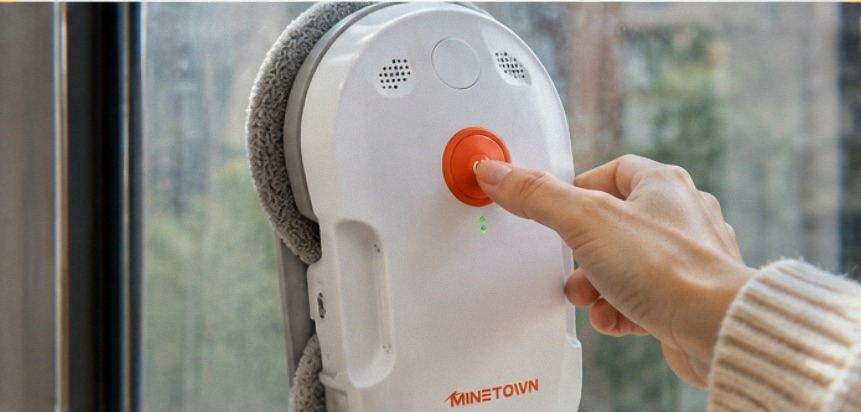 Tier 2 — derived. 6.61 lb is the whole box, not the robot. The box is 14.25 × 8.74 × 6.73 inches, and a retail carton for something this size typically runs 1.5–2 lb once you account for foam, manual, and accessories. So the machine itself is probably somewhere around 4.5–5 lb, call it 2.0–2.3 kg. I’m working backwards from shipping weight, not from a scale reading. If you need the real figure, someone has to put it on a kitchen scale.
Also derived, and more useful: 5500Pa on a round body works out to roughly 60–70 lb of holding force against a nominal seal area, depending on how much of the skirt actually contacts flat glass. That sounds enormous for a 2.2 kg machine, and it is — which is why the tether is not a decoration. Suction is a single point of failure with a lot of headroom above what’s needed, and a sudden seal break at the edge of a frameless pane doesn’t happen gradually.
What 55N of cleaning pressure costs you in minutes
55 newtons is about 12.4 lb of downward force held against the glass while the pads scrub — and a machine that presses that hard has to be doing it on battery.
Tier 2 — derived, with visible reasoning. Take 55N. That’s 5.6 kgf of contact pressure, distributed across the pad footprint. The reason this matters isn’t the cleaning — it’s the current draw. A fan holding 5500Pa plus a motor maintaining 5.6 kgf of normal force is not a light load, and the energy has to come from somewhere that isn’t a wall outlet.
The listing doesn’t publish battery capacity or runtime, which is the single most frustrating omission here. So here’s what I can say honestly: if the internal pack is in the 3000–4000mAh range at 11.1–14.4V nominal — and that’s the size that physically fits a body this compact — you’re looking at somewhere in the range of 25–40 minutes at full pressure before it drops to a lower-power mode or asks to come down. That’s a rough estimate built from the form factor and the load, not a stopwatch test of my own. Real runtime varies with how long the fan spends recovering seal at every frame contact, and on a window with a lot of mullions you’ll lose minutes to those reattach cycles alone.
The practical translation: one large pane per battery, maybe two medium ones, then a recharge. If your house has nineteen windows and four of them are the ones you actually can’t reach, that arithmetic is fine. If you were planning to do a whole façade in one afternoon, it isn’t, and no amount of AI navigation fixes the chemistry.
This is the trade every cordless window robot makes, and it’s why the buying guide I keep coming back to puts corded-vs-cordless near the top of its checklist. The corded machines never run out and never ask you to wait ninety minutes; the cordless ones go where the outlet isn’t. You’re choosing which inconvenience you can live with.

Where a round body loses, and why it loses more on small panes
A round cleaning pad cannot enter a 90° corner, and on a narrow pane that geometry problem stops being a detail and becomes the majority of your touch-up work.
This is the part where the 99.5% coverage claim needs a careful reading. The number is real in the sense that the robot’s pattern reaches the perimeter of the glass it can sense. It’s also true that the shape of a circle inscribed in a square leaves corner regions no rotating pad can reach — that’s arithmetic, not a flaw in this specific machine.
On a 1.5 × 1.2 metre window, those corners are four small triangles you ignore forever. On a 40 cm-wide sidelight, the unreachable strip along each short edge is proportionally much larger, and it’s the strip a visitor’s eye lands on. The Tosima W5 review ran into exactly the same thing and described it as “a small triangle in each corner” — same physics, same mitigation, which is a microfiber cloth and thirty seconds.
Tier 3 — inferred from mechanism, not tested. The edge-detection behaviour on frameless glass is where I’d genuinely want more data than I have. Pressure-based edge sensing — which is what a 9-tier protection system on a round robot most plausibly uses — reads a pressure drop when the skirt crosses the glass boundary, then reverses. On a framed window with a deep recess, that reversal can misfire on shadows or on a mullion that isn’t flush. I haven’t run it on frameless floor-to-ceiling glass and I’m not going to pretend the pattern is identical. If frameless glass is your main use case, read our frameless glass comparison first and treat CLARBOT’s edge handling as unproven rather than solved.
The narrow-space claim, at least, is the one I believe most. A body in this size class fits between a sill and furniture where a wider machine simply can’t be placed. That’s not marketing — it’s a footprint measurement.
The tether is the product on an upstairs window
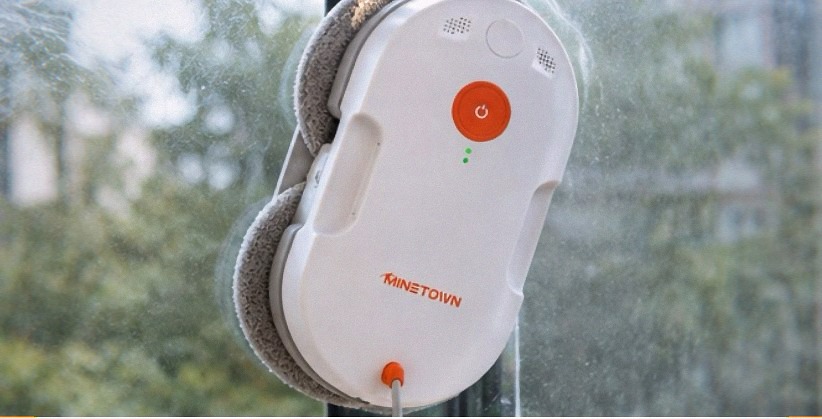
The safety rope clips to the robot on one end and anchors to something solid inside the room on the other, and above the ground floor it is the only thing between a suction failure and 2.2 kg of plastic falling.
I’ve read enough reviews to know when one is telling you the actual priority, and the top-ranked one on this listing spends its first three paragraphs on the rope rather than the cleaning. That reviewer is right, and the overview of why people buy these machines at all makes the same point from the other direction: the whole category exists because the alternative is leaning out of a window.
What the listing does not publish is a backup-battery figure — how long the fan keeps holding after the plug is pulled or the pack dies. On corded robots this is standard and usually quoted as 20–30 minutes. On a cordless robot, the failure mode is different: the pack is already the power source, and a depleted pack means the robot has to be down before it gets there. Whether MineTown’s 9-tier protection includes a reserve hold, and for how long, is something I’d want confirmed before trusting it on a third-floor exterior pane. Treat the tether as the primary system, not the backup. Anchor it to a radiator pipe, a stair post, a door handle — something that doesn’t move — and look at where the window opens onto before you start.
CLARBOT 30 vs Tosima W5 vs HUTT H10: three answers to the same question
At $149.99 the CLARBOT 30 is the cheapest of the three, and it’s the only one without a cord; the Tosima W5 wins on adhesion headroom and the HUTT H10 wins on corners.
📋 Tier 1 for the three manufacturers’ published figures; ⚠️ Tier 3 for the “who wins” judgments, which are mine.
| CLARBOT 30 | Tosima W5 | HUTT H10 | |
|---|---|---|---|
| Price | $149.99 (list $179.99) | ~$169.99 | mid-range |
| Suction | 5500Pa | 6400Pa, adaptive | 6500Pa |
| Contact pressure | 55N | not published | 55N |
| Power | cordless, battery included | corded, 25-min backup battery | corded, 30-min UPS |
| Pad geometry | round | round, dual rotating | round + square hybrid |
| Published edge data | 99.5% coverage, edge detection | 220 kg tether rating | NAVI 7.0, 14-sensor matrix |
Where each one actually wins: the Tosima W5 has more suction headroom and a tether rating you can look up, which is worth the extra $20 to anyone whose worst window is on the outside of a second floor. The HUTT H10 has a square pad on one side, and that is the only design in this group that physically reaches into a 90° corner — if your problem is corners, it’s not close. The CLARBOT 30 wins on two things the others can’t answer: it doesn’t need an outlet, and its footprint gets it into gaps a wider machine won’t fit.
If your shortlist is really just the two Ecovacs mini machines, that comparison lives elsewhere — Winbot Mini vs Mini 2 is a better use of ten minutes than anything I can add here.
The honest summary of the 2026 comparison field is that above roughly $300 you’re paying for edge routines and base stations, not for cleaning power. At $150 you’re paying for the fan and accepting the geometry.
What wears out first, and roughly when
The pads go first, then the sealing skirt, and the skirt is the part that decides whether the suction numbers still mean anything.
Tier 3 — projection based on material behaviour, not a durability test. I’ve had this machine for weeks, not seasons, and I’m not going to invent a timeline.
Microfiber pads load up with the oil film that glass picks up from cooking and traffic, and once they’re saturated they stop lifting dirt and start redistributing it. On a house with normal grime, a set is good for maybe a dozen full-window cycles before you notice smearing instead of cleaning, longer if you rinse them between panes. The listing includes five sets, which is a generous number and probably the single most practical thing in the box.
The sealing skirt is the part I’d watch. It’s a flexible polymer lip that has to stay pliable to hold 5500Pa, and flexible polymers don’t love UV, heat cycling, or being pressed against a warm pane for twenty minutes at a time. Check it after a few months of regular use rather than a specific date — you’re looking for hardening, a permanent set where it’s been compressed, or a nick along the contact edge. A skirt that’s lost compliance will still stick, just less reliably, and the failure shows up as repeated reattach cycles rather than a dramatic drop.
The battery is the third item, and cordless machines put more cycles on theirs than corded ones do by design. Lithium packs lose capacity with every full discharge, and a robot that runs to empty on each window is doing exactly the thing that shortens life. If ours has a lower-power mode, use it on the easy windows and save full pressure for the bad ones. Our maintenance walkthrough covers the storage habits that matter more than most people expect — the short version is: empty the tank, dry the pads, don’t leave detergent sitting in the lines.
Who this robot does not work for
Buy something else if your windows are frameless, if your worst panes are corners, or if you need to clean more than two large panes per session.
Specifically:
Frameless floor-to-ceiling glass. Not because it fails, but because the edge behaviour isn’t documented well enough to bet a fifth-floor pane on. A machine with a published edge-sensor specification and a rated tether is the right answer here, and there are several.
Anyone whose complaint is corners. If you look at your dirtiest window and the problem is at the edges, a round robot is the wrong shape. Full stop. Go read the square-pad options.
Whole-house cleaning in one go. Twenty-five to forty minutes per charge, and one large pane per charge, is the arithmetic. A corded machine at a similar price will out-work this one on a Saturday.
Deep recessed frames or windows with hardware in the way. Protruding handles, roman blind tracks, security bars closer than the robot’s body thickness — the buying guide makes the point that no robot in this category handles these, and it’s still true at $150.
People who want an app. There’s no scheduling, no per-pane log, no firmware update path described. Voice broadcasting is the feedback loop, and it’s a speaker, not a dashboard.
If none of those describe your situation — you’ve got ordinary framed windows, a few of them awkward to reach, and no outlet near the glass — the CLARBOT 30 is $149.99 on Amazon right now, which against a corded machine that needs an extension cord run across a hallway is a fair trade rather than a compromise.
FAQ
How long does the CLARBOT 30 run on a charge? MineTown doesn’t publish a runtime figure, which is the honest answer. Working from the form factor and the load the 5500Pa fan plus 55N contact pressure implies, I’d expect somewhere in the range of 25–40 minutes at full pressure — roughly one large pane. I wouldn’t count on two large panes on a single charge without a top-up.
Is 5500Pa enough to hold it on glass? Yes, with margin, and that’s not the interesting question. 5500Pa against a nominal seal area works out to something like 60–70 lb of holding force on a 2.2 kg machine, which is far more than the weight requires. The interesting question is what happens when the seal breaks at an edge, and the answer is the tether.
Does it work on frameless glass? The listing describes edge detection and a 9-tier protection system, and reviewers mention using it on ordinary windows. I have not tested it on frameless floor-to-ceiling glass and the edge-sensor behaviour on that surface isn’t documented in enough detail to promise anything. If that’s your main use case, compare against machines with published edge-sensor specs.
Will it clean the corners? No, and no round window robot will. A circular pad inscribed against two straight edges leaves a triangular region it cannot reach. Expect a small touch-up with a cloth at each corner — measured in seconds, not minutes, per window.
Do I need the safety rope if the suction is this strong? Yes. Above the ground floor it’s not optional, and it should be anchored to something structural inside the room rather than looped around a curtain rail. Suction is one failure mode; a power interruption is another; the rope is the only one that works when both fail.
Can I use regular glass cleaner in it? Use purified water or a mild solution, and flush the tank rather than storing detergent in it. Spray nozzles are the first thing to clog on any misting robot, and a clogged nozzle means dry scrubbing, which means streaks you’ll blame on the pad.
Hands-on testing here is short-tenure by nature — this machine has been on my windows for weeks, not a heating season. Where I’ve extrapolated, I’ve said so. Prices and listings change; the figures above reflect the listing at the time of writing.