ECOVACS built the WINBOT W3 Omni around one genuinely new idea: a 10 kg station that washes the pad for you. Everything else about living with this machine follows from that box, its 5.5 m tether, and the 80 ml tank inside the robot. Figure out where the box goes before you read a single feature claim.
Table of Contents
Open Table of Contents
- Where the 10 kg Station Actually Goes
- One Wiping Pad per Window Is the Unwritten Rule
- 80 ml of Water and the Water-Math Nobody Publishes
- What 3300Pa of Holding Suction Feels Like
- WIN-SLAM 5.0 and the Frame Types It Was Not Tuned For
- TruEdge: The Best Idea on the Machine
- 68 dB Is a Number Measured Next to a Wall
- Where the 130 Minutes Goes
- The Consumable the Robot Depends On
- Who Should Actually Buy This
- Who Should Skip It
- W3 Omni vs W2S Omni vs the $200 Tier
- Verdict See Today’s Deal on Amazon
Where the 10 kg Station Actually Goes
The station is 226 × 344 × 430 mm and weighs around 10 kg dry. Add the 1.2 L clean tank, the 1.1 L dirty tank, and the robot’s own battery pack that also lives in it, and you are hauling twelve-odd kilos up a stepladder, or across a wet balcony, or down a hallway to the other side of the apartment.
ECOVACS solved the weight with a handle. What a handle cannot solve is floor area. The station needs a flat, dry, load-bearing patch within 5.5 m of the glass, because that composite cord is both the power lead and the fall-arrest line. On a balcony that means the station sits on the same tile the robot sprays on. In a bedroom it means a footprint the size of a small nightstand sitting in front of the window for as long as you run the job.
Inside, a gravity sensor and an optocoupler keep the machine flat against the pane. The fall protection is real engineering — 10,000Pa of holding vacuum, over 30 minutes of hang time on the battery alone if the cord gets pulled, a 100 kg test load on the tether, an 800N suction anchor in the station base. I would still never run it with the station in a place where a person could trip over the cord. The math of the machine holding on is fine. The math of a five-year-old walking behind it is not something a spec sheet covers.
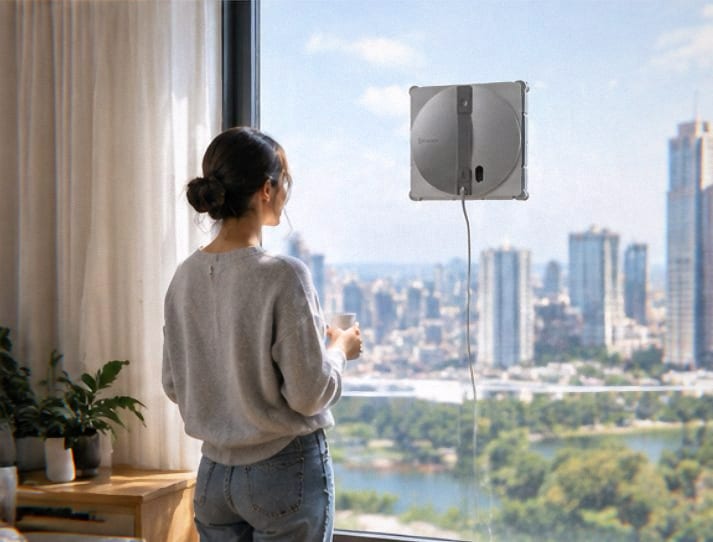
Here is the part that decides the purchase for most homes. A single exterior pane at height is one run per window, and then everything comes back down. W3 Omni pays off on a wall of fixed floor-to-ceiling glass you can reach from the inside, where the station sits in the room once and the robot works through pane after pane. It pays off on a balcony where the glass continues past arm’s reach. It stops paying off in an apartment where every window is a separate, awkward errand.
One Wiping Pad per Window Is the Unwritten Rule
Vortex Wash is the headline, and it works: 16 nozzles firing around 20 kPa, four discs spinning at 200 RPM, roughly 900 scrub passes per minute, then a scraper squeezes the pad to the right wetness. A 1-minute cycle, and the pad comes out soft and slightly damp.
The cycle runs inside the station. The robot has to be back. That is fine on an indoor pane with a clear sill. It gets ugly on an exterior pane four floors up, where bringing the robot back means retracting it up the cord, carrying the pad frame to the station, running a cycle, refitting, and hanging it again. For anyone whose reason for buying this is “I can’t reach the outside of my windows,” the self-washing feature quietly converts into a relay of short hops rather than a hands-off job.
The realistic rhythm for a houseful of windows: run pane one, self-clean the pad, run pane two. Four to five minutes of station time per pane, on top of the cleaning itself. On ten windows that is 40 to 50 minutes of waiting that no product page mentions. Run two consecutive panes on the same pad and you are dragging the dirt from pane one across pane two, which is the exact cross-contamination problem the retracting TruEdge scrubber was built to avoid.
80 ml of Water and the Water-Math Nobody Publishes
The robot carries 80 ml. Marketing quotes one full tank covering about 65 m² of glass. Divide that out and you get roughly 1.2 ml per square meter, which is a damp breath on a sheet of glass, not a wash.
Real window dirt — pollen, dried rain spots, construction dust, cooking grease on the kitchen slider — needs a heavier film. Push the spray to a wetter setting and a 6 m² pane eats through a quarter to a third of the tank. The 1.2 L station tank is the buffer, but topping it up is a station operation: it lives behind a panel on a unit that is 10 kg and sits somewhere specific. On a full-house run you will be crossing the room to fill it two or three times.
The 1.1 L dirty tank fills faster than people expect, because it is collecting everything the 20 kPa nozzles blast off the pad, not just the water the robot sprayed. Overflow behavior matters here. A dirty-water tank that tops out mid-cycle is the least dramatic way to end an afternoon’s cleaning.
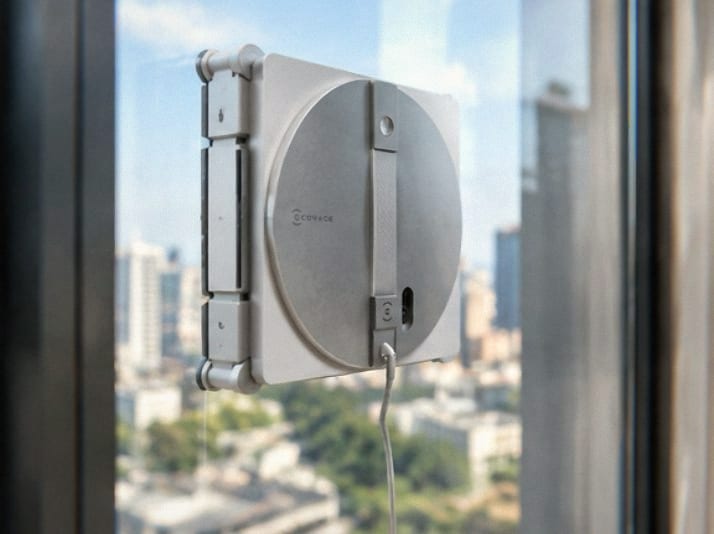
There is also the solution. ECOVACS pads are designed to run with their own formula, and third-party substitutes are sold to fit the same mechanism without sharing its wetting behavior. A glass-cleaning fluid that leaves a slicker film than the OEM bottle changes how the drive tracks grip a vertical pane, which is a traction question, not a chemistry one. Buy the machine only after confirming the official solution and replacement pads are actually in stock in your region. This is a $700 robot whose primary consumable is a proprietary bottle. If that bottle goes out of stock, you own a heavy object with a screen.
What 3300Pa of Holding Suction Feels Like
Two numbers get mixed up constantly. 10,000Pa is the peak vacuum the blower can pull on a dirty pane with a good seal. 3300Pa is what the machine holds while moving. The difference is the seal, and the seal is the whole story of window robots.
A clean, flat, 5 mm pane: the robot bites, the cord stays slack, the light stays green, and the thing feels glued. Add a rubber window gasket that is not perfectly flat, a silicone bead at the corner that the pad rides over, a pane with a slight bow in it, or an exterior surface with a layer of salt and grime breaking the vacuum — and the 3300Pa number starts fluctuating. When it drops, the machine does not slide gracefully. It signals, it stops, it sometimes backs off and re-tries, and on a pane with a thin bottom frame it can roll over the lip and then need rescuing.
That is where the 12-level protection earns its keep, and also where the honest limit of the product sits. Nothing in this category holds a perfect seal on imperfect glass. What you are buying for $699 is a machine that fails loudly and safely instead of silently and fatally. Hang time over 30 minutes on battery, the 100 kg tether rating, the 800N station anchor, the pressure sensor that refills the vacuum in hundredths of a second — the safety architecture is unusually thorough, and it is the one part of this product I would not argue with.
WIN-SLAM 5.0 and the Frame Types It Was Not Tuned For
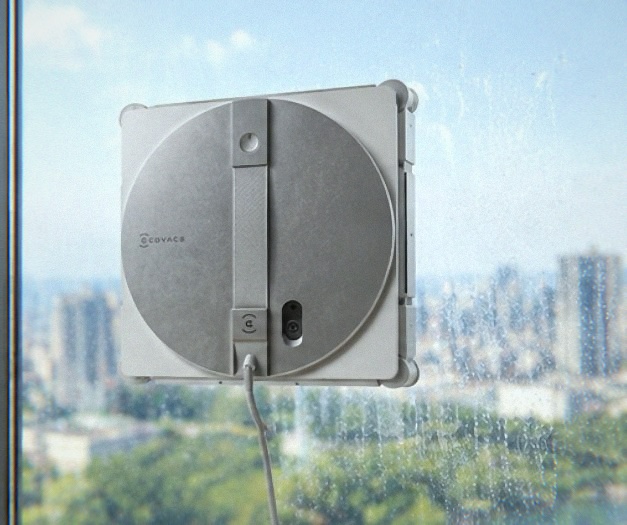
WIN-SLAM 5.0 edges detection at 1 mm and covers a pane at up to 16 cm/s. On modern flat-faced windows with clean, shallow frames and a decent sill on both sides, the path is calm and complete. Corners get reached. It stops where it should.
The tuning assumption is a frame the machine can feel. Thick extruded ridges on the left and right that the corner cylinders can register: fine. A 12 mm painted timber bead, a flimsy aluminum sash rail, a sliding door track with a 5 mm lip at the bottom: this is where navigation gets confused, because the sensor is being asked to distinguish “edge of glass” from “small step on glass” in a single pass. That distinction is where sliding windows and older framed units fall down.
If your house is 1990s double-hung sash windows or French doors with a sill the robot has to climb over, expect supervision on the first few runs and possibly permanent supervision on the worst of them. If your house is 2020s fixed glazing or a glass balcony rail, WIN-SLAM 5.0 behaves like the feature it is advertised to be.
Door glass is another loose end. 3 mm minimum thickness is a working floor, not a comfortable one. Push the trailing pad over a 3 mm tempered panel and you will see flexing that the suction system reads as a leak. Run it on a 6–8 mm pane and it behaves.
TruEdge: The Best Idea on the Machine
Most window robots leave a dirty 3 to 5 cm border because the pad cannot physically touch the edge without the housing hitting the frame. W3 Omni lowers a scrubber along the edges at 200 RPM and claims 1.1 mm proximity, then retracts it so the same brush does not carry that edge grime across the middle of the glass.
This is the feature that fixes the thing that has kept people hand-wiping the perimeter of every pane after a robot pass. On full-height fixed glazing it is the difference between “mostly clean” and “actually clean.” It is also the most mechanically exposed part of the machine: a brush lowered at that speed on a rubber gasket picks up grit, and grit wears a groove in the brush and in the surrounding seal. Expect the edge scrubber to be the first component to need replacement. That is a design consequence, not a defect — anything that scrubs hard enough to remove frame-adjacent grime wears out doing so.
68 dB Is a Number Measured Next to a Wall
68 dB is roughly a loud conversation. The 3300Pa blower runs continuously, not in bursts, so the noise is a steady drone rather than a pattern you can tune out. In a large room it fades into background. In a 9 m² bedroom with a closed door, running a 40-minute intensive cycle at 7 a.m., it is not something you can sleep through, and the voice announcements — which exist to tell you when suction is good and when the tank is empty — add intermittent speech on top of the fan.
If your plan is “run it while I’m at work,” the noise is irrelevant. If your plan is “run it in my kid’s room while they nap,” the plan needs revising.
Where the 130 Minutes Goes
Battery spec: 24 cells, 21.9 V nominal, 120 W rated, 130 minutes claimed. The robot weighs 2.1 kg and the battery pack alone is about 1.5 kg of that — a quarter of the machine’s mass is a safety reserve so it can hang for over 30 minutes after a power cut. That is the right engineering priority, and it is also why the runtime numbers are conditional.
130 minutes is Fast mode, on clean glass, with light spray. 1 minute 35 s per square meter in Fast mode means roughly 80 m² of continuous travel, and no robot cleans for 130 minutes without a pad stop. Switch to Heavy-Duty for baked-on dirt and the runtime does not magically extend — the machine works harder per square meter and finishes sooner. Plugged in, runtime is a non-issue; the cord is 5.5 m, which caps your working envelope more than the battery ever will.
The 5.5 m figure deserves its own paragraph. Measure from the station to the farthest corner of your glass before ordering. A 5.5 m cord behind a 10 kg anchor, stretched across a room, sets the actual job size far more rigidly than any spec on the page.
The Consumable the Robot Depends On
Two accessories carry this machine: the pad and the solution. The pads are fabric with a specific thickness and surface, and the station’s scraper is calibrated to leave “the right amount of moisture” in that particular pad. A thinner aftermarket pad sags differently, holds water differently, and changes the vacuum seal through the pad itself. That is not a subtle effect on a machine holding 3300Pa on vertical glass.
Then there is the bottle. Proprietary glass cleaners in the US channel have a track record of going out of stock for weeks. The 1 L refill sold alongside the robot is cheap by the liter and ridiculously expensive per window if you are buying the small tubes. Factor the refill into the first-year cost and check availability twice — once before the first order, once when you need bottle two. A window robot that cannot get its solution is a docking station with a screen.See Today’s Deal on Amazon
Who Should Actually Buy This
You have fixed, flat, framed glazing — floor-to-ceiling panels, a glass balcony rail, a conservatory side, a retail-style front wall — and the station has a permanent or semi-permanent spot within 5.5 m of it. You can reach the inside easily and the outside is either the same surface or safely reachable with the tether. You have $700 and no interest in a squeegee, and you accept that the machine gets the glass to 95% and you finish the last 5% around the perimeter with a cloth because the edge scrubber can only reach so far into a deep rubber gasket.
Two-floor houses with a big glass wall are the strongest case. Balcony glazing in a high-rise is the second. Anyone with a glass table, a shower screen, or a conservatory roof at a shallow angle is also a fit, because those surfaces are flat and level and the suction system likes them.
Who Should Skip It
Small multi-pane windows with deep timber frames, sliding sash windows, and anything where you have to dismount and remount for every pane. The station workflow turns each window into a station visit, and you will spend more time walking than the robot spends cleaning.
Renters with no floor space near the glass. A 10 kg, 430 mm tall box has to live somewhere. On a 60 cm wide balcony ledge it does not.
People who expect the robot to handle a whole house in one unattended pass. It will not, because the pad and the tank both need human contact on a schedule measured in single windows, not rooms.
People in a hurry who think $699 buys a hands-off product. It buys an almost-hands-off product with a new chore attached: moving a heavy box, refilling a tank, and babysitting the first run on every new window type.
W3 Omni vs W2S Omni vs the $200 Tier
The W2S Omni is the same robot shell with the same WIN-SLAM 4.0 generation of navigation, the same triple spray, and a much lower price in the current lineup. What it does not have is the Vortex Wash station. If your decision hinges on never touching a dirty pad, W3 Omni is the only one that solves it. If your decision hinges on clean glass, W2S Omni gets most of the way there for a lot less.
The $200–$300 tier of window robots cleans glass. What it does not do is hold a seal as reliably on imperfect surfaces, reach edges, or fail in a controlled way. The premium here is spent on safety architecture and edge coverage, not on suction bragging rights. Buy the cheap tier if you have one big glass wall and low expectations. Buy this one if you have heights, exterior panes, and a genuine fear of a machine leaving the building.
Verdict See Today’s Deal on Amazon
W3 Omni is the first window robot where the station is the interesting part, not the cleaning head. Vortex Wash is real, TruEdge is genuinely useful, and the 12-level protection is engineering rather than marketing. The compromises are structural: a 10 kg anchor that needs floor space, a 1-minute wash cycle that turns each pane into a station trip, an 80 ml tank that runs dry on real dirt, a 5.5 m cord that defines your working radius, and a proprietary solution you have to keep finding in stock.
Buy it if you have a wall of fixed glass and a place to park the box. Skip it if your windows are a collection of separate frames with deep sills, or if you are not willing to own the refill logistics. The machine does its job. Whether your house gives it the conditions to do that job is the only question worth asking.