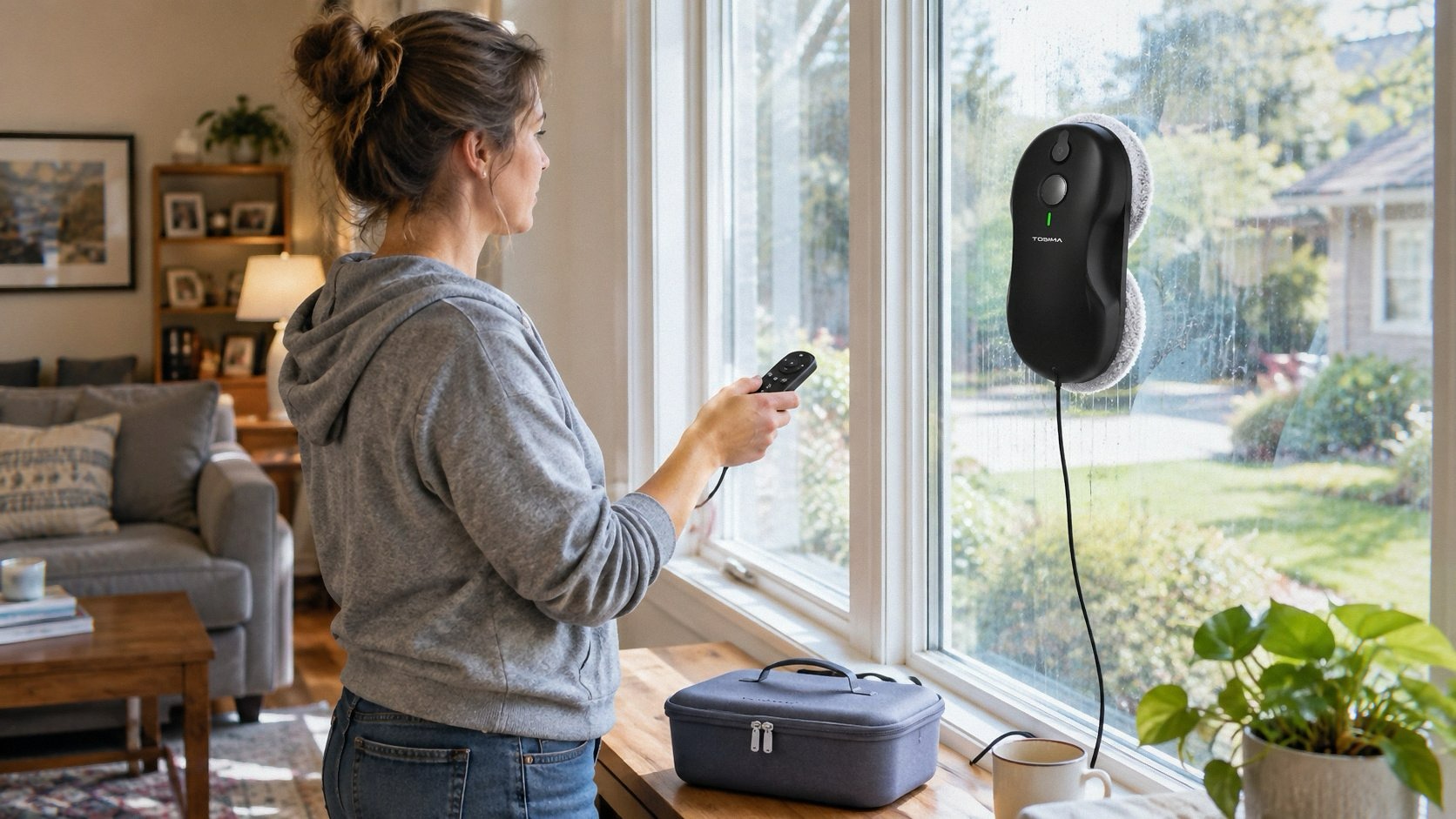
The first sound the Tosima W3 made in my house was a thud.
Not a beep. Not a cheerful startup chime. A thud — the specific, stomach-dropping thud of a $140 gadget peeling itself off my sliding glass door and meeting the concrete patio below. I was inside, holding a mug of tea that had already gone lukewarm, watching through the very glass the thing was supposed to be cleaning. It had hit the low beveled seal at the bottom edge of the door, ridden up it like a tiny optimistic ramp, and lost suction. Down it went.
I picked it up. Brushed it off. Stuck it back on the glass. It kept going like nothing happened, and I stood there feeling an emotion I did not expect to feel toward a window robot: respect, maybe, or the early stages of Stockholm syndrome.
That was week one. I’ve been running it ever since, and this is the review I wish someone had written for me before I bought it — because the Amazon listing for the Tosima W3 will tell you what it does, but not what it’s like to live with.
Why I even bought this thing
I have a history here. A dumb, expensive history.
There was the squeegee era, which ended with me on a ladder at an angle my insurance company would have opinions about. There was the magnetic double-sided cleaner era, which ended with the thing pinching my finger hard enough that I said a word my neighbor definitely heard through the open window. And I’ve been circling the robot category for a while now — I wrote about the Hutt H10 earlier this year, and before that the Schbot Wind X3, and both of those cost noticeably more than this one. The Hutt in particular set a bar. Once you’ve watched a pricier machine hug a window properly, you get picky.
So when the W3 showed up on my radar at $139.99 — with a 3.8-star average across 855 ratings, which is the most “you get what you pay for, mostly” number I’ve ever seen — my expectations were set to basement level. I bought it the way you buy a lottery ticket or a gas station sandwich. Braced.
Out of the box
The box is fine. The robot is small — about 5.9 by 11.8 inches, 2.1 pounds — and lighter in the hand than I expected, which initially read as “cheap” and later read as “oh, that’s actually good for not falling.” Physics. It comes with twelve microfiber pads, which sounds generous until you realize you’re meant to swap them constantly, and then it reads as “appropriate.”
First boring detail, because I promised myself I’d be honest about the texture of ownership: the power button has this soft, slightly mushy click. Not a satisfying mechanical snap. More like pressing the rubber dome on an old TV remote. You push it and there’s a half-second of nothing before the motor spins up, and every single time I think it’s broken for that half-second. Every time. Months in. Still.
The vacuum motor has a sound I’d describe as “hair dryer with a sinus infection.” It’s not quiet. One of the review summaries on the listing says people find it “not noisy at all,” and I genuinely do not know what those people own for comparison. A jet wash? It’s tolerable. You can hold a conversation near it. But my cat has filed a formal complaint and now supervises from the hallway.

The spray situation, which is the whole point
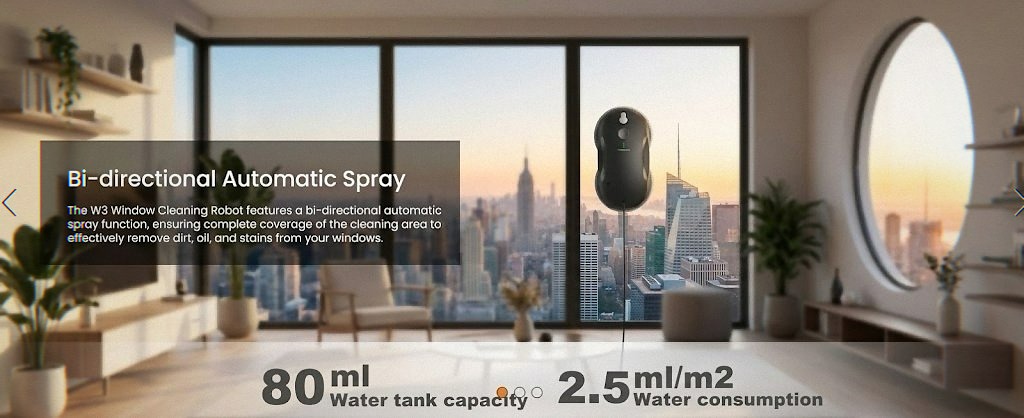
The headline feature is dual-direction auto-spray, and here’s the translation from marketing to kitchen-table English: it mists water ahead of itself in whichever direction it’s currently traveling, so the pads aren’t grinding dry dirt around in circles. Older cheap robots — and I suffered through one years ago that shall remain nameless — just drag damp pads across dry glass and redistribute the grime into a nice even film. The W3 actually wets the path it’s about to take.
Does it work? Mostly. On maintenance-level dirt — the pollen film, the water spots, the mysterious splatter that appears on patio doors when you have weather — one pass is genuinely enough. The glass looks good. Not professionally-squeegeed good. Good.
On the kitchen window above the sink, though, the one that collects a fine aerosol of cooking grease because I refuse to use the exhaust fan like an adult, the first pass left those circular swirl marks. Round pads, round motion, round streaks. The fix is exactly what every owner forum says: swap to fresh pads, run it again. Second pass got it clean. So the honest math is that a genuinely dirty window costs you two runs and one pad change, and the machine is doing the climbing while you do the pad-swap, which is still a trade I’ll take over the ladder.
If you grab one through the links here, I might get a small cut — costs you nothing extra and keeps the lights on.
The safety stuff, since it did fall once See Today’s Deal on Amazon
Tosima advertises a triple safety system: anti-drop sensors, edge detection, and the suction motor itself, plus a built-in 650mAh battery. That last one matters and people misunderstand it, so let me be the boring guy who explains: the battery doesn’t run the robot. The W3 is corded. It cleans while plugged in. The battery is a parachute — if the power cuts or the cord gets yanked, the robot keeps sucking itself to the glass for roughly twenty minutes instead of committing suicide, and it screams a beep alarm the whole time so you come rescue it. I tested this by unplugging it mid-run, standing there like a villain in a lab, and it just hung there beeping at me indignantly. Held fine.
The edge detection works on frameless glass. It gets to the edge, hesitates, turns. It’s kind of fun to watch, the little pause, like it’s thinking.
But — and this is the part the spec sheet won’t say — “edge detection” and “beveled rubber seal at the bottom of a sliding door” are not the same problem. A raised bevel breaks the vacuum seal from underneath, and no sensor sees that coming. That’s my thud. The unit survived the fall onto concrete completely unharmed, which is genuinely impressive, but I now babysit the patio door run with one hand hovering near the glass like a nervous spotter at a climbing gym.
There’s a safety tether in the box. Use it. I didn’t, that first time, because I am exactly the kind of person manuals are written for.
Navigation and the remote you didn’t know you’d need
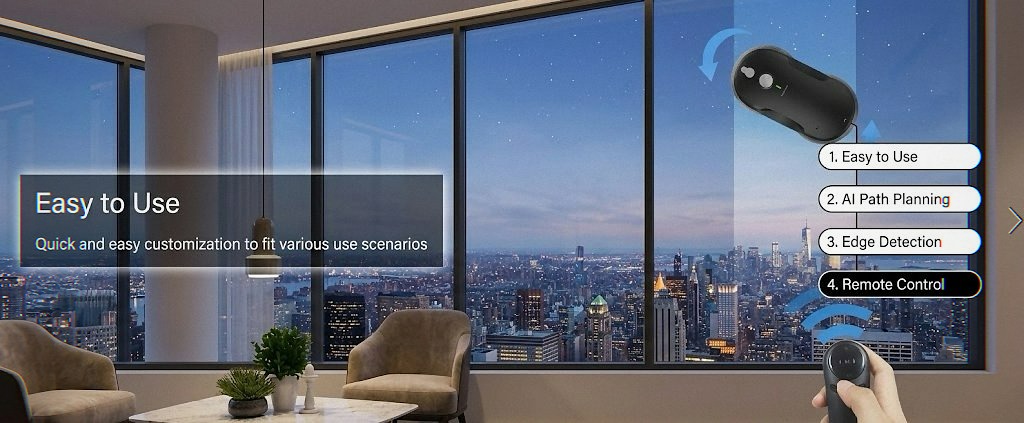
The path planning is the zigzag kind: up, across, down, across, with the occasional diagonal flourish. On a standard rectangular window it covers well, and when it finishes it returns to roughly where it started, which sounds like a small thing until you’ve owned a robot that parks itself at the top center of a second-story pane, out of reach, mocking you. Position memory. Good feature. Quietly the best one.
It will, occasionally, get lost. Mine has twice stopped in the middle of a pane and just sat there, humming, contemplating its choices. That’s what the remote is for. One quirk nobody tells you: you have to fully pause the robot before the directional buttons respond. Not slow it down. Full pause. I spent an embarrassing amount of time jabbing the remote like a broken elevator button before figuring that out, so now you get it for free.
Corners, though. The pads are round, windows are square, and geometry is undefeated. Every cleaned window has four small triangles of untouched grime at the corners. You either accept them as the tax on not using a ladder, or you do a thirty-second wipe with a cloth afterward. I do the wipe. It takes less time than finding the ladder.
Speed, or the lack of it
Four minutes per eleven square feet, says the spec sheet, and that’s about right. A full sliding door, both sides, with a pad swap in the middle, is most of a half hour — with you nearby. This is not a machine you set and leave the house with. It’s a machine you supervise the way you’d supervise a toddler near a staircase: mostly fine, occasionally a lunge.
The thing is, I don’t actually mind. There’s something hypnotic about watching it work. I caught myself standing there for a full cycle last Saturday, tea going cold on the windowsill, doing absolutely nothing productive, and I can’t even be mad about it. It cleans the window and provides a show. The Mova T1 Station I looked at earlier this year tries to solve the babysitting problem with a whole dock-and-tether setup, and it’s a more serious machine for it — but it’s also a bigger spend and a bigger production. The W3 is the “stick it on the glass and hover nearby” tier, and it knows it.
The downsides, friend to friend
Let me collect these in one place, because you’ve earned the warning list:
It can fall. Rarely, on weird seals, but it can. Tether. Always.
It streaks on genuinely dirty glass on the first pass. Budget two runs and fresh pads for anything beyond maintenance cleaning.
Corners stay dirty. Round pads, square world.
The remote needs a full stop before it listens to you.
The 3.8-star rating is real and it’s earned — a chunk of the one-star reviews are durability complaints, units dying within a handful of uses. Mine is still alive after a season of regular runs, and the build feels tougher than the price suggests (see: survived concrete), but I’m not going to sit here and promise you longevity I can’t verify yet. Check back with me in a year. If it dies, I’ll say so.
Also the power brick gets warm. Not scary warm. “Noticeable when you unplug it” warm. I only mention it because nobody ever mentions it and I noticed.
The money question See Today’s Deal on Amazon
$139.99, at the time I’m writing this. A professional window cleaning for a whole house runs $150 and up where I live, so the math is embarrassingly simple: if this thing survives two full-house cleanings, it’s paid for itself, and everything after that is free labor with a sinus infection soundtrack. Compared to the Hutt or the [Ophinique X5], you’re giving up some refinement — app control, smarter edge behavior, quieter motors — and keeping a hundred bucks or more in your pocket.
Is it the best window robot I’ve used? No. The Hutt H10 is better in ways you can feel within five minutes. Is it the best one per dollar? That one’s not close. It is.
Mine is currently stuck to the upstairs bathroom window, doing its second pass, and I can hear the muffled hair-dryer hum through the floor as I type this at the kitchen table. The tea is cold. The corners of the patio door still have their little triangles of dirt, and I’ve decided those triangles are fine, actually. Character.See Today’s Deal on Amazon
Three months, one fall, zero injuries, clean-ish windows. The cat remains unimpressed.