I’ve been staring at my living room windows for about three months now. Not because they’re beautiful—they’re streaked, dusty, and the top corners look like a family of spiders has been hosting a convention up there. Every time I walked past, I’d make a mental note. “This weekend.” Then the weekend would come, and I’d look at the stack of squeegees and microfiber cloths in the closet, remember the last time I nearly fell off a step stool, and decide my windows were fine. They were not fine.
The HUTT H10 window cleaning robot arrived in a box that was larger than I expected. I’ll get to the full HUTT window cleaning robot review in a minute, but first—the packaging was oddly satisfying. Tight foam inserts, everything individually wrapped. The robot itself has this clean white finish that makes it look like a tiny sci-fi appliance. It weighs 1.3kg, which is lighter than it looks. The first thing I did, like a complete idiot, was flip it over to look at the pads. The square pad is mounted on one side, the round pad on the other. That was the moment I realized this thing wasn’t just another round puck with a suction fan.
My windows are floor-to-ceiling, about 2 meters by 1.5 meters each. The previous summer, I tried using a magnetic cleaner that had me leaning out the window at a 45-degree angle, sweating, and praying the magnet wouldn’t slip. That thing lasted exactly two sessions before I threw it in a drawer, never to be seen again. So my expectations for anything robotic were somewhere between “it’ll fall off immediately” and “it’ll leave more streaks than a teenage pizza delivery guy.” But I’d already ordered it, the box was open, and the robot was sitting on my coffee table like a challenge.
The setup process took me about ten minutes, mostly because I was reading the manual with a beer in one hand and my phone in the other. You plug it in, attach the safety rope (mountaineering-grade, rated for 220kg, which is honestly overkill for a 1.3kg robot but I’m not complaining), and fill the 80ml water tank. The nozzle components gave me a brief moment of confusion—there are six of them, and the manual doesn’t exactly hold your hand. I ended up using the standard pair and figuring I’d experiment later.
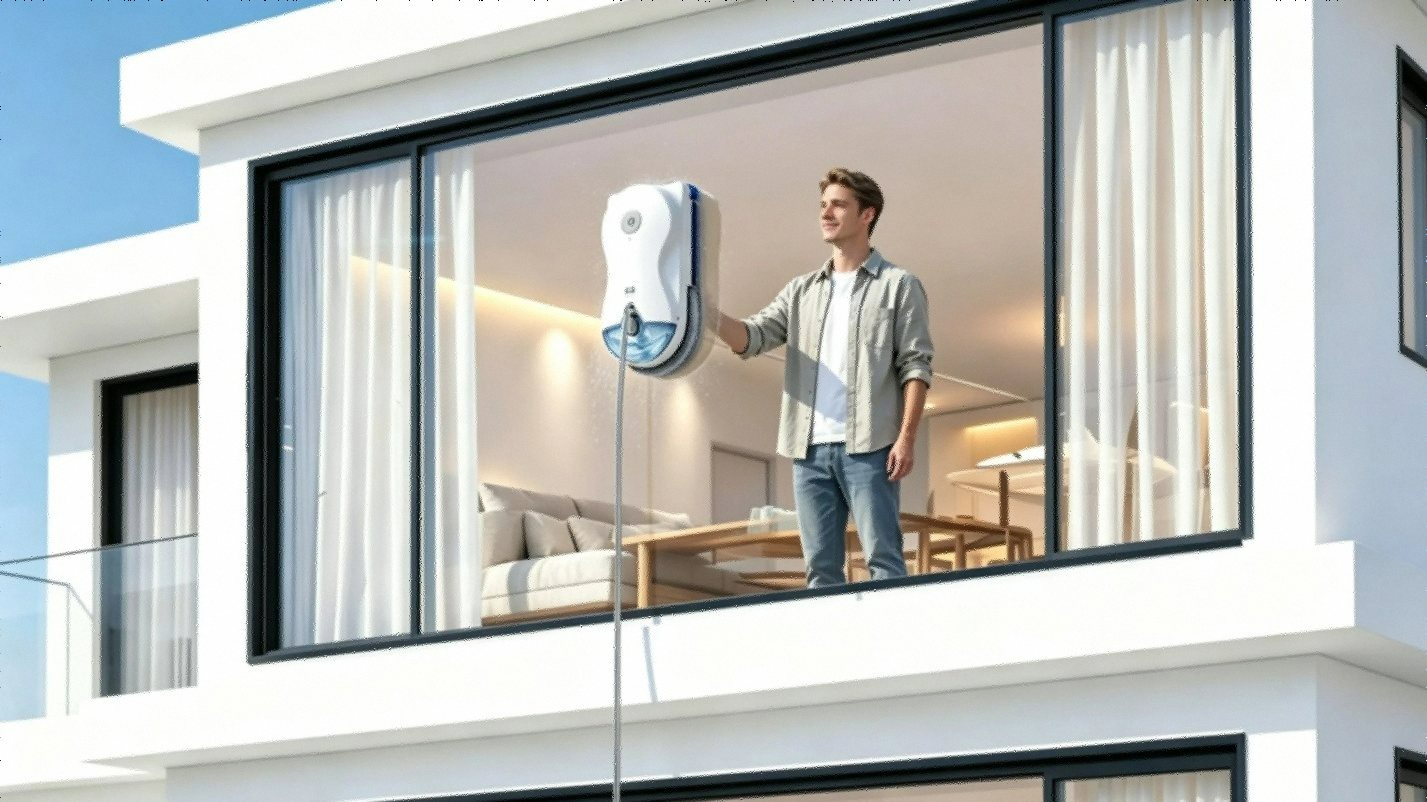
Turning it on, you’re greeted with a soft beep and the NAVI 7.0 system kicking in. The robot maps the window, which I can see in real-time on its indicator lights. Then it starts moving. The suction engages, and I’m not kidding—you can hear the difference. The brushless motor sounds more like a quiet vacuum than a whiny toy. HUTT claims 6500Pa suction with 55N constant pressure via a 3D suspension beam. What that actually feels like: the robot sticks to the glass with a satisfying thump, and when you tug on the power cord, it doesn’t budge. I tested this on the first window, pressing my palm against the glass from the inside while the robot was on the outside, just to see if I could feel any vibration. Barely anything.

Now, the dual-stage cleaning. This is the part that actually impressed me, and I say that with my usual level of skepticism. The round pad rotates at 70 RPM, doing the wet scrubbing. It lifts dirt, pollen, and what I can only assume is years of accumulated city grime. The square pad follows up as the dry finish, polishing away the water marks. That weird “round-square hybrid” design they keep talking about on the product page? I thought it was marketing fluff. It’s not. The square shape is specifically designed to reach corners and edges, and the round part handles the larger glass surface. Watching it work is oddly hypnotic—the robot follows a serpentine pattern, overlapping its previous passes like a lawnmower with a lot more anxiety.
The dual ultrasonic spray system is another detail I wasn’t expecting to care about. The nozzles mist water onto the glass ahead of the pads, and it’s a fine enough spray that you don’t get those big water droplets running down the window. The 80ml tank gave me about 45 minutes of cleaning time before I needed to refill, which covers roughly 50-60 square meters of glass. I had to refill it twice for the six windows I tackled in the first session, but that was because I was being thorough and letting it run extra cycles on the dirtiest spots. The visible tank is convenient—you can see the water level dropping in real-time, which means you’re not caught off-guard in the middle of a window.
The NAVI 7.0 navigation actually worked
I’ve used robotic vacuums that bounce off walls like a drunk pinball. The HUTT H10’s navigation system is different. It measures the window dimensions before it starts cleaning, then calculates an optimized path. The 14-sensor matrix includes edge detection, pressure monitoring, and obstacle sensing. I watched it approach the top left corner of a window, pause, make a tiny adjustment, then rotate and clean right into the corner. The edge cleaning actually works. I ran a microfiber cloth along the edges after it finished, and there wasn’t any residual grime.
That being said, the corner coverage has limits. On one particularly narrow window—about 60cm wide—the robot struggled a bit with the full edge reach. It still cleaned the glass, but I had to run an extra pass for the very top edges. For standard windows, it’s more than adequate. If you have unusually shaped glass or those tiny transom windows, you might need to spot-clean manually.
The 30-minute backup protection is a nice feature. The built-in UPS battery maintains suction for up to 30 minutes if the power goes out or the plug gets accidentally yanked. I intentionally unplugged it while it was at the top of a window, just to see what happened. The robot paused, the suction stayed on, and it emitted a warning beep. It didn’t drop, didn’t slide, just sat there waiting for power. Then it resumed its path when I plugged it back in. This isn’t something you’ll think about until you need it, but if you’re cleaning high-rise windows, it’s a peace-of-mind feature that matters.
Noise and real-world usability
The claimed 65dB noise level is accurate. It’s quieter than my dishwasher and about as loud as a regular conversation. I had no problem watching TV in the adjacent room while it ran. The remote control is basic but functional—you can start, stop, switch cleaning modes, and manually guide the robot if you need to spot-treat an area. I used the manual mode once for a stubborn bird dropping that had been on the glass for who knows how long. It worked, though it took a couple of passes.
If you’re wondering about the small glass compatibility—it can handle windows as small as 30x30cm. I tested this on my bathroom’s small frosted window, and it did a decent job. The robot’s overall footprint is compact enough that it didn’t look comically oversized on that tiny glass.
Let’s talk about the cleaning pads. The H10 uses round and directional pads, and they’re washable. I ran mine through a gentle wash cycle, and they came out clean and reusable. If you do a lot of windows, buy the 6-pack replacement pads. The pads that ship with the unit will last a few months with regular use, but having extras means you can swap them mid-cleaning session if a window is especially dirty.
The downsides—and there are a few
The robot has to stay plugged in while operating. The power cord is long (I’d guess around 4-5 meters), but you still need an outlet within reach. For my second-floor windows, I had to use an extension cord because the reach was just a bit short. This isn’t a dealbreaker, but it’s an inconvenience if you don’t have outlets near your windows.
 The manual is a bit sparse. The core instructions are there, but the details—like which nozzle setup to use for different types of glass or how to interpret specific blinking light patterns—are glossed over. I had to look up a few things online. If you’re the kind of person who hates troubleshooting, this might annoy you.
The LED lights on the robot are bright. Like, “find your way to the bathroom at 3am” bright. Since the robot is typically on the glass, and you’re inside looking at it, the lights are mostly aimed away from you. But if you have interior glass panels or mirrors where the robot faces you, the LEDs are distracting. I don’t think it’s a huge problem, but it’s one of those small design choices I wish they’d reconsidered.
I also noticed a faint chemical smell from the pads during the first use. It faded after the first window and was completely gone by the second. Not a safety issue, just a manufacturing residue that doesn’t get mentioned anywhere.
How it compares to the others
I’ve tested a few robot window cleaners before this one. If you’re looking for something more affordable, the Gnovel window cleaning robot is a solid budget option, but its suction isn’t as strong and the edge cleaning is less reliable. The [Winbot W2 Pro Omni] has better app integration and a more polished user experience, but it costs significantly more. The HUTT H10 sits in a comfortable middle ground—strong suction, intelligent navigation, and the dual-stage design gives it an edge on streak-free results that the purely round models can’t match.
Check the HUTT H10 price on Amazon
What I haven’t mentioned yet
The HUTT H10’s outer shell has this soft-touch plastic that doesn’t show fingerprints easily. I’ve been handling it all day, and it still looks clean. The power cord is thick and feels durable, with a strain relief at the connection point. When the robot is running, the pads make a gentle whooshing sound as they rotate. It’s not loud enough to be annoying, but it’s present.
If you’re planning to use this on outdoor windows, you’ll want to be careful with the safety rope. It’s long enough to reach from my third-floor windows to the ground, but I used an extra anchor point just to be safe. The rope itself is smooth and doesn’t fray easily, which is good because I don’t want to think about what happens if that thing snaps.
One weird detail: the robot leaves the glass slightly warm after a cleaning run. The friction from the pads and the motor heat make the surface just barely warm to the touch. It cools off within a minute, but it’s a tiny sensory detail that’s going to be seared into my memory now. Not useful, not harmful, just a thing.
A quick note on cleaning solution
Don’t use soap. The manual doesn’t explicitly say it, but customer reviews and common sense suggest sticking to water or a mild vinegar solution. I used a distilled water and white vinegar mix (about 2 cups water to 1/4 cup vinegar), which worked fine. Soap leaves residue that gums up the pads and can create streaks. The ultrasonic spray system is precise enough that you don’t need any extra cleaning agents for most dirt.
One final thought before I stop
My cat watched the entire first cleaning session from the couch. She followed the robot’s movement with her head, slowly turning, and then she just… stopped caring. Which is the highest praise she gives anything that isn’t food. My windows are clean. My arms aren’t sore. I didn’t lean out a single window. The HUTT H10 did its job, and I’m going to stop pretending I’ll ever clean windows manually again.
If you grab one through the links here, I might get a small cut—costs you nothing extra and keeps the lights on.
My windows are clean now. I’m gonna go take the recycling out and figure out dinner.