Disclosure: As an Amazon Associate, Window Robot Lab earns from qualifying purchases. This does not influence our testing or comparisons.
Walk through any Reddit thread on window cleaning robots and you will see two camps arguing over body shape. One side insists that square robots are the only sensible design because windows have 90-degree corners. The other side argues that dual round-pad robots scrub harder because their circular cloths spin instead of just sliding in a straight line. Both observations are rooted in how these two drive systems physically work on glass.
Direct Answer: Square window robots do a better job on large floor-to-ceiling panels, frameless glass, and 90-degree window edges, cleaning 30% to 40% faster in straight paths while reaching within 1 mm to 5 mm of corners. Dual round-pad robots do a better job on narrow casement panes (30 cm to 45 cm wide) and localized dried water spots where counter-rotating pads provide extra buffing friction, though their circular pads always leave a 3 cm to 4 cm unwashed triangle in every corner.
Best Square and Round-Pad Robots Compared
Want both square corner reach and active rotational scrubbing? The ECOVACS WINBOT W3 OMNI pairs a square chassis with a 200 RPM TruEdge corner brush. Prefer a sub-$200 dual-spinning round model? The Tosima W3 is our top budget pick.
How Square and Round Window Robots Actually Move
The shape of a window robot is not just a styling choice. It dictates how the machine climbs vertical glass and how it applies friction to dirt.
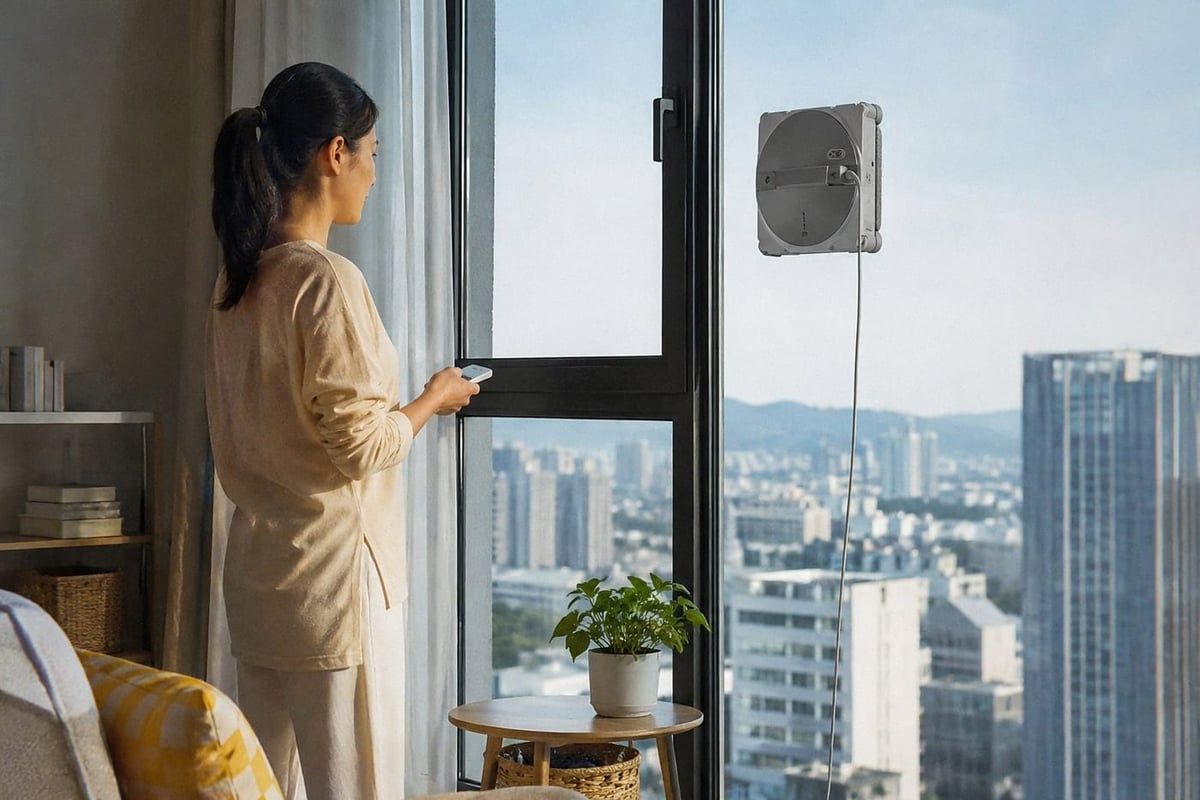
- Square robots use tank treads and a wrap-around pad: Two motorized rubber caterpillar tracks sit inside a single large square microfiber cloth. The robot drives in crisp horizontal or vertical lines like a lawnmower, pressing a wide flat surface of microfiber against the glass on every pass.
- Round-pad robots walk on two spinning suction wheels: Dual-disc robots do not have rubber drive tracks. Instead, two circular vacuum cups wrapped in thick microfiber pads alternate gripping and pivoting. One wheel holds position while the other swings forward and buffs the glass in an arc.
Because of that mechanical difference, a traditional square robot excels at speed, straight edge alignment, and coverage consistency, while a round-pad robot trades speed and corner geometry for continuous rotary buffing.
Side-by-Side Comparison: Square vs. Hybrid Square vs. Dual Round Pads
In 2026, the market has split into three distinct mechanical categories rather than just two: standard static-pad square robots, active-scrubbing square flagships, and dual-spinning round robots.
| Performance Metric | Standard Square Flat-Pad (HOBOT-298 / WINBOT W2 Pro Omni) | Active-Scrub Square Flagship (WINBOT W3 OMNI / HOBOT S7 Pro) | Dual Round-Pad Spinning (Tosima W3 / AlfaBot GLS480) |
|---|---|---|---|
| Drive & Pad Action | Rubber tracks + static wrap-around cloth | Rubber tracks + 200 RPM TruEdge brush or 600 RPM dual vibrating plates | Alternating counter-rotating circular vacuum discs |
| 90-Degree Corner Gap | 4 mm to 6 mm (limited only by corner bumper roller) | 1 mm to 2 mm (reaches right into frame corners) | 30 mm to 40 mm triangular gap in every corner |
| Scrubbing on Dried Spots | Relies on multi-nozzle spray + wide pad drag | High (combines flat-pad wipe with active mechanical scrubbing) | High in the center of the pane due to spinning friction |
| Cleaning Speed on Large Glass | Fast (systematic N-path or Z-path lines) | Fast (16 cm/s on WIN-SLAM 5.0) | Slower (alternating pivot steps take longer per square meter) |
| Narrow Window Compatibility | Requires at least 40 cm to 45 cm pane width | Requires at least 40 cm to 45 cm pane width | Fits narrow panes down to 30 cm wide |
| Frameless Glass Safety | Strong (optical or laser sensors sit ahead of tracks) | Strongest (ELB air-leak sensors or optocouplers) | Moderate (better suited to framed casement windows) |
For a full spec-by-spec ranking of our top tested machines across all body shapes, see our 2026 best window cleaning robot comparison.
The Corner and Edge Reality: Do Square Robots Clean Every Millimeter?
A common frustration mentioned by Reddit owners is that even a square window robot does not clean 100% of a sharp 90-degree corner unless it has an active edge mechanism.
On a standard square model, four small plastic guide rollers sit at the outer corners of the shell so the chassis can glide along aluminum or vinyl window frames without jamming. Those rollers create a tiny 4 mm to 6 mm buffer zone at the very tip of a 90-degree corner where a flat pad cannot press down.
Even with that tiny roller gap, a square robot covers vastly more of the corner than a circular pad. On top of that, two recent engineering upgrades solved the static flat-pad limitation on flagship square units:
- Active corner turrets (ECOVACS TruEdge): On the ECOVACS WINBOT W3 OMNI, a small circular scrubber sits at the corner of the square body. When the robot approaches a frame border, the scrubber lowers automatically, spins at 200 RPM within 1 mm of the frame edge, and retracts when moving across open glass.
- Reciprocating dual square plates (HOBOT S7 Pro): On the HOBOT S7 Pro, the bottom of the square chassis is divided into two separate rectangular mop pads that oscillate back and forth 600 times per minute, giving you the scrubbing agitation of a moving pad without giving up square corner geometry.
Where Dual Round-Pad Robots Still Make Sense
If square flagships cover corners better and finish big patio sliders in half the time, why do dual round-pad models remain popular?
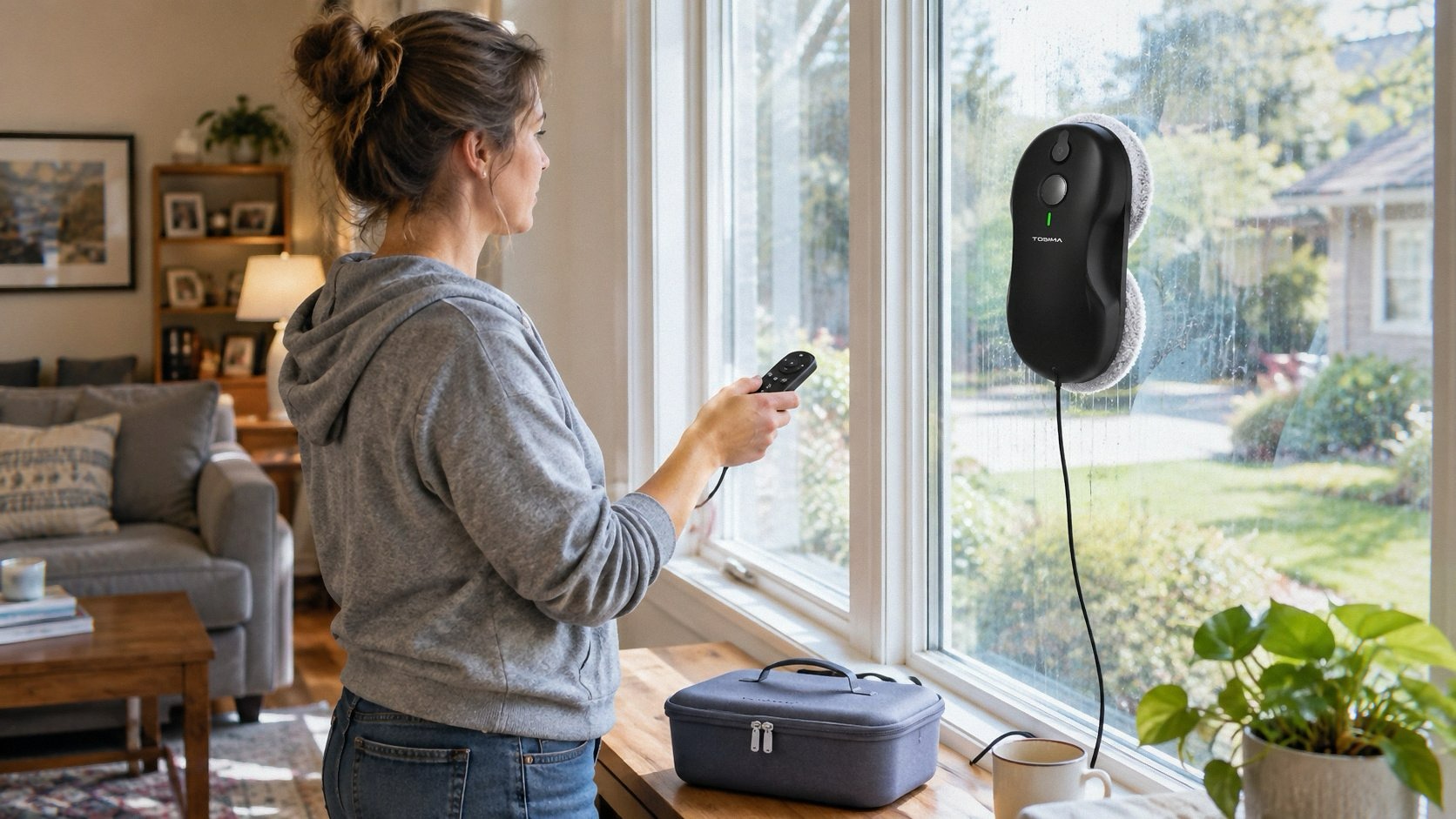
In our hands-on testing of models like the Tosima W3 and the AlfaBot GLS480, round-pad robots hold three practical advantages for specific homes:
- Narrow casement and French-door panes: A square robot typically measures 25 cm to 27 cm across and needs extra clearance to execute a 90-degree turn. If your home has narrow vertical panes between 30 cm and 40 cm wide, a square robot often refuses to start or gets trapped turning around. A dual-round unit is only about 14.5 cm wide across a single disc, allowing it to step up and down narrow glass strips without turning sideways.
- Thick, machine-washable ring pads: Round robots use plush microfiber rings with elasticated cuffs that stretch over the two plastic wheels. Most budget round models ship with 10 to 12 spare rings in the box, making it easy to swap fresh dry pads onto every second window.
- Lower entry price: Because dual-wheel robots use the spinning mop discs themselves for locomotion instead of a separate rubber track transmission, they cost much less to manufacture. You can buy a reliable dual-spray round robot for under $180, whereas active-scrubbing square robots sit between $450 and $699.
How to Choose the Right Shape for Your Windows
Instead of picking by aesthetics, match the pad geometry to your window layout:
- Measure your narrowest pane width: If your windows are wider than 45 cm (standard sliding doors, picture windows, and balcony panels), buy a square robot. If you have narrow 32 cm casement strips or divided Colonial grilles, a dual round-pad unit is often the only shape that fits.
- Check whether your glass is framed or frameless: Never rely on a budget dual-round robot on unframed balcony railings. Without dedicated forward optical or air-leak bumpers ahead of a drive track, a round wheel can pivot too far over an unframed edge. Stick to lab-tested square units from our frameless glass window robot guide.
- Decide how much manual corner touch-up you tolerate: If leaving a 3.5 cm dusty triangle in the four corners of every window will bother you, skip round-pad robots entirely. Choose a square model with active edge scrubbing or ultrasonic mist.
Frequently Asked Questions
Why do round window cleaning robots miss corners?
A circular pad with a 14.5 cm diameter physically cannot fit into a 90-degree rectangular corner. As the circular disc rolls tangent to the top and side window frames, it leaves an untouched triangular gap of roughly 3 cm to 4 cm at every corner apex.
Do spinning round pads scratch glass if outdoor dust is heavy?
Either shape can cause micro-scratches if hard sand grit gets trapped under a dry pad, though high-RPM spinning rings grind trapped grit in circles more noticeably than a straight-line wipe. On heavily dusty outdoor windows, always run a dry dust pass first or rinse pads between windows.
Which square robot scrubs as hard as a spinning round-pad model?
The ECOVACS WINBOT W3 OMNI on Amazon combines a square wrap-around pad with a 200 RPM TruEdge rotating corner brush and a Vortex station that washes the pad in 60 seconds. If you prefer dual reciprocating square mop plates without a floor station, check the HOBOT S7 Pro on Amazon.
What is the best budget alternative in each shape?
For a proven square robot under $200 with ultrasonic fine-mist spray, check the HOBOT-298 Window Cleaning Robot on Amazon. For a budget dual round-pad robot with bi-directional water spray and 12 washable pads, check the Tosima W3 Window Cleaning Robot on Amazon.