The squeegee fell apart in my hand on a Sunday. That’s how this started.
Not dramatically. Nobody was hurt. I was leaning out of a 17th-floor window — which, typing it out now, sounds like the opening of an insurance claim — holding a telescopic pole I’d bought two summers ago, and the rubber blade just… let go. Twisted free, bounced once off the glass, and dropped seventeen stories onto the awning of the building’s entrance canopy. I watched it lie there like a dead bird. The window was maybe one-third wiped, streaked in that specific way where the dirt isn’t gone, it’s just been redistributed into wider arcs.
I came back inside, sat down at the kitchen table, and stared at the smog film on the outside pane that I’d been mentally filing under “deal with in spring” for three consecutive springs. The coffee I’d made was already cold. I’d been sipping it anyway. That’s where my standards were.
This is the part of living up high that nobody puts in the listing photos. Great view, floor-to-ceiling glass, and absolutely no dignified way to clean the outside of any of it. Hiring a cleaning crew for exterior windows at this height costs real money and involves strangers rigging ropes off your balcony, which my building’s management treats with roughly the enthusiasm of a dentist hearing you’ve been chewing ice. I’d been quoted a price last year that I won’t repeat because my mother reads this blog sometimes.
So when the ECOVACS WINBOT W2S showed up, my expectations were parked somewhere between “mildly useful gadget” and “expensive regret.” I’d been burned before — I reviewed the [ECOVACS WINBOT Mini 2] a while back and liked it more than I planned to, but it had a leash. A literal one. The cord situation was the whole story with that thing.
The W2S has no leash. That’s the headline. Everything else is footnotes.
What This Thing Actually Is
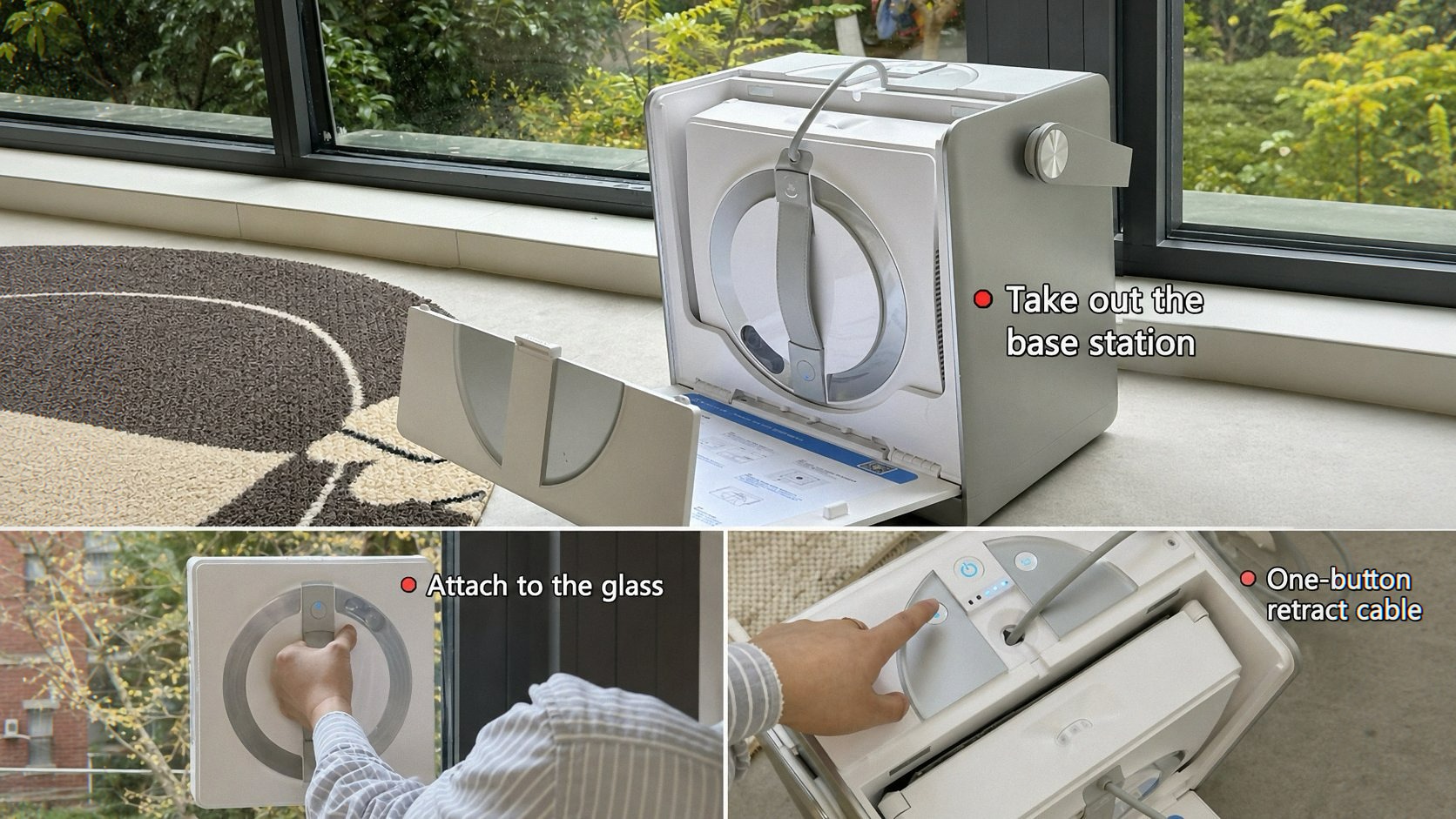
Quick version, because I know some of you landed here from a search and want the bones before the memoir: the WINBOT W2S is ECOVACS’ window-cleaning robot that runs off a portable station instead of a wall outlet. The robot itself sucks onto the glass — 5500Pa of suction, up from the 2800Pa era that older models lived in — sprays water through three nozzles on each side, walks itself around the pane in a planned pattern, and then comes back to where you stuck it. The station holds the battery, the safety rope, and the cable, and it reels the cable in automatically when the job’s done.
Five cleaning modes. Twelve layers of safety protection. A panel of physical buttons on the unit for when you don’t feel like negotiating with an app.
That’s the spec sheet. Spec sheets are written by people who have never personally watched a machine dangle off their home. Here’s the version from someone who has.
Unboxing, or: The Cardboard Fought Back
I want to tell you about the box, because the box was a whole thing.
ECOVACS packs this like they’re shipping a Fabergé egg to a war zone. The station sits in a molded pulp cradle that required me to pull at angles my wrist doesn’t do anymore, and at one point I was holding the entire box upside down over my living room floor, shaking it gently, while my neighbor’s dog barked through the wall at whatever it imagined was happening. There’s a particular shame in losing a fight to packaging. The dog knew.
Once free, though — the station is smaller than I expected. Think car battery that went to design school. There’s a handle on top, an actual handle, which sounds like nothing until you’ve carried older window robots around in both arms like a fussy toddler. I picked it up one-handed and carried it to the window, and I remember thinking, fine, that’s one point.
The robot itself has a weight to it that reads as reassuring rather than heavy. Picking it up, the balance sits low, and the microfiber pads on the underside have this dense, slightly rough texture — like a good gym towel, not the sad fuzzy stuff on cheap mops. First boring sensory detail, logged for the record: the power button on the station clicks with a short, damped thunk, not a snap. Somebody tuned that. It matters more than it should at 8 a.m.
Setup was: fill the tank, wet the pads, charge the station, stick the robot on the glass, press go. I’m leaving out twenty minutes of me reading a quick-start guide that was clearly translated by someone in a hurry, but even with that, total time from cardboard to cleaning was under half an hour.
The Station Changes the Whole Deal
Let me stay on the cordless thing, because it deserves its own section and I don’t care about pacing.
Every window robot I’ve touched before this one had the same tax built in: you needed an outlet near the window. My living room’s big pane — the good one, the one with the view — is a solid eight feet from the nearest socket. With corded units that meant an extension cable dragging across the floor, which meant a tripping hazard, which meant I cleaned that window roughly never. The best automatic window cleaners of 2026 roundup I keep updated has this problem stamped all over the category: the robot is smart, the logistics are stupid.
The W2S’s station is the logistics, solved. You charge it wherever, carry it to whatever window needs attention, and the robot runs off it. The safety rope and the composite cable spool out of the station as the robot climbs, and here’s the part I keep telling people about in person, with hand gestures: when the robot finishes, the station reels everything back in by itself. Automatic retraction. No hand-winding a damp cable like a deckhand. It just winds itself up with this low mechanical whir, and you’re done.
An owner-only detail you won’t find in any listing copy: after a long cleaning run, the station’s internal fan keeps humming for a good fifteen, twenty minutes after the robot’s docked. First time it happened I thought something was wrong and stood there watching it like it might confess. It’s just cooling itself down. Now I find it kind of companionable, like the machine is catching its breath too.
Is this the section where I tell you it worked? It worked. On the first full run of my big living room window — the one that hadn’t seen a proper clean since I stopped wanting to think about when — the W2S went edge to edge, and I stood there with my cold coffee watching a robot do the thing I’d been avoiding for three years. There’s a specific feeling when a problem you’ve been ignoring gets solved by something you were skeptical of. Relief, mostly. A little embarrassment.
If you’re already half-sold and just wanted a nudge, this is me nudging: grab the ECOVACS WINBOT W2S here. If you buy through that link I might get a small cut — costs you nothing extra and keeps the lights on. Now back to me complaining about things.
The Spray System, Which I Didn’t Expect to Care About
Three nozzles per side. Wide-angle. Self-spraying.
I read that on the box and shrugged, because every cleaning gadget claims some spray innovation and it usually means “drips, but fancier.” Then I watched it work and shut up. The dual-side three-nozzle setup mists a wide, even band ahead of the cleaning pads — both directions of travel get covered, so the robot isn’t dragging a dry pad across gritty glass on the return pass. That return-pass thing was one of my complaints about older units. Fixed here. Fine. Credit where due.
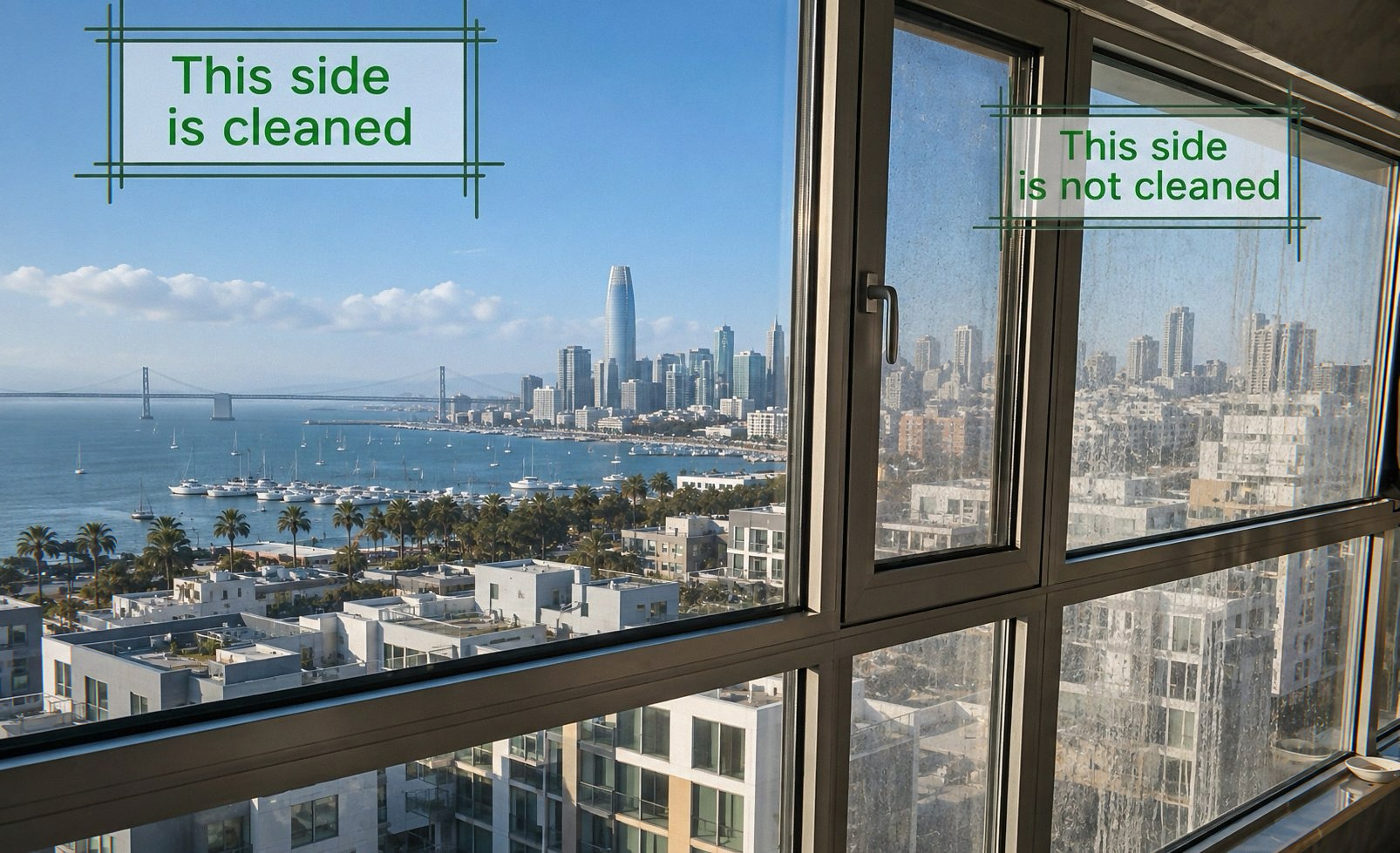
What it means in practice: one pass is genuinely enough for ordinary city grime. The smog film, the rain spots, the mysterious vertical streaks that appear on high-rise glass like crop circles. One pass, gone. For the kitchen-side window — which had a seasoning of cooking grease mixed with dust, the signature dish of every apartment above a stir-fry household — I ran it twice and stopped pretending I needed a third run out of principle.
The water tank is, and I’m choosing my words carefully, adequate. Small apartment full of windows, fine. My place, six windows total, I refilled once. If you live in some glass-walled modernist cube, you’ll be refilling more often and you’ll know the exact sound the empty-spray change makes, a thinner, higher hiss. Ask me how I know.
One more owner detail, free of charge: if your tap water is hard, the nozzles will slowly sulk. Mine started misting unevenly around week four — a faintly lopsided spray pattern, like the robot developed a lazy eye. The fix is a soak in vinegar solution and a gentle poke with the little cleaning pin that comes in the box. Five minutes. But nobody tells you this upfront, and now I’ve told you.
Suction, Modes, and Watching It Think See Today’s Deal on Amazon
5500Pa. The number sounds like marketing until the robot is on the outside of your seventeenth-floor glass and the number is the only thing between it and a very bad day for the awning below.
The grip is confident. That’s the word I keep landing on. When it first adheres, there’s a deep, brief whoosh as the vacuum seals — you feel it in your stomach more than hear it — and after that the unit sits on the glass like it was installed there. I pressed on it with my palm early on, gently, then less gently. It didn’t care.
Five modes is, in my experience, three modes you’ll use and two you’ll click through once out of curiosity. There’s the standard full clean, a deep clean that double-passes, a spot mode for one disgusting area, and a fast mode for when guests are coming and the windows are lying about your housekeeping. The fifth one I genuinely can’t describe without going to look at the app again, which tells you everything. The point isn’t the count. The point is the robot adjusts how it moves and sprays based on what you pick, and the differences are visible in the results, not just in the menu.
The path planning is the part that made me stop fiddling with my phone and just watch. Older window robots I’d used wandered. Charming in a goldfish way, annoying in a “you missed a strip” way. The W2S walks the pane in clean, deliberate rows, corners included, and its edge behavior on my frameless balcony glass was — look, I wrote a whole piece about window robots on frameless glass because it’s the scenario that separates real machines from toys. No frame means no bumper to bonk into. The robot has to know where the world ends. The W2S slows at edges, reads them, turns. I watched it work the balcony panel with my heart rate somewhere it shouldn’t be for housework, and it never once overran.
Safety: The Part Where I Stop Being Funny for a Minute
Twelve layers of protection, says the box. I can’t recite all twelve and neither can ECOVACS’ own marketing, probably, but the ones that matter:
The safety rope is real rope, anchored to the station, rated well beyond the robot’s weight. The station itself is heavy enough that it stays put, and it has a low center of gravity that I’d describe as “deliberately boring engineering,” the best kind. If suction drops, the robot alarms and the rope catches it. If the battery in the robot itself runs low mid-pane, there’s a backup battery that holds it on the glass for a stretch while it complains loudly — I tested this on purpose, on an inside pane, because I’m not a monster, and the alarm is indeed loud enough to find you in another room. A high, urgent beeping. My neighbor’s dog filed a protest through the drywall.
Seventeen floors. I keep coming back to that number because it’s the entire reason this category exists. A robot falling off my window isn’t a “whoops,” it’s a lawsuit and a news clip. So I don’t say this lightly: after weeks of runs, including balcony glass in wind I probably should’ve postponed for, the W2S never slipped, never drifted, never gave me the quiet dread moment. The rope stayed slack the whole time, which is exactly what a safety rope is for — existing, untouched, while everything goes right.
The App, the Noise, and Other Small Truths
The app works. Faint praise? Fine, let me be fair: it connected on the first try, it shows cleaning progress as a little map of your window filling in, which is weirdly satisfying, like watching a progress bar with consequences, and it lets you drive the robot manually to a specific spot. I used the manual drive exactly twice, both times for bird-related emergencies, and both times it did what I asked. That’s a 100% success rate on bird crime response. The physical buttons on the unit cover the basics, so on normal days I never open the app at all. That’s the correct relationship with an app.
Noise level: audible, not offensive. It’s a vacuum pressed against a window; it sounds like a vacuum pressed against a window. Quieter than my stick vac, louder than a dishwasher’s swooshing. I ran it during a phone call once and the person on the other end asked if I was “finally vacuuming,” which stung for reasons unrelated to the robot.
And the rubber treads — last owner detail, I promise — leave faint parallel track marks on the pads if you store the robot while the pads are still damp. Cosmetic only, wipes off the next run, but the first time I saw it I spent a full minute convinced something was degrading. Nothing was degrading. Store it dry. Learn from me.
The Downsides, Because You Deserve Them Straight See Today’s Deal on Amazon
It’s not cheap. Let’s just put that on the table and look at it together. This is a premium device with a premium price, and if your windows are easy to reach, or you have two of them, or you secretly enjoy squeegeeing, the math won’t math for you. The W2S makes sense for people with lots of glass, awkward glass, or high glass. If that’s not you, there are cheaper paths — the Alfabot GLS480 I reviewed costs a good chunk less and does respectable work, as long as you accept the cord and the weaker spray system. I keep a running comparison of the best window cleaning robots for exactly this kind of decision, and the honest summary is: the W2S wins on logistics and polish, the budget options win on budget.
The tank, as mentioned, is sized for normal homes, not glass palaces. Refilling is easy but it’s still a refill.
The quick-start guide reads like it was translated during a fire drill. You’ll figure it out, but you’ll mutter while doing it.
The station fan hum after docking. Not a flaw, just a quirk you now know about before it startles you at midnight.
And the manual translation strikes again inside the app — one of the mode descriptions is worded so strangely that I chose that mode expecting spot cleaning and got what I can only describe as enthusiasm. It cleaned the whole window, twice. There are worse bugs.
Where It Lands
Six windows. Three weeks of regular runs at this point. The smog film that I’d been treating as a permanent weather condition turns out to have been optional the entire time, and the view I pay rent for is actually visible now, which is almost offensive — I was owed three years of that view and nobody’s refunding me.
What the W2S gets right, in order of how much it changed my behavior: the cordless station, the spray coverage, the edge handling, the auto cable rewind, the grip. What it gets wrong is a short list of quirks you’ll forget about by the second week. I’ve tested enough of these machines to know the difference between a product that’s impressive in a demo and one that becomes part of how you run a home, and this one crossed over somewhere around the fourth window.
It’s sitting on its station by the balcony door right now. The fan just stopped humming. The dog next door has stopped barking and I can hear my neighbor’s TV through the wall, some cooking show, and it occurs to me I haven’t eaten anything today except cold coffee, which is not a food.
Anyway. My windows are clean. All six of them, including the balcony glass I used to pretend didn’t exist. The squeegee is still down there on the awning, probably. It can stay. It can be a warning to the other squeegees.
I’m gonna go make lunch.