There’s a specific kind of frustration that comes with living on a high floor — you can see the grime on the outside of your windows perfectly, and there’s absolutely nothing you can do about it without either risking your life or paying someone a lot of money. That’s exactly the problem ECOVACS has been trying to solve with its WINBOT line, and the W2S is their current flagship answer.
I spent time going through the specs, the technology claims, and — more importantly — what actual buyers are saying after living with this thing for weeks. Here’s the honest picture.
Table of Contents
Open Table of Contents
Price and Model Lineup

The W2S lists at $399.99 but frequently sells for $319, which is where most people are buying it. It holds Amazon’s Choice status and has moved 600+ units in a single month — not a fringe product by any measure.
There are three versions in this lineup:
- W2S — the standard model reviewed here, corded only, 26-foot power cable
- W2S OMNI — adds a portable battery pack so you can use it away from outlets
- W2 PRO — higher-end model with additional features
One thing worth flagging early: a handful of negative reviews come from buyers who didn’t realize the standard W2S requires a power cord at all times. If you need wireless freedom for outdoor glass railings or windows far from outlets, the W2S OMNI is the one to get. The confusion seems to stem from packaging that mentions battery-related warnings — but that’s for the OMNI version, not this one.
Key Features Explained
TruEdge Cleaning: The Part That Actually Matters
If you’ve used older window robots, you already know the problem: the middle of the glass comes out fine, but the edges and corners are untouched. It’s genuinely maddening.
The W2S addresses this with TruEdge technology — a scrubber design that gets within millimeters of the window frame. The comparison above tells the story pretty clearly. Traditional dual circular pads can’t reach right angles. Flat pads without a liftable mechanism just spread dirt sideways. The W2S OMNI takes this further with a physically liftable TruEdge scrubber.
To be honest: it’s not magic. True corners will still have a small amount of residue. But compared to what most robots in this category can do, it’s a meaningful improvement — and better than what most people manage by hand with a squeegee.
Triple Spray System: More Water Pressure, Less Streaking

The upgraded triple-nozzle system doubles water pressure compared to the W1 PRO and covers 90% of the cleaning surface per pass. In practical terms: fingerprints, dust, and light smudges dissolve in fewer passes.
Where it struggles is heavy-duty grime — windows that haven’t been touched in years. Multiple users dealing with that situation needed two or three passes, rinsing the pad between each run. That’s not a failure, that’s just realistic expectations. A robot isn’t a pressure washer.
One note on streaking: the most common cause isn’t the machine — it’s pad maintenance. Rinse the microfiber pad after every cycle, wring it out properly before attaching, and stick with the official cleaning solution. Most streak complaints in reviews trace back to soap residue or a dirty pad being reused.
WIN-SLAM 4.0 Navigation: 37% Faster Than Before
The fourth-generation navigation scans the glass surface, maps it, and picks the most efficient cleaning route. Top speed hits 5.5 inches per second — 37% faster than the previous generation.
In practice this means a standard 6×8 foot window takes roughly 10 minutes on a thorough cleaning cycle. Multiple modes are available depending on how dirty the glass is, and the companion app lets you manually steer the robot if it ends up somewhere you can’t reach — which, per several user reports, does happen occasionally.
Even Climbing System and Microfiber Pad
Two details here that are easy to overlook:
The drive system uses a water-resistant synchronous belt and an external drive wheel. This matters because the robot is wiping a wet surface while trying to move upward — without this, slippage during wet passes would be a constant issue.
The microfiber pad has 400% water retention compared to standard materials. It stays damp long enough to actually lift dirt rather than just pushing it around, and it won’t scratch glass. Both included pads are machine washable, which keeps ongoing costs low.
Check Price on Amazon: Ecovacs Winbot W2 Pro Omni
How Well Does It Actually Clean?
For regular maintenance — running the robot every few weeks on windows that aren’t heavily soiled — this thing genuinely earns its keep. Setup is straightforward, the suction kicks in immediately, and it gets to work without much fuss.
For neglected glass (think: two or three years of city grime), you’ll need to manage expectations and give it multiple passes. One verified buyer ran nearly 40 cleaning cycles on their glass deck railings in a single afternoon. The results surprised them. That’s not the robot underperforming — that’s the robot doing what a machine reasonably can with a very difficult surface.
Situations where results may disappoint:
- Windows with protruding handles, blinds rails, or Roman shades that block the robot’s path
- Frameless glass (the edge sensors can get confused without a clear frame to reference)
- Very heavy grease or oil contamination (this is a maintenance cleaner, not a deep restoration tool)
Safety: The Question Everyone Has

Any robot working on a window ten floors up needs to answer one question before anything else: what happens when something goes wrong?
The W2S runs a 10-layer safety stack:
- 8,000Pa suction — primary adhesion force
- Optocoupler sensor — real-time contact monitoring
- Auto air pressure compensation — adjusts suction if the seal starts slipping
- Floating pad plate — adapts to minor surface irregularities
- Power-off protection — maintains suction if the power cuts out
- Compound safety cable — physical backup if suction fails completely
- Classic pad design — consistent surface contact
- Insurance policy — ECOVACS provides additional coverage
- Gravitational acceleration sensor — detects abnormal tilting
- Intelligent obstacle escape — auto-adjusts around window hardware
The compound cable is the one most people want to know about: if the power goes out mid-cycle on a high-rise window, the cable keeps the robot from falling. In real-world testing, users report the suction holding extremely well on standard framed glass. The edge cases where people hit problems tend to involve truly frameless glass panels where the sensor has no reference point to detect edges.
What Real Buyers Are Saying
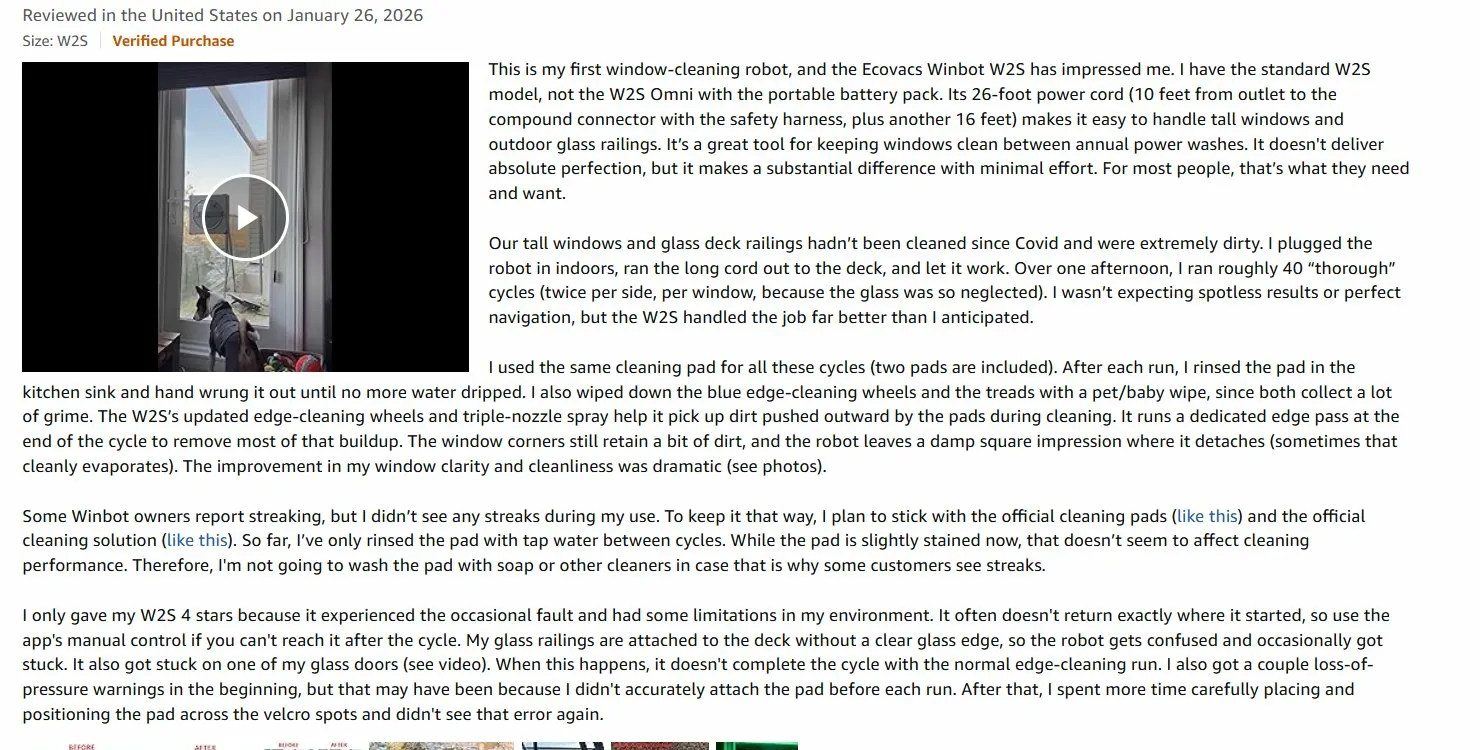
The most useful review I came across was from someone who’d never owned a window robot before. Their glass deck railings hadn’t been cleaned since before COVID — genuinely neglected. After an afternoon of repeated cycles (rinsing the pad between each run), they described the improvement as dramatic. They gave it four stars instead of five because it occasionally needed the app’s manual control to return to a reachable spot.
That four-star-instead-of-five pattern shows up a lot. People like the results. They’re just honest about the limitations.
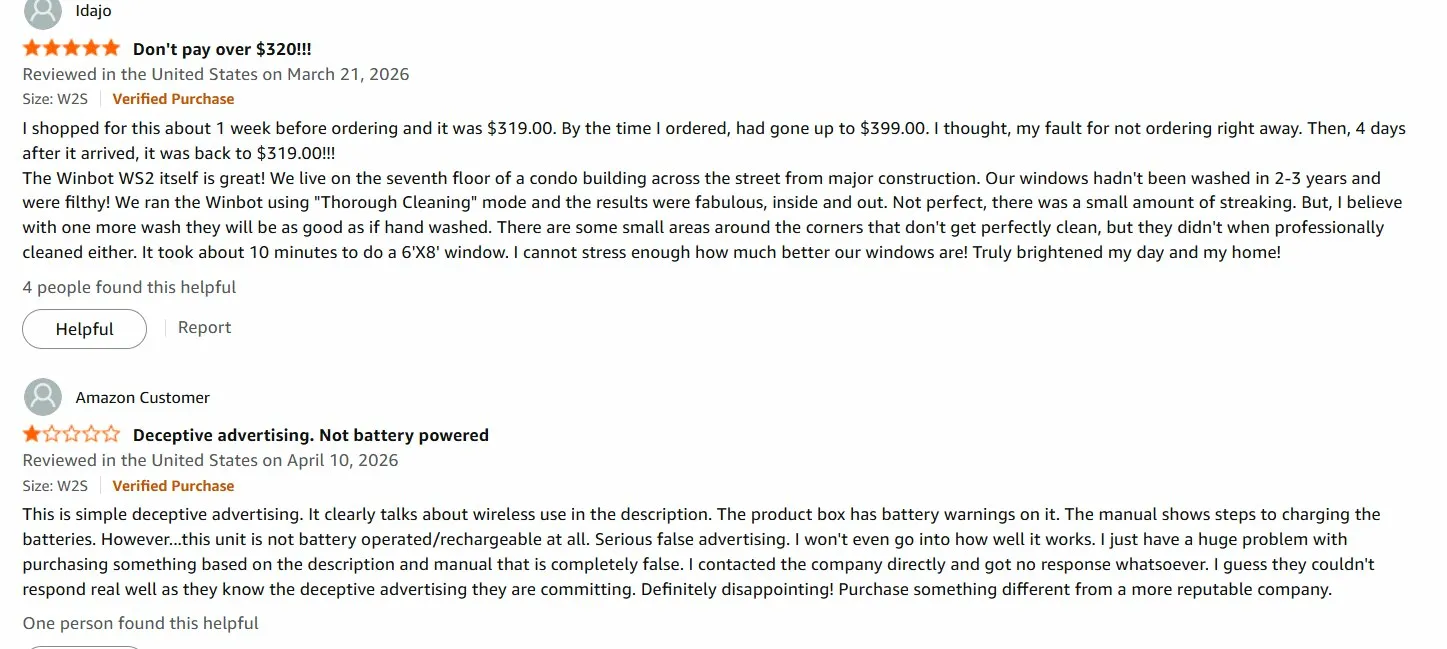
The negative reviews mostly split into two camps. One is legitimate criticism: some users got streaking, some had the robot get stuck on windows with hardware obstacles. The other camp is a misunderstanding — buyers who expected the W2S to be battery-powered like the OMNI version.
There’s a lesson in there for ECOVACS about clearer packaging, but if you’re reading this before buying, you already know: W2S requires a power cord, W2S OMNI has the battery.
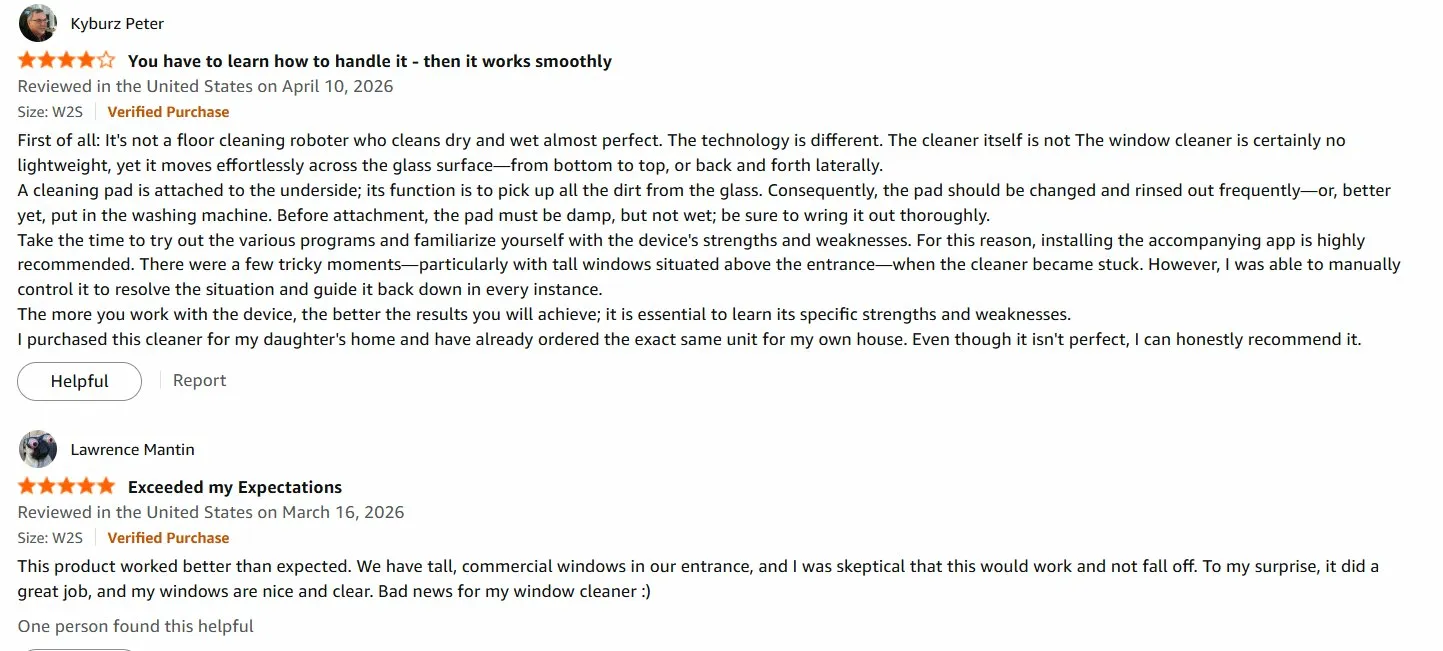
The learning curve point comes up repeatedly, and it’s real. The first time you use it, you’ll probably spend 20 minutes reading the app, second-guessing the pad installation, and worrying about the suction. By the third or fourth session, you’re just putting it on the glass and walking away. That progression is pretty consistent across reviews.
Who Should (and Shouldn’t) Buy This
Good fit if you:
- Live in a high-rise or apartment where outdoor window access is genuinely difficult or dangerous
- Have large floor-to-ceiling windows or glass sliding doors
- Want a maintenance routine that doesn’t involve standing on a ladder
- Have glass shower enclosures that need regular upkeep
- Can accept “significantly cleaner” rather than “showroom perfect”
Not a great fit if you:
- Have windows with protruding hardware, deep-set frames, or blinds that sit inside the glass area
- Need truly frameless glass cleaned (outdoor glass balcony railings with no edge frame)
- Want spotless results on windows that haven’t been cleaned in years without multiple sessions
- Are expecting wireless operation — get the OMNI version if that’s your use case
Final Verdict
The WINBOT W2S is a well-engineered product that does what it claims for the scenarios it’s designed for. The TruEdge system handles edges better than competitors in this class. The triple-spray setup reduces streaking if you maintain the pad properly. The safety stack is thorough enough that running this on a high-rise window doesn’t feel reckless.
What it isn’t: a replacement for a professional window cleaning service if you want perfection, or a solution for heavily obstructed windows.
At $319, the math works for anyone with large windows in hard-to-reach places. The time and physical effort it saves — especially for regular maintenance — is real. Just go in with accurate expectations, learn the app controls early, and keep the pad clean. That’s basically the whole formula.